


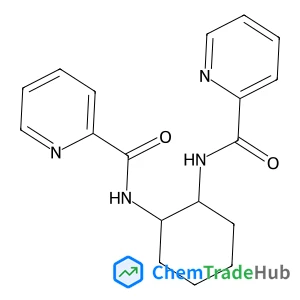
Synergistic effects in controlling excited-state photodimerisation using multiple supramolecular interactions
文献情報
出版日
2004-04-29
DOI
10.1039/B402298J
インパクトファクター
6.222
著者
Yolanda Vida Pol, Rafael Suau, Ezequiel Perez-Inestrosa, Dario M. Bassani
原文を見る
要旨
The use of two independent binding sites, hydrogen-bonding and metal ion complexation, to accelerate and direct the photodimerisation of cinnamate chromophores demonstrates the operability of cooperative and synergistic effects on the excited state potential energy surface.
おすすめジャーナル

Pharmacological Reviews

Proceedings of the National Academy of Sciences of the United States of America

Journal of Organometallic Chemistry

Science Progress

Pure and Applied Chemistry

European Journal of Wood and Wood Products

Organic Preparations and Procedures International

Journal of Medicinal Chemistry

Molecular Pharmacology

Nature
関連文献
Investigation of collisional quenching of CCl2( 1B1 and ã 3B1) by some inorganic molecules
Yide Gao, Changjin Hu, Qin Ran, Yang Chen, Xingxiao Ma, Congxiang Chen
2002-02-26
Paper
DOI: 10.1039/B105728F
Analysis of the effect of changing the a0 parameter of the Becke3-LYP hybrid functional on the transition state geometries and energy barriers in a series of prototypical reactions
Jordi Poater, Miquel Solà, Miquel Duran, Juvencio Robles
2002-01-31
Paper
DOI: 10.1039/B108910M
Solvation dynamics of Coumarin 490 in methanol and acetonitrile reverse micelles
Partha Hazra, Nilmoni Sarkar
Paper
DOI: 10.1039/B109447E
New phase phenomena in ternary systems at high pressures – Cosolvency and miscibility windows up to 100 MPa
Arndt L. Scheidgen, Gerhard M. Schneider
2002-02-12
Paper
DOI: 10.1039/B109224N
Pairing of the nucleobases guanine and cytosine in the gas phase studied by IR–UV double-resonance spectroscopy and ab initio calculations
Ch. Janzen, P. Imhof, K. Kleinermanns, M. S. de Vries
2002-01-29
Paper
DOI: 10.1039/B107429F
The nature of proton transport in fully hydrated Nafion®
Stephen J. Paddison, Reginald Paul
2002-02-28
Paper
DOI: 10.1039/B109792J
On the structure and coordination of the oxygen-donating species in Ti↑MCM-41/TBHP oxidation catalysts: a density functional theory and EXAFS study
Nikolas Kaltsoyannis
2002-03-04
Paper
DOI: 10.1039/B104735N
Liquid–liquid coexistence curves of re-entrant phase transitions beyond the asymptotic range: tetrahydrofuran + water and tetrahydrofuran + heavy water
2002-02-15
Paper
DOI: 10.1039/B109349E
Preferential solvation of Ca2+ in aqueous ammonia solution: Classical and combined ab initio quantum mechanical/molecular mechanical molecular dynamics simulations
Anan Tongraar, Kritsana Sagarik, Bernd Michael Rode
2002-01-08
Paper
DOI: 10.1039/B107786D
Experimental and theoretical study on the reaction Sc + NO → ScO + N
Gwang-Hi Jeung, Paul Luc, Raymond Vetter, Kyoung Hoon Kim, Yoon Sup Lee
2002-01-14
Paper
DOI: 10.1039/B107190D
こちらもおすすめ
化合物よくある質問
アエポキシアビレーターONE酢酸エステルを含む廃棄物はどのように処理すべきですか?
アエポキシアビレーターONE酢酸エステルを含む廃棄物は、焼却や専門廃棄処理が一般的です。具体的には、廃棄物は密閉容器に収集し、適切な温度と湿度の下で保存します。...
2484719-11-9a-Epoxyabiraterone A...
化合物よくある質問
4-ヒドロキシ但線を取り扱う際の実験室安全事項は何ですか?
取り扱いには化学製品安全管理データシート(SDS)を参照してください。温度10℃以下で保存し、密閉容器に保管してください。漏れ時にはドラフトチャンバーを使用し、...
25714-71-04-Hydroxybutanal
化合物よくある質問
4-(3-環戊基尿素)フェノールボロネートはどの業界で使用されていますか?
4-(3-環戊基尿素)フェノールボロネートは主に医薬品産業で使用されています。この化合物は抗炎症薬や抗うつ薬の候補物質として研究されています。また、ポリマー産業...
874297-80-01-Cyclopentyl-3-[4-(...
化合物よくある質問
N~1~-[3-氯-5-(三氟甲基)-2-吡啶]-1,2-乙二胺の市場動向や研究トレンドはどうですか?
市場では、安全性と効果性を基にした化学物質の需要が高まっています。研究分野では、環境に優しい代替品の開発が進んでおり、その結果、この化合物の市場需要は減少傾向に...
219478-19-0N'-[3-chloro-5-(trif...
化合物よくある質問
6-硝基苯并二氢吡喃-4-酮についての法規ガイドラインは何ですか?
6-硝基苯并二氢吡喃-4-酮(CAS番号: 68043-53-8)は、GHS(統一化された化学品の危険性的分類と標識)で急性毒性第4クラスに分類されます。EUで...
68043-53-86-Nitro-2,3-dihydro-...
1016705-16-05-(Hydrazinomethyl)-...
化合物よくある質問
6-乙酰基-2(3H)-苯并噻唑酮は安全ですか?
安全性は化合物の使用方法によります。適切な取扱いと防護措置を講じれば、一定の安全性があります。ただし、吸入や皮膚への接触は避けてください。
133044-44-76-Acetyl-1,3-benzoth...
化合物よくある質問
3-メチル-6-(1-メチルヒドラジニル)ピリジジンはどの業界で使用されていますか?
3-メチル-6-(1-メチルヒドラジニル)ピリジジンは主に医薬品、ポリマー、センサー製造業界で使用されています。特に、医薬品産業では抗がん剤や抗真菌剤の候補物質...
175135-44-13-Methyl-6-(1-methyl...
化合物よくある質問
tert-butyl 5-oxo-2,6-diazaspiro[3.4]octane-2-carboxylateの物理化学的性質は何ですか?
tert-butyl 5-オキソ-2,6-ジアザスパイロ[3.4]オクタネ-2-カルボキサongyangはCAS番号1330765-39-3で、分子量は334....
1330765-39-32-Methyl-2-propanyl ...
化合物よくある質問
3-塩素メチルフェニル-4,4,5,5-テトラメチル-1,3,2-ジオキソボロラノールは安全ですか?
3-塩素メチルフェニル-4,4,5,5-テトラメチル-1,3,2-ジオキソボロラノールは、毒性が低いと考えられていますが、直接的な皮膚接触や吸入は避けるべきです...
1073353-44-22-[3-(Chloromethyl)p...
掲載誌
Chemical Communications

CiteScore:
8.6
自己引用率:
4.7%
年間論文数:
2458
ChemComm publishes urgent research which is of outstanding significance and interest to experts in the field, while also appealing to the journal’s broad chemistry readership. Our communication format is ideally suited to short, urgent studies that are of such importance that they require accelerated publication. Our scope covers all topics in chemistry, and research at the interface of chemistry and other disciplines (such as materials science, nanoscience, physics, engineering and biology) where there is a significant novelty in the chemistry aspects. Major topic areas covered include: Analytical Chemistry Catalysis Chemical Biology and medicinal chemistry Computational Chemistry and Machine Learning Energy and sustainable chemistry Environmental Chemistry Green Chemistry Inorganic Chemistry Materials Chemistry Nanoscience Organic Chemistry Physical Chemistry Polymer Chemistry Supramolecular Chemistry
おすすめ化合物
おすすめサプライヤー





免責事項
このページに表示される学術雑誌情報は、参考および研究目的のみを目的としています。当社は雑誌出版社とは提携しておらず、投稿の取り扱いも行っておりません。出版に関するお問い合わせは、各雑誌出版社に直接ご連絡ください。
表示されている情報に誤りがある場合は、support@chemtradehub.com までご連絡ください。迅速に確認し、対応いたします。