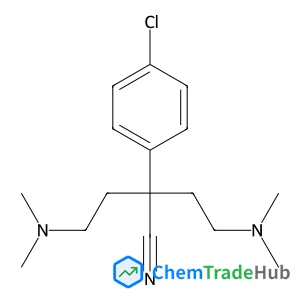
2-(4-Chlorophenyl)-4-(dimethylamino)-2-(2-(dimethylamino)ethyl)butanenitrile
CAS番号:
1246816-57-8
分子式:
C16H24ClN3
N. C. Michenfelder, H. A. Ernst, C. Schweigert, M. Olzmann, A.-N. Unterreiner
Early-time dynamics of nitroaromatics and its coressponding bases can give valuable insights into photo-induced reactions relevant to atmospheric and environmental processes. In this work, femtosecond broadband absorption spectroscopy between 350 and 700 nm has been applied to explore the ultrafast dynamics of o-, p- and m-nitrophenol anions (NP−) in basic organic and aqueous solution. Excitation at 400 nm promotes these compounds into the first bright electronic singlet state, which is a charge-transfer state. A surprising finding for all nitrophenolates was a characteristic, spectrally broad stimulated emission (SE) from the electronically excited state into the ground state. The corresponding lifetime was on the order of a few hundred femtoseconds for o- and p-NP− while it was roughly ten times larger for m-NP−. In line with earlier observations, the SE is governed by an out-of-plane torsional motion of the nitro group, leading to a close energetic approach of the relevant electronically excited singlet and ground states. Subsequent dynamics can be assigned to excited state absorption and ground state relaxation due to energy dissipation of the vibrational modes to the solvent that occur for up to several tens of picoseconds. No longer-lasting transient absorption (TA) was found; instead, a complete recovery of the ground state bleaching was observed indicating that triplet state relaxation is either not significantly involved in this spectral part or shifted to other regions. In the aqueous system, time constants for all processes are much smaller than in organic solution, a fact that can be explained by the larger dipole moment of the solvent and the correspondingly stronger intermolecular coupling between NP− and the aqueous solvent.
Chang Liu, Hang Zhai, Ying Sun, Weiguang Gong, Yan Yan, Quan Li, Weitao Zheng
DOI: 10.1039/C8CP00205C
Padmalochan Panda, R. Ramaseshan, Madhusmita Sahoo, Nanda Gopala Krishna, A. K. Yadav, S. N. Jha, D. Bhattacharyya
DOI: 10.1039/C8CP01686K
Seishi Shimizu
DOI: 10.1039/C7CP07309G
Takumi Tokuda, Takahiro Uchida, Kazuya Sonoda, Bogdan A. Marekha, Abdenacer Idrissi, Takashi Tokushima, Hiroyuki Sakurai, Masahiro Kawano, Koichiro Sadakane, Hiroki Iwase
DOI: 10.1039/C8CP00963E
Nur Sena Yüzbasi, Paula M. Abdala, Qasim Imtiaz, Sung Min Kim, Agnieszka M. Kierzkowska, Andac Armutlulu, Wouter van Beek, Christoph R. Müller
DOI: 10.1039/C8CP01309H
Yasuyuki Yokota, Hiroo Miyamoto, Akihito Imanishi, Kouji Inagaki, Ken-ichi Fukui
DOI: 10.1039/C8CP01043A
Ziling Ding, Yan Xiong
DOI: 10.1039/C7CP07491C
Moamen M. Soliman, Mohamed H. Al Haron, Menna Samir, Sarah A. Tolba, Basamat S. Shaheen, Ahmed W. Amer, Omar F. Mohammed, Nageh K. Allam
DOI: 10.1039/C7CP08629F
J. Kłos, S. D. Le Picard
DOI: 10.1039/C7CP05092E
François Lique, Izaskun Jiménez-Serra, Serena Viti, Sarantos Marinakis
DOI: 10.1039/C7CP05605B
2-ヒドロキシ-5-ニトロベンジンブロモイドは特定の化学反応に適しているため、代替品は限られています。しかし、同様の構造を持つ2-ヒドロキシ-4-ニトロベンジン...
N-(2-ブロモフェニル)-1-チロール-3-オキソ-3-(ピペリジニル)プロペン-2-イル)ベンゼンアミドは有毒で、皮膚や粘膜に刺激を与える可能性があります。...
この化合物は、新規治療薬の開発に注目されています。市場では、その有効性と安全性が評価され、研究分野では、分子生物学と医薬化学の新たな発見が期待されています。
Succinimidyl-alanyl-phenylalanyl-prolyl-phenylalanine 4-nitroanilide は主に医薬品開発やポ...
メチル6-アミノ-5-クロロピリジン-2-カーボイル酸(CAS番号: 1256794-05-4)の使用には、GHS( Globally Harmonized S...
取り扱いには、耐薬品性の容器を使用し、通気性の良い場所で操作することを推奨します。漏れ時は、SDS(安全データシート)を参照して適切な措置を取ること。手洗いと洗...
(S)-3-ベンZYルピペリジン塩酸塩は、CAS番号1258940-00-9で表される化合物です。これは、(S)-3-苯基哌啶的盐酸盐であり、主に医薬品の原料と...
3,5-二甲基金剛胺は、主に医薬品の原料として使用され、また抗うつ薬や抗アルツハイマー薬の開発に利用されます。さらに、化粧品や食品添加物の製造でも重要な役割を果...
ビス(4-メチル-2-ペンチル)フェニルカルボン酸エステル (CAS番号: 1398066-13-1) の代替品には、ビス(2-エチルヘキシル)フェノールカルボ...

Physical Chemistry Chemical Physics (PCCP) is an international journal co-owned by 19 physical chemistry and physics societies from around the world. This journal publishes original, cutting-edge research in physical chemistry, chemical physics and biophysical chemistry. To be suitable for publication in PCCP, articles must include significant innovation and/or insight into physical chemistry; this is the most important criterion that reviewers and Editors will judge against when evaluating submissions. The journal has a broad scope and welcomes contributions spanning experiment, theory, computation and data science. Topical coverage includes spectroscopy, dynamics, kinetics, statistical mechanics, thermodynamics, electrochemistry, catalysis, surface science, quantum mechanics, quantum computing and machine learning. Interdisciplinary research areas such as polymers and soft matter, materials, nanoscience, energy, surfaces/interfaces, and biophysical chemistry are welcomed if they demonstrate significant innovation and/or insight into physical chemistry. Joined experimental/theoretical studies are particularly appreciated when complementary and based on up-to-date approaches.
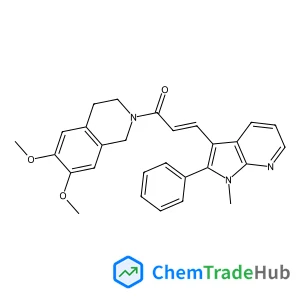
![4-Chloro-3-(trifluoromethyl)-1H-pyrrolo[2,3-b]pyridine structure](https://static.chemtradehub.com/structs/869/869335-75-1-a9d0.webp "4-Chloro-3-(trifluoromethyl)-1H-pyrrolo[2,3-b]pyridine structure")