












![N-[(5,6-Dichloro-1H-benzimidazol-2-yl)methyl]-9-(1-methyl-1H-pyrazol-4-yl)-2-(4-morpholinyl)-9H-purin-6-amine structure](https://static.chemtradehub.com/structs/238/2387704-62-1-25f4.webp "N-[(5,6-Dichloro-1H-benzimidazol-2-yl)methyl]-9-(1-methyl-1H-pyrazol-4-yl)-2-(4-morpholinyl)-9H-purin-6-amine structure")
Influence of the nature of the anchoring group on electron injection processes at dye–titania interfaces
文献情報
出版日
2017-10-17
DOI
10.1039/C7CP05638A
インパクトファクター
3.676
著者
David Cornil, Yasser Karzazi, Belkheir Hammouti, Roberto Lazzaroni, Jérôme Cornil
原文を見る
要旨
We report (time-dependent) density functional theory calculations characterizing the changes in the electronic and optical properties of oligothiophene dyes when grafted on a titania surface via a carboxylic acid or catechol moiety as anchoring group, in relation to their use in dye-sensitized solar cells. The broadening of the LUMO level of the compounds upon adsorption has been extracted from the computed electronic structures and used to estimate electron injection times into the conduction band of the oxide. The strongly coupled carboxylic-containing dyes lead to faster electron injection times compared to catechol-substituted dyes. This difference is ascribed to the electron–donating character of the catechol moiety that polarizes the dye LUMO away from the dye@titania interface. The absorption spectra simulated at the TD-DFT level indicate that the grafted carboxylic–thiophene dyes undergo an indirect injection mechanism (type I) in which an intramolecular excitation is created before the charge is transferred to titania. In contrast, catechol dyes with a short conjugation length for the thiophene backbone are type II sensitizers exhibiting a direct injection mechanism leading to a direct photoexcitation from the dye HOMO to the titania conduction band. A mixed character prevails for the injection in the case of catechol dyes containing a longer oligothiophene chain.
おすすめジャーナル
関連文献
Spatial requirement for PAMO for transformation of non-native linear substrates
Miguel de Abreu, Lyndsey J. Ferguson, Derek J. Quinn, Meilan Huang
2018-01-03
Paper
DOI: 10.1039/C7CP07172H
Non-percolating small metallic clusters and sharp suppression of metallicity in RE0.55Sr0.45Mn1−xRuxO3 manganites
H. S. Alagoz, I. Živković, K. H. Chow, J. Jung
2018-01-02
Paper
DOI: 10.1039/C7CP02423A
Influence of quasi-particle density over polaron mobility in armchair graphene nanoribbons
Wiliam Ferreira da Cunha, Rafael Timóteo de Sousa Junior, Antonio Luciano Almeida Fonseca, Geraldo Magela e Silva
2018-05-22
Paper
DOI: 10.1039/C8CP02373E
Analysis of competitive binding of several metal cations by graphene oxide reveals the quantity and spatial distribution of carboxyl groups on its surface
Rustem R. Amirov, Julia Shayimova, Zarina Nasirova, Alexander Solodov, Ayrat M. Dimiev
2017-12-12
Paper
DOI: 10.1039/C7CP07055A
Dynamic tailoring of electromagnetic behaviors of graphene plasmonic oligomers by local chemical potential
Junbo Ren, Wangqing Wang, Weibin Qiu, Pingping Qiu, Zeyu Wang, Zhili Lin, Jia-Xian Wang
2018-05-22
Paper
DOI: 10.1039/C8CP01281D
Enhancement of CO2 adsorption on oxygen-functionalized epitaxial graphene surface under near-ambient conditions
Susumu Yamamoto, Kaori Takeuchi, Yuji Hamamoto, Ro-Ya Liu, Yuichiro Shiozawa, Takanori Koitaya, Takashi Someya, Keiichiro Tashima, Hirokazu Fukidome, Kozo Mukai, Shinya Yoshimoto, Maki Suemitsu, Yoshitada Morikawa, Jun Yoshinobu, Iwao Matsuda
2018-07-05
Paper
DOI: 10.1039/C8CP03251C
Abnormal separation of the silicon–oxygen bond in the liquid layering transition of silicon dioxide in a nanoslit
Zhichao Wang, Tao Li, Yunrui Duan, Weikang Wu, Zhenyang Zhao, Yao Liu, Hui Li
2018-01-02
Paper
DOI: 10.1039/C7CP06843C
Analyses of trajectory on-the-fly based on the global reaction route map
Takuro Tsutsumi, Yuriko Ono, Satoshi Maeda, Tetsuya Taketsugu
2017-12-08
Paper
DOI: 10.1039/C7CP06528K
Magnetic field dependent steady-state shear response of Fe3O4 micro-octahedron based magnetorheological fluids
A. V. Anupama, V. B. Khopkar, V. Kumaran, B. Sahoo
2018-07-13
Paper
DOI: 10.1039/C8CP02335B
Effect of transition-metal-ion dopants on the oxygen evolution reaction on NiOOH(0001)
Alexander J. Tkalych, John Mark P. Martirez, Emily A. Carter
2018-07-03
Paper
DOI: 10.1039/C8CP02849D
こちらもおすすめ
化合物よくある質問
環戊烷-1,3-二甲酸甲酯はどのように合成されますか?
環戊烷-1,3-二甲酸甲酯は、環戊烷と塩酸によるヒンデンブルク反応を経由して合成されます。この反応では、環戊烷が塩酸と作用し、1,3-ジカルボキシ基が導入されま...
2435-36-1Dimethyl 1,3-cyclope...
化合物よくある質問
4-メトキシ-1,2,3-スチアゼ-3,5-ジオンとは何ですか?
4-メトキシ-1,2,3-スチアゼ-3,5-ジオンは、CAS番号107843-77-6の化合物で、(E)-ベンジル3-(3,4-ジヒドロキシフェニル) acry...
107843-77-6(E)-Benzyl 3-(3,4-di...
化合物よくある質問
プロスタグランジンA2について「に適用される法規ガイドラインは何ですか?'
プロスタグランジンA2 (CAS番号: 41691-92-3) は、化学物質の安全管理に関する規制として、GHS (危険物質の国際的ハザード分類・ラベル付けシス...
41691-92-316,16-DIMETHYL PROST...
化合物よくある質問
4-アミノ-1-ナフタレン sulfonic 酸についての物理化学的性質は何ですか?
4-アミノ-1-ナフタレン sulfonic 酸のCAS番号は84-86-6です。この化合物は結晶性で、分子量は212.15 g/molです。アルコールや水など...
84-86-64-Amino-1-naphthalen...
化合物よくある質問
N-GlcNAc-生物素を取り扱う際の実験室安全事項は何ですか?
N-GlcNAc-生物素は吸収性があり、皮膚や目への接触を避けることが重要です。PPE(個体保護具)は使用し、ドラフトチャンバーは必要に応じて使用します。漏洩時...
1272755-69-72-Acetamido-2-deoxy-...
化合物よくある質問
3-アミノメチルフローラノピペリジン-1-カルボニル酸テルブチルエステルとは何ですか?
CAS番号1209781-11-2の3-アミノメチルフローラノピペリジン-1-カルボニル酸テルブチルエステルは、有機化合物の一種で、化学式はC10H17FNO3...
1209781-11-22-Methyl-2-propanyl ...
化合物よくある質問
6-溴-1-甲基-1H-ベンゾ[d][1,2,3]三氮唑はどのように合成されますか?
6- bromo-1-methyl-1H-benzotriazoleは、ブロモフリオリンと1-メチル-1H-ベンゾ[d][1,2,3]三氮唑の反応により合成され...
944718-32-56-Bromo-1-methyl-1H-...
化合物よくある質問
4-硫代尿苷はどのように合成されますか?
4-硫代尿苷は、尿素とD-リボシルヒドロキシアルデヒドを用いてスルホン化反応を経て合成されます。通常は塩酸ヒドロキシチオニルスルホン酸などの触媒を使用し、選択性...
6741-73-71-(4-thio-beta-D-rib...
化合物よくある質問
ブレインナトリユリックペプチド32ラットとは何ですか?
ブレインナトリユリックペプチド32ラット(CAS番号: 133448-20-1)は、心臓で作られるホルモンの一つで、心不全の診断や予後評価に使用されます。
133448-20-1Brain Natriuretic Pe...
化合物よくある質問
1-(3-氮杂啶)-4-羟基哌啶双盐酸盐の物理化学的性質は何ですか?
CAS番号810680-60-5の1-(3-氮杂啶)-4-羟基哌啶双盐酸盐は、白色の結晶性粉末である。分子量は360.84 g/molで、水に溶けやすい。反応活...
810680-60-51-(3-Azetidinyl)-4-p...
掲載誌
Physical Chemistry Chemical Physics

CiteScore:
5.5
自己引用率:
10.3%
年間論文数:
3036
Physical Chemistry Chemical Physics (PCCP) is an international journal co-owned by 19 physical chemistry and physics societies from around the world. This journal publishes original, cutting-edge research in physical chemistry, chemical physics and biophysical chemistry. To be suitable for publication in PCCP, articles must include significant innovation and/or insight into physical chemistry; this is the most important criterion that reviewers and Editors will judge against when evaluating submissions. The journal has a broad scope and welcomes contributions spanning experiment, theory, computation and data science. Topical coverage includes spectroscopy, dynamics, kinetics, statistical mechanics, thermodynamics, electrochemistry, catalysis, surface science, quantum mechanics, quantum computing and machine learning. Interdisciplinary research areas such as polymers and soft matter, materials, nanoscience, energy, surfaces/interfaces, and biophysical chemistry are welcomed if they demonstrate significant innovation and/or insight into physical chemistry. Joined experimental/theoretical studies are particularly appreciated when complementary and based on up-to-date approaches.
おすすめ化合物
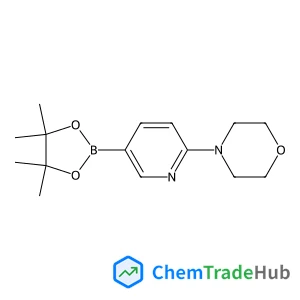
4-(5-(4,4,5,5-tetramethyl-1,3,2-dioxaborolan-2-yl)pyridin-2-yl)morpholine
CAS番号:
485799-04-0
分子式:
C15H23BN2O3
おすすめサプライヤー




免責事項
このページに表示される学術雑誌情報は、参考および研究目的のみを目的としています。当社は雑誌出版社とは提携しておらず、投稿の取り扱いも行っておりません。出版に関するお問い合わせは、各雑誌出版社に直接ご連絡ください。
表示されている情報に誤りがある場合は、support@chemtradehub.com までご連絡ください。迅速に確認し、対応いたします。