












Associative detachment (AD) paths for H and CN− in the gas-phase: astrophysical implications
文献情報
出版日
2017-10-17
DOI
10.1039/C7CP05573K
インパクトファクター
3.676
著者
Stanka V. Jerosimić, Franco A. Gianturco, Roland Wester
原文を見る
要旨
The direct dynamical paths leading to Associative Detachment (AD) in the gas-phase, and specifically in the low-temperature regions of the Dark Molecular Clouds (DMC) in the ISM, or in cold trap laboratory experiments, are investigated with quantum chemical methods by using a high-level multi-reference Configuration Interaction (CI) approach that employs single and double excitations plus Davidson perturbative correction [MRSDCI(Q)] and the d-aug-cc-pV5Z basis set. The potential energy curves for H + CN− are constructed for different directions of the H partner approaching the CN− anion within the framework of the Born–Oppenheimer approximation. The present calculations found that the AD energetics at low temperature becomes favorable only along a selected range of approaching directions, thus showing that there is a preferred path of forming HCN at low temperatures, while that of forming its HNC isomer is found to be energetically forbidden. Given the existence in the ISM of different HCN/HNC ratios in different environments, we discuss the implications of our findings for selective formation of either isomer in the low-temperature conditions of the molecular cloud cores.
関連文献
Bioactive flake–shell capsules: soft silica nanoparticles for efficient enzyme immobilization
Tatyana G. Terentyeva, Wim Van Rossom, Qingmin Ji
2013-05-10
Paper
DOI: 10.1039/C3TB20461H
A synergistic approach to achieving the high thermoelectric performance of La-doped SnTe using resonance state and partial band convergence
Srikanth Mandava, Ranita Basu, B. Khasimsaheb, Sai Muthukumar V., Ajay Singh, S. Neeleshwar
2021-05-12
Paper
DOI: 10.1039/D1MA00155H
Switching and tuning organic solid-state luminescence via a supramolecular approach
Savarimuthu Philip Anthony, Sunil Varughese, Sylvia M. Draper
2009-11-04
Communication
DOI: 10.1039/B914027A
Straightforward radical organic chemistry in neat conditions and “on water”‡
Nelly Shapiro, Maria Kramer, Israel Goldberg, Arkadi Vigalok
2010-02-09
Communication
DOI: 10.1039/B922475K
Atomic spectrometry update. Environmental analysis
Owen T. Butler, Jennifer M. Cook, Chris F. Harrington, Steve J. Hill, John Rieuwerts, Douglas L. Miles
2005-12-22
Atomic Spectrometry Update
DOI: 10.1039/B516025C
Molecular gate effects observed in fluoroalkylsilane self-assembled monolayers grafted on LiNi0.5Mn1.5O4 cathodes: an application to efficient ion-exchange reactions
Youn Charles-Blin, Hitomi Todoki
2021-06-22
Paper
DOI: 10.1039/D1MA00426C
Understanding the low voltage losses in high-performance non-fullerene acceptor-based organic solar cells
Jakob Hofinger, Felix Mayr, Katarina Gugujonovic, Dominik Wielend, Markus C. Scharber
2021-05-25
Paper
DOI: 10.1039/D1MA00293G
Design of ternary Pt–CoZn alloy catalysts coated with N-doped carbon towards acidic oxygen reduction
Xieweiyi Ye, Yakun Xue, Kaijia Li, Wen Tang, Xiao Han, Xibo Zhang, Zhijia Song, Zhiping Zheng, Qin Kuang
2021-07-12
Paper
DOI: 10.1039/D1MA00475A
Robust, flexible, freestanding and high surface area activated carbon and multi-walled carbon nanotubes composite material with outstanding electrode properties for aqueous-based supercapacitors
Bruno Freitas, Willian G. Nunes, Davi Marcelo Soares, Fernando C. Rufino, Cássio Murilo Moreira, Leonardo Morais Da Silva, Hudson Zanin
2021-03-30
Paper
DOI: 10.1039/D0MA00783H
こちらもおすすめ
化合物よくある質問
4-アミノフェノール酸ナトリウム水和物とは何ですか?
4-アミノフェノール酸ナトリウム水和物は、CAS番号206557-08-6の化合物で、4-アミノフェノールとナトリウムが結合した塩と水和物です。この化合物は、白...
206557-08-64-Aminobenzoic acid ...
化合物よくある質問
Methyl 3-methyl-N-{[(2-methyl-2-propanyl)oxy]carbonyl}-L-histidinateの代替品はありますか?
この化合物は特定の合成プロセスに使用される可能性がありますが、代替品として、他の类似的な化合物、例えばMethyl 3-methyl-N-{[(2-methyl...
72212-51-2Methyl 3-methyl-N-{[...
化合物よくある質問
4-Boc-2-哌嗪甲酸の市場動向や研究トレンドはどうですか?
4-Boc-2-哌嗪甲酸は、薬品開発や合成化学分野で広く使用されており、その需要は継続的に推移しています。特に、新薬開発における合成化学分野での需要が高まってい...
192330-11-3(2R)-4-[(tert-butoxy...
化合物よくある質問
4,4'-二羟甲基联苯の物理化学的性質は何ですか?
4,4'-二羟甲基联苯のCAS番号は1667-12-5です。この化合物は白色の結晶粉末で、分子量は154.20です。水にわずかに溶けますが、アルコールや有機溶媒...
1667-12-54,4'-Biphenyldiyldim...
化合物よくある質問
5-甲硫基戊腈はどの業界で使用されていますか?
5-甲硫基戊腈は医薬品産業で使用される可能性があります。また、ポリマー合成の触媒として、センサー製造の一部として、半導体製造のプロセス改善に使用される可能性があ...
59121-25-45-(Methylsulfanyl)pe...
化合物よくある質問
CAS番号1311961-50-8の化合物はどのように合成されますか?
この化合物は、1-abieta-8,11,13-trien-19-イルと6'-メトキシシンコナナン-9-基を含有する窒素含有化合物から合成されます。一般的な合成...
1311961-50-81-Abieta-8,11,13-tri...
化合物よくある質問
6-ブロモベンジジミダゾール-2-カルビルデオキシドはどのように保存すればよいですか?
6-ブロモベンジジミダゾール-2-カルビルデオキシドは、避光・乾燥した容器(密閉容器)で-20℃~4℃の低温で保存してください。高温や直射日光、湿気は避けてくだ...
885280-26-25-Bromo-1H-benzimida...
化合物よくある質問
Boc-N-甲基氨甲环酸とは何ですか?
621-65-8のCAS番号を持つBoc-N-甲基氨甲环酸は、化学式C7H13NO5を有する化合物です。この化合物は白色の結晶性粉末で、吸湿性があります。
621-65-83-Hydroxy-1,2-propan...
化合物よくある質問
乙基三氟硼酸钾はどのように合成されますか?
乙基三氟硼酸钾は、トリフLUオール酸カリウムとエチルブロミドを反応させて合成されます。この反応は高い選択性と収率を持ち、触媒を用いることで効率的に進行します。
882871-21-8Potassium ethyltrifl...
化合物よくある質問
2-フロウロ-5-クロロ-4-アミノフェノールはどのように保存すればよいですか?
2-フロウロ-5-クロロ-4-アミノフェノールは、直射日光を避けて冷却された暗所で保存し、密閉容器に保管してください。温度は常温か低温が適しています。
847872-10-04-Amino-5-chloro-2-f...
掲載誌
Physical Chemistry Chemical Physics

CiteScore:
5.5
自己引用率:
10.3%
年間論文数:
3036
Physical Chemistry Chemical Physics (PCCP) is an international journal co-owned by 19 physical chemistry and physics societies from around the world. This journal publishes original, cutting-edge research in physical chemistry, chemical physics and biophysical chemistry. To be suitable for publication in PCCP, articles must include significant innovation and/or insight into physical chemistry; this is the most important criterion that reviewers and Editors will judge against when evaluating submissions. The journal has a broad scope and welcomes contributions spanning experiment, theory, computation and data science. Topical coverage includes spectroscopy, dynamics, kinetics, statistical mechanics, thermodynamics, electrochemistry, catalysis, surface science, quantum mechanics, quantum computing and machine learning. Interdisciplinary research areas such as polymers and soft matter, materials, nanoscience, energy, surfaces/interfaces, and biophysical chemistry are welcomed if they demonstrate significant innovation and/or insight into physical chemistry. Joined experimental/theoretical studies are particularly appreciated when complementary and based on up-to-date approaches.
おすすめ化合物
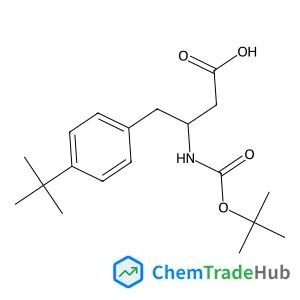
(S)-3-((tert-Butoxycarbonyl)amino)-4-(4-(tert-butyl)phenyl)butanoic acid
CAS番号:
403661-85-8
分子式:
C19H29NO4
おすすめサプライヤー




免責事項
このページに表示される学術雑誌情報は、参考および研究目的のみを目的としています。当社は雑誌出版社とは提携しておらず、投稿の取り扱いも行っておりません。出版に関するお問い合わせは、各雑誌出版社に直接ご連絡ください。
表示されている情報に誤りがある場合は、support@chemtradehub.com までご連絡ください。迅速に確認し、対応いたします。