












Understanding the low voltage losses in high-performance non-fullerene acceptor-based organic solar cells
文献情報
出版日
2021-05-25
DOI
10.1039/D1MA00293G
インパクトファクター
0
著者
Jakob Hofinger, Felix Mayr, Katarina Gugujonovic, Dominik Wielend, Markus C. Scharber
原文を見る
要旨
Despite the rapid increase in power conversion efficiency (PCE) of non-fullerene acceptor (NFA) based solar cells in recent years, organic photovoltaic (OPV) devices exhibit considerably larger voltage losses compared to their highly-efficient inorganic counterparts (e.g. Si or GaAs). Further material optimizations and strategies to reduce the voltage losses in OPV systems are required to close the gap to inorganic PV technologies and allow for efficiencies surpassing 20%. The main focus of this study is on understanding the voltage losses in high performance NFA-based solar cells, as furthering the knowledge in this area is critical in promoting their recent success. In this article, the open circuit voltage losses observed in high-performance D18:Y6 organic solar cells with a PCE of 16% are investigated in detail. The voltage losses of D18:Y6 devices are compared to fullerene-devices consisting of D18 and PC71BM in order to highlight the differences between non-fullerene and fullerene acceptors. A low open-circuit voltage loss of 0.51 V has been found for Y6-based devices suggesting a 0.29 V lower voltage loss compared to PC71BM-based devices (0.8 V). The observed differences can be explained by the high-lying charge transfer state energy in Y6-based solar cells and the strong emissivity of the pristine acceptor. Both properties seem to be prerequisites for efficient OPV systems with low voltage losses. Based on the experimental results, we suggest two design strategies to further improve the performance of OPV systems.
関連文献
Dual fluorescence in strap ESIPT systems: a theoretical study
Chris Ewels, Denis Jacquemin
2019-12-10
Paper
DOI: 10.1039/C9CP06261K
Redox-mediated transformation of a Tb2O3(111) thin film from the cubic fluorite to bixbyite structure
Christopher J. Lee, Ameen Sayal, Saumye Vashishtha, Jason F. Weaver
2019-12-02
Paper
DOI: 10.1039/C9CP05083C
About the origin of the large Stokes shift in aminoalkyl substituted heptamethine cyanine dyes
Cristina Sissa, Anna Painelli, Francesca Terenziani, Massimo Trotta, Roberta Ragni
2019-12-10
Paper
DOI: 10.1039/C9CP05473A
High-throughput HSE study on the doping effect in anatase TiO2
Jiahua Liu, Mouyi Weng, Sibai Li, Xin Chen, Jianhang Cen, Jianshu Jie, Weiji Xiao, Jiaxin Zheng, Feng Pan
2019-10-23
Paper
DOI: 10.1039/C9CP04591K
Theoretical insights into the effect of the overpotential on CO electroreduction mechanisms on Cu(111): regulation and application of electrode potentials from a CO coverage-dependent electrochemical model
Lihui Ou, Junxiang Chen
2019-11-25
Paper
DOI: 10.1039/C9CP05043D
Understanding deep dehydrogenation and cracking of n-butane on Ni(111) by a DFT study
Li Wang, Zhourong Xiao, Guozhu Li, Lichang Wang
2019-11-22
Paper
DOI: 10.1039/C9CP05022A
Transition of interfacial capacitors in electrowetting on a graphite surface by ion intercalation
2019-09-26
Paper
DOI: 10.1039/C9CP04436A
こちらもおすすめ
化合物よくある質問
4-アミノフェノール酸ナトリウム水和物とは何ですか?
4-アミノフェノール酸ナトリウム水和物は、CAS番号206557-08-6の化合物で、4-アミノフェノールとナトリウムが結合した塩と水和物です。この化合物は、白...
206557-08-64-Aminobenzoic acid ...
化合物よくある質問
Methyl 3-methyl-N-{[(2-methyl-2-propanyl)oxy]carbonyl}-L-histidinateの代替品はありますか?
この化合物は特定の合成プロセスに使用される可能性がありますが、代替品として、他の类似的な化合物、例えばMethyl 3-methyl-N-{[(2-methyl...
72212-51-2Methyl 3-methyl-N-{[...
化合物よくある質問
4-Boc-2-哌嗪甲酸の市場動向や研究トレンドはどうですか?
4-Boc-2-哌嗪甲酸は、薬品開発や合成化学分野で広く使用されており、その需要は継続的に推移しています。特に、新薬開発における合成化学分野での需要が高まってい...
192330-11-3(2R)-4-[(tert-butoxy...
化合物よくある質問
4,4'-二羟甲基联苯の物理化学的性質は何ですか?
4,4'-二羟甲基联苯のCAS番号は1667-12-5です。この化合物は白色の結晶粉末で、分子量は154.20です。水にわずかに溶けますが、アルコールや有機溶媒...
1667-12-54,4'-Biphenyldiyldim...
化合物よくある質問
5-甲硫基戊腈はどの業界で使用されていますか?
5-甲硫基戊腈は医薬品産業で使用される可能性があります。また、ポリマー合成の触媒として、センサー製造の一部として、半導体製造のプロセス改善に使用される可能性があ...
59121-25-45-(Methylsulfanyl)pe...
化合物よくある質問
CAS番号1311961-50-8の化合物はどのように合成されますか?
この化合物は、1-abieta-8,11,13-trien-19-イルと6'-メトキシシンコナナン-9-基を含有する窒素含有化合物から合成されます。一般的な合成...
1311961-50-81-Abieta-8,11,13-tri...
化合物よくある質問
6-ブロモベンジジミダゾール-2-カルビルデオキシドはどのように保存すればよいですか?
6-ブロモベンジジミダゾール-2-カルビルデオキシドは、避光・乾燥した容器(密閉容器)で-20℃~4℃の低温で保存してください。高温や直射日光、湿気は避けてくだ...
885280-26-25-Bromo-1H-benzimida...
化合物よくある質問
Boc-N-甲基氨甲环酸とは何ですか?
621-65-8のCAS番号を持つBoc-N-甲基氨甲环酸は、化学式C7H13NO5を有する化合物です。この化合物は白色の結晶性粉末で、吸湿性があります。
621-65-83-Hydroxy-1,2-propan...
化合物よくある質問
乙基三氟硼酸钾はどのように合成されますか?
乙基三氟硼酸钾は、トリフLUオール酸カリウムとエチルブロミドを反応させて合成されます。この反応は高い選択性と収率を持ち、触媒を用いることで効率的に進行します。
882871-21-8Potassium ethyltrifl...
化合物よくある質問
2-フロウロ-5-クロロ-4-アミノフェノールはどのように保存すればよいですか?
2-フロウロ-5-クロロ-4-アミノフェノールは、直射日光を避けて冷却された暗所で保存し、密閉容器に保管してください。温度は常温か低温が適しています。
847872-10-04-Amino-5-chloro-2-f...
掲載誌
おすすめ化合物
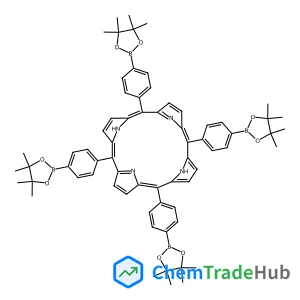
5,10,15,20-tetrakis(4-boronic acid pinacol ester phenyl) porphyrin
CAS番号:
1332748-00-1
分子式:
C68H74B4N4O8
おすすめサプライヤー






免責事項
このページに表示される学術雑誌情報は、参考および研究目的のみを目的としています。当社は雑誌出版社とは提携しておらず、投稿の取り扱いも行っておりません。出版に関するお問い合わせは、各雑誌出版社に直接ご連絡ください。
表示されている情報に誤りがある場合は、support@chemtradehub.com までご連絡ください。迅速に確認し、対応いたします。