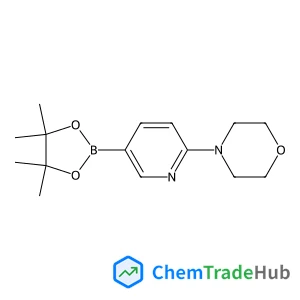
4-(5-(4,4,5,5-tetramethyl-1,3,2-dioxaborolan-2-yl)pyridin-2-yl)morpholine
CAS番号:
485799-04-0
分子式:
C15H23BN2O3
Hanlin Gan, Liang Peng, Feng Long Gu
Density functional theory calculations are employed to study the mechanism of photoselective catalytic reduction of 4-bromobenzaldehyde (4-BBA) in acetonitrile and in ethanol solvents. A totally relaxed Ti3O9H6 cluster model is proposed to represent titanium dioxide (TiO2) surfaces. The reduction selectivity of an adsorbed 4-BBA molecule on Ti3O9H6 has been investigated. Owing to the difference in the proton and H atom donating capabilities between explicit CH3CN and C2H5OH solvent molecules, the photocatalytic reduction of 4-BBA is the debromination process in acetonitrile, whereas in ethanol it is the carbonyl reduction process. Therefore 4-BBA can be selectively reduced to benzaldehyde in acetonitrile and 4-bromobenzyl alcohol in ethanol, respectively. Our computational results have verified the reaction mechanism proposed by experiments and show that the debromination of 4-BBA would be efficient if both 4-BBA and Ti3O9H6 have an extra photoelectron. The Ti3O9H6 cluster, playing a role as a hydrogen source and a bridge to transfer photoelectrons from bulk TiO2, would have potential to be an ideal molecular model for understanding photocatalytic reactions on the TiO2 surface.
Christopher Szakal, David S. Simons, Albert J. Fahey
DOI: 10.1039/C9AN00774A
Yufei Shan
DOI: 10.1039/C8AN00456K
Ramshad Kalluruttimmal, Divya Thekke Thattariyil, Archana Panthalattu Parambil, Ashis Kumar Sen, Lakshmi Chakkumkumarath, Muraleedharan Kannoth Manheri
DOI: 10.1039/C9AN00522F
Chunxue Liu, Susu Zhang, Wei Jiang
DOI: 10.1039/C9AN00589G
Janice B. Rabor, Koki Kawamura, Junichi Kurawaki, Yasuro Niidome
DOI: 10.1039/C9AN00247B
環戊烷-1,3-二甲酸甲酯は、環戊烷と塩酸によるヒンデンブルク反応を経由して合成されます。この反応では、環戊烷が塩酸と作用し、1,3-ジカルボキシ基が導入されま...
4-メトキシ-1,2,3-スチアゼ-3,5-ジオンは、CAS番号107843-77-6の化合物で、(E)-ベンジル3-(3,4-ジヒドロキシフェニル) acry...
プロスタグランジンA2 (CAS番号: 41691-92-3) は、化学物質の安全管理に関する規制として、GHS (危険物質の国際的ハザード分類・ラベル付けシス...
4-アミノ-1-ナフタレン sulfonic 酸のCAS番号は84-86-6です。この化合物は結晶性で、分子量は212.15 g/molです。アルコールや水など...
N-GlcNAc-生物素は吸収性があり、皮膚や目への接触を避けることが重要です。PPE(個体保護具)は使用し、ドラフトチャンバーは必要に応じて使用します。漏洩時...
CAS番号1209781-11-2の3-アミノメチルフローラノピペリジン-1-カルボニル酸テルブチルエステルは、有機化合物の一種で、化学式はC10H17FNO3...
6- bromo-1-methyl-1H-benzotriazoleは、ブロモフリオリンと1-メチル-1H-ベンゾ[d][1,2,3]三氮唑の反応により合成され...
4-硫代尿苷は、尿素とD-リボシルヒドロキシアルデヒドを用いてスルホン化反応を経て合成されます。通常は塩酸ヒドロキシチオニルスルホン酸などの触媒を使用し、選択性...
ブレインナトリユリックペプチド32ラット(CAS番号: 133448-20-1)は、心臓で作られるホルモンの一つで、心不全の診断や予後評価に使用されます。
CAS番号810680-60-5の1-(3-氮杂啶)-4-羟基哌啶双盐酸盐は、白色の結晶性粉末である。分子量は360.84 g/molで、水に溶けやすい。反応活...

Physical Chemistry Chemical Physics (PCCP) is an international journal co-owned by 19 physical chemistry and physics societies from around the world. This journal publishes original, cutting-edge research in physical chemistry, chemical physics and biophysical chemistry. To be suitable for publication in PCCP, articles must include significant innovation and/or insight into physical chemistry; this is the most important criterion that reviewers and Editors will judge against when evaluating submissions. The journal has a broad scope and welcomes contributions spanning experiment, theory, computation and data science. Topical coverage includes spectroscopy, dynamics, kinetics, statistical mechanics, thermodynamics, electrochemistry, catalysis, surface science, quantum mechanics, quantum computing and machine learning. Interdisciplinary research areas such as polymers and soft matter, materials, nanoscience, energy, surfaces/interfaces, and biophysical chemistry are welcomed if they demonstrate significant innovation and/or insight into physical chemistry. Joined experimental/theoretical studies are particularly appreciated when complementary and based on up-to-date approaches.