












Smartphone-based rapid quantification of viable bacteria by single-cell microdroplet turbidity imaging
文献情報
出版日
2018-04-25
DOI
10.1039/C8AN00456K
インパクトファクター
4.616
著者
Yufei Shan
原文を見る
要旨
Standard plate count (SPC) has been recognized as the golden standard for the quantification of viable bacteria. However, SPC usually takes one to several days to grow individual cells into a visible colony, which greatly hampers its application in rapid bacteria enumeration. Here we present a microdroplet turbidity imaging based digital standard plate count (dSPC) method to overcome this hurdle. Instead of cultivating on agar plates, bacteria are encapsulated in monodisperse microdroplets for single-cell cultivation. Proliferation of the encapsulated bacterial cell produced a detectable change in microdroplet turbidity, which allowed, after just a few bacterial doubling cycles (i.e., a few hours), enumeration of viable bacteria by visible-light imaging. Furthermore, a dSPC platform integrating a power-free droplet generator with smartphone-based turbidity imaging was established. As proof-of-concept demonstrations, a series of Gram-negative bacteria (Escherichia coli) and Gram-positive bacteria (Bacillus subtilis) samples were quantified via the smartphone dSPC accurately within 6 hours, representing a detection sensitivity of 100 CFU ml−1 and at least 3 times faster. In addition, Enterobacter sakazakii (E. sakazakii) in infant milk powder as a real sample was enumerated within 6 hours, in contrast to the 24 hours needed in traditional SPC. Results with high accuracy and reproducibility were achieved, with no difference in counts found between dSPC and SPC. By enabling label-free, rapid, portable and low-cost enumeration and cultivation of viable bacteria onsite, smartphone dSPC forms the basis for a temporally and geographically trackable network for surveying live microbes globally where every citizen with a cellphone can contribute anytime and anywhere.
おすすめジャーナル
関連文献
Probing the communication of deoxythymidine triphosphate in HIV-1 reverse transcriptase by communication maps and interaction energy studies
2017-10-09
Paper
DOI: 10.1039/C7CP06386E
Thermodynamic assessment of the oxygen reduction activity in aqueous solutions
2017-10-18
Paper
DOI: 10.1039/C7CP05448C
On the nanosecond proton dynamics in phosphoric acid–benzimidazole and phosphoric acid–water mixtures
Jan-Patrick Melchior, Bernhard Frick
2017-09-22
Paper
DOI: 10.1039/C7CP04116K
Effect of cooling on droplet size in supersaturation-induced emulsions
Shirui Luo, Jarrod Schiffbauer
2017-10-18
Paper
DOI: 10.1039/C7CP05905A
Pure zero-dimensional Cs4PbBr6 single crystal rhombohedral microdisks with high luminescence and stability
Qing Liao, Yishi Wu, Qinggang Gao
2017-10-05
Paper
DOI: 10.1039/C7CP06097A
Hydrogen evolution based on the electrons/protons stored on amorphous TiO2
Ling Zhang, Wenzhong Wang
2017-10-18
Communication
DOI: 10.1039/C7CP06067J
Fluoride substitution in LiBH4; destabilization and decomposition
Bo Richter, Dorthe B. Ravnsbæk, Manish Sharma, Alexandra Spyratou, Hans Hagemann, Torben R. Jensen
2017-10-16
Paper
DOI: 10.1039/C7CP05565J
Design of an efficient coherent multi-site single-molecule rectifier
Matthijs Doelman, Rienk Eelkema, Herre S. J. van der Zant
2017-10-18
Paper
DOI: 10.1039/C7CP04456A
The fountain effect of ice-like water across nanotubes at room temperature
Kuiwen Zhao, Huiying Wu
2017-09-13
Communication
DOI: 10.1039/C7CP04693F
Quantitative DFT modeling of product concentration in organometallic reactions: Cu-mediated pentafluoroethylation of benzoic acid chlorides as a case study
2017-10-10
Paper
DOI: 10.1039/C7CP05709A
こちらもおすすめ
化合物よくある質問
環戊烷-1,3-二甲酸甲酯はどのように合成されますか?
環戊烷-1,3-二甲酸甲酯は、環戊烷と塩酸によるヒンデンブルク反応を経由して合成されます。この反応では、環戊烷が塩酸と作用し、1,3-ジカルボキシ基が導入されま...
2435-36-1Dimethyl 1,3-cyclope...
化合物よくある質問
4-メトキシ-1,2,3-スチアゼ-3,5-ジオンとは何ですか?
4-メトキシ-1,2,3-スチアゼ-3,5-ジオンは、CAS番号107843-77-6の化合物で、(E)-ベンジル3-(3,4-ジヒドロキシフェニル) acry...
107843-77-6(E)-Benzyl 3-(3,4-di...
化合物よくある質問
プロスタグランジンA2について「に適用される法規ガイドラインは何ですか?'
プロスタグランジンA2 (CAS番号: 41691-92-3) は、化学物質の安全管理に関する規制として、GHS (危険物質の国際的ハザード分類・ラベル付けシス...
41691-92-316,16-DIMETHYL PROST...
化合物よくある質問
4-アミノ-1-ナフタレン sulfonic 酸についての物理化学的性質は何ですか?
4-アミノ-1-ナフタレン sulfonic 酸のCAS番号は84-86-6です。この化合物は結晶性で、分子量は212.15 g/molです。アルコールや水など...
84-86-64-Amino-1-naphthalen...
化合物よくある質問
N-GlcNAc-生物素を取り扱う際の実験室安全事項は何ですか?
N-GlcNAc-生物素は吸収性があり、皮膚や目への接触を避けることが重要です。PPE(個体保護具)は使用し、ドラフトチャンバーは必要に応じて使用します。漏洩時...
1272755-69-72-Acetamido-2-deoxy-...
化合物よくある質問
3-アミノメチルフローラノピペリジン-1-カルボニル酸テルブチルエステルとは何ですか?
CAS番号1209781-11-2の3-アミノメチルフローラノピペリジン-1-カルボニル酸テルブチルエステルは、有機化合物の一種で、化学式はC10H17FNO3...
1209781-11-22-Methyl-2-propanyl ...
化合物よくある質問
6-溴-1-甲基-1H-ベンゾ[d][1,2,3]三氮唑はどのように合成されますか?
6- bromo-1-methyl-1H-benzotriazoleは、ブロモフリオリンと1-メチル-1H-ベンゾ[d][1,2,3]三氮唑の反応により合成され...
944718-32-56-Bromo-1-methyl-1H-...
化合物よくある質問
4-硫代尿苷はどのように合成されますか?
4-硫代尿苷は、尿素とD-リボシルヒドロキシアルデヒドを用いてスルホン化反応を経て合成されます。通常は塩酸ヒドロキシチオニルスルホン酸などの触媒を使用し、選択性...
6741-73-71-(4-thio-beta-D-rib...
化合物よくある質問
ブレインナトリユリックペプチド32ラットとは何ですか?
ブレインナトリユリックペプチド32ラット(CAS番号: 133448-20-1)は、心臓で作られるホルモンの一つで、心不全の診断や予後評価に使用されます。
133448-20-1Brain Natriuretic Pe...
化合物よくある質問
1-(3-氮杂啶)-4-羟基哌啶双盐酸盐の物理化学的性質は何ですか?
CAS番号810680-60-5の1-(3-氮杂啶)-4-羟基哌啶双盐酸盐は、白色の結晶性粉末である。分子量は360.84 g/molで、水に溶けやすい。反応活...
810680-60-51-(3-Azetidinyl)-4-p...
掲載誌
Analyst

CiteScore:
7.8
自己引用率:
5.6%
年間論文数:
653
Analyst publishes analytical and bioanalytical research that reports premier fundamental discoveries and inventions, and the applications of those discoveries, unconfined by traditional discipline barriers.
おすすめ化合物
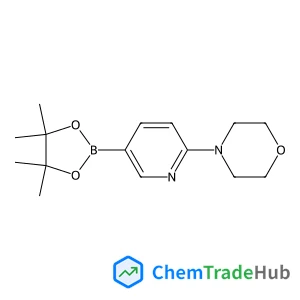
4-(5-(4,4,5,5-tetramethyl-1,3,2-dioxaborolan-2-yl)pyridin-2-yl)morpholine
CAS番号:
485799-04-0
分子式:
C15H23BN2O3
![Ethyl 3-((6-(4,5-dihydro-1H-benzo[d]azepin-3(2H)-yl)-2-(pyridin-2-yl)pyrimidin-4-yl)amino)propanoate structure](https://static.chemtradehub.com/structs/137/1373423-53-0-496a.webp "Ethyl 3-((6-(4,5-dihydro-1H-benzo[d]azepin-3(2H)-yl)-2-(pyridin-2-yl)pyrimidin-4-yl)amino)propanoate structure")
おすすめサプライヤー





免責事項
このページに表示される学術雑誌情報は、参考および研究目的のみを目的としています。当社は雑誌出版社とは提携しておらず、投稿の取り扱いも行っておりません。出版に関するお問い合わせは、各雑誌出版社に直接ご連絡ください。
表示されている情報に誤りがある場合は、support@chemtradehub.com までご連絡ください。迅速に確認し、対応いたします。