


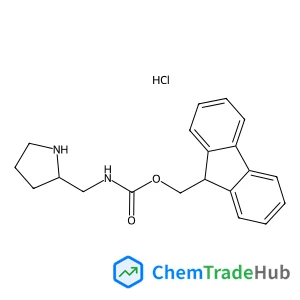
(S)-(9H-Fluoren-9-yl)methyl (pyrrolidin-2-ylmethyl)carbamate hydrochloride
CAS番号:
1217813-15-4
分子式:
C20H23ClN2O2
Duy Khanh Nguyen, Yu-Tsung Lin, Shih-Yang Lin, Yu-Huang Chiu, Ngoc Thanh Thuy Tran, Ming Fa-Lin
The feature-rich electronic and magnetic properties of fluorine-doped graphene nanoribbons are investigated by the first-principles calculations. They arise from the cooperative or competitive relations among the significant chemical bonds, finite-size quantum confinement and edge structure. There exist C–C, C–F, and F–F bonds with multi-orbital hybridizations. Fluorine adatoms can create p-type metals or concentration- and distribution-dependent semiconductors, depending on whether the π bonding is seriously suppressed by the top-site chemical bonding. Furthermore, five kinds of spin-dependent electronic and magnetic properties cover the non-magnetic and ferromagnetic metals, non-magnetic semiconductors, and anti-ferromagnetic semiconductors with/without spin splitting. The diverse essential properties are clearly revealed in the spatial charge distribution, spin density, and orbital-projected density of states.

Electroanalysis

Medicinal Chemistry Research

Journal of Asian Natural Products Research

Biocatalysis and Biotransformation

Main Group Chemistry

NDT & E International

Journal of the Indian Institute of Science

Cellulose

Bioorganic & Medicinal Chemistry Letters

Critical Reviews in Solid State and Materials Sciences
Yevgeny Moskovitz, Simcha Srebnik
DOI: 10.1039/C4CP00354C
Aniruddha Ganguly, Soumen Ghosh, Nikhil Guchhait
DOI: 10.1039/C4CP04175E
Goutam Prasanna Kar, Priti Xavier, Suryasarathi Bose
DOI: 10.1039/C4CP01594K
Priti Xavier, Suryasarathi Bose
DOI: 10.1039/C4CP00832D
Chengxi Huang, Haiping Wu, Kaiming Deng, Weihua Tang
DOI: 10.1039/C4CP04385E
Vojtěch Mlýnský, Nils G. Walter
DOI: 10.1039/C4CP03857F
Jocenir Boita, Lucas Nicolao, Maria C. M. Alves, Jonder Morais
DOI: 10.1039/C4CP01925C
Christophe Morell, Alberto Vela, Frédéric Guégan, Henry Chermette
DOI: 10.1039/C4CP03167A
Istvan Szilagyi, Tamas Szabo, Anthony Desert, Gregor Trefalt, Tamas Oncsik, Michal Borkovec
DOI: 10.1039/C4CP00804A
F. J. Aoiz, J. Aldegunde, V. J. Herrero, V. Sáez-Rábanos
DOI: 10.1039/C3CP53908C
2-メトキシ-4-(メチルスルフィニル)アミンは、主に医薬品および農薬の製造に使用されます。また、合成化学の一部として研究用材料としても利用されます。
代替品としては、4,6-二クロロピラミジンアミンや他のピラミジン系化合物が考えられます。ただし、目的と用途によって最適な代替品は異なります。
6-氯-4-甲基-1H-吲哚の廃棄物は、適切な容器に収集し、密閉して保管します。温度は常温、湿度は低く、直射日光を避けて保管することを推奨します。廃棄処理は専門...
2-フローユロ-4-(トリフルオロメチル)ベンゾイドのCAS番号は207974-08-1です。この化合物はGHS分類で毒性物質と有害な反応物質として分類されます...
4-ニトロフェニルN-[(ベンゼルオキシルカーボンイル]グリシングリシングリシン酸は、室温で暗所に保管し、乾燥した環境で保存することを推奨します。容器は密閉性の...
イソデスロラタドリンの代替品としては、デスロラタドリンや他の抗ヒスタミン薬が挙げられます。具体的には、デスロラタドリン、ラセカミド、フェルタドリンなどが、症状や...
5-甲氧基-1,2,3,4-四氢异喹啉盐酸盐の一般的な合成方法は、メタノール中で5-メトキシ-1,2,3,4-四ヒュドロイソキシンを塩酸で塩化します。この反応で...
CAS番号6471-78-9の4-アミノ-5-メトキシ-2-トルエンサルホニック酸は、GHS分類では corrosive(腐食性)と識別されます。EUのREAC...
甲基孕酮の取り扱いは、PPE(個人保護具)の使用が必要な重要な安全事項を伴います。防塵マスク、ゴーグル、手袋を着用することが推奨されます。ドラフトチャンバーを使...

Physical Chemistry Chemical Physics (PCCP) is an international journal co-owned by 19 physical chemistry and physics societies from around the world. This journal publishes original, cutting-edge research in physical chemistry, chemical physics and biophysical chemistry. To be suitable for publication in PCCP, articles must include significant innovation and/or insight into physical chemistry; this is the most important criterion that reviewers and Editors will judge against when evaluating submissions. The journal has a broad scope and welcomes contributions spanning experiment, theory, computation and data science. Topical coverage includes spectroscopy, dynamics, kinetics, statistical mechanics, thermodynamics, electrochemistry, catalysis, surface science, quantum mechanics, quantum computing and machine learning. Interdisciplinary research areas such as polymers and soft matter, materials, nanoscience, energy, surfaces/interfaces, and biophysical chemistry are welcomed if they demonstrate significant innovation and/or insight into physical chemistry. Joined experimental/theoretical studies are particularly appreciated when complementary and based on up-to-date approaches.
![4-Chloro-2-{[(2-chlorophenoxy)acetyl]amino}benzoic acid structure](https://static.chemtradehub.com/structs/351/351424-20-9-9467.webp "4-Chloro-2-{[(2-chlorophenoxy)acetyl]amino}benzoic acid structure")




