


Elucidating the mechanism of MgB2 initial hydrogenation via a combined experimental–theoretical study
文献情報
出版日
2017-07-19
DOI
10.1039/C7CP03709K
インパクトファクター
3.676
著者
Keith G. Ray, Leonard E. Klebanoff, Jonathan R. I. Lee, Vitalie Stavila, Tae Wook Heo, Patrick Shea, Alexander A. Baker, Shinyoung Kang, Michael Bagge-Hansen, Yi-Sheng Liu, James L. White, Brandon C. Wood
原文を見る
要旨
Mg(BH4)2 is a promising solid-state hydrogen storage material, releasing 14.9 wt% hydrogen upon conversion to MgB2. Although several dehydrogenation pathways have been proposed, the hydrogenation process is less well understood. Here, we present a joint experimental–theoretical study that elucidates the key atomistic mechanisms associated with the initial stages of hydrogen uptake within MgB2. Fourier transform infrared, X-ray absorption, and X-ray emission spectroscopies are integrated with spectroscopic simulations to show that hydrogenation can initially proceed via direct conversion of MgB2 to Mg(BH4)2 complexes. The associated energy landscape is mapped by combining ab initio calculations with barriers extracted from the experimental uptake curves, from which a kinetic model is constructed. The results from the kinetic model suggest that initial hydrogenation takes place via a multi-step process: molecular H2 dissociation, likely at Mg-terminated MgB2 surfaces, is followed by migration of atomic hydrogen to defective boron sites, where the formation of stable B–H bonds ultimately leads to the direct creation of Mg(BH4)2 complexes without persistent BxHy intermediates. Implications for understanding the chemical, structural, and electronic changes upon hydrogenation of MgB2 are discussed.
おすすめジャーナル

Russian Chemical Bulletin

Chemistry Education Research and Practice

Journal of Natural Medicines

Current Opinion in Colloid & Interface Science

Organic Process Research & Development

Crystallography Reports

Russian Journal of Applied Chemistry

Journal of Saudi Chemical Society

New Journal of Chemistry

Current Opinion in Solid State & Materials Science
関連文献
Redistribution of valence and conduction band states depending on the method of modification of SiO2 structure
A. S. Konashuk, E. O. Filatova
2017-09-07
Paper
DOI: 10.1039/C7CP04914E
Two-dimensional GeP3 as a high capacity electrode material for Li-ion batteries
Chunmei Zhang, Yalong Jiao, Tianwei He, Fengxian Ma, Liangzhi Kou, Ting Liao, Steven Bottle, Aijun Du
2017-08-18
Paper
DOI: 10.1039/C7CP04758D
Light-induced piston nanoengines: ultrafast shuttling of a styryl dye inside cucurbit[7]uril
Ekaterina Y. Chernikova, Yuri V. Fedorov, Olga A. Fedorova, François Maurel, Gediminas Jonusauskas
2017-09-08
Communication
DOI: 10.1039/C7CP04283C
A topological study of chemical bonds under pressure: solid hydrogen as a model case
Vanessa Riffet, Vanessa Labet, Julia Contreras-García
2017-09-11
Paper
DOI: 10.1039/C7CP04349J
Unravelling hydrogen bonding interactions of tryptamine–water dimer from neutral to cation
Zongyuan Liu, Carl O. Trindle, Quanli Gu, Wei Wu, Peifeng Su
2017-08-04
Paper
DOI: 10.1039/C7CP03491A
Temperature dependence of the conversion efficiency of photochromic perylene bisimide dithienylcyclopentene triads embedded in a polymer
Johann Thurn, Johannes Maier, Martti Pärs, Katja Gräf, Mukundan Thelakkat, Jürgen Köhler
2017-09-12
Paper
DOI: 10.1039/C7CP03634E
The magnetic and adsorption properties of ZnO1−xSx nanoparticles
Huiyun Zhang, Guixian Liu, Yanqiang Cao, Jing Chen, Kai Shen, Ashwini Kumar, Mingxiang Xu, Qi Li
2017-09-12
Paper
DOI: 10.1039/C7CP03470A
Self-assembled bundled TiO2 nanowire arrays encapsulated with indium tin oxide for broadband absorption in plasmonic photocatalysis
Xingce Fan, Zhengwei Luo, Xiangyu Hou, Xiaozhi Yang, Teng Qiu, Paul K. Chu
2017-09-14
Paper
DOI: 10.1039/C7CP04196A
Cooperative hydrogen bonds form a pseudocycle stabilizing an isolated complex of isocyanic acid with urea
John C. Mullaney, Chris Medcraft, David P. Tew, Luke Lewis-Borrell, Bernard T. Golding, Nicholas R. Walker, Anthony C. Legon
2017-09-07
Paper
DOI: 10.1039/C7CP04315E
Exploration of significant influences of the operating conditions on the local O2 transport in proton exchange membrane fuel cells (PEMFCs)
Shuiyun Shen, Xiaojing Cheng, Chao Wang, Xiaohui Yan, Changchun Ke, Jiewei Yin, Junliang Zhang
2017-09-06
Paper
DOI: 10.1039/C7CP04837H
こちらもおすすめ
化合物よくある質問
間溴苯甲酰腈の市場動向や研究トレンドはどうですか?
間 brom 苯甲酰腈は、合成化学や薬物化学において重要な Intermediate として使用されています。市場動向としては、その合成性と機能性により、研究開...
24999-51-7(3-Bromophenyl)(oxo)...
287966-62-5Desulfo Glucoraphani...
化合物よくある質問
Methyl 2-amino-5-(trifluoromethyl)benzoateに適用される法規ガイドラインは何ですか?
CAS番号117324-58-0の塩酸メチル2アミノ-5-トリフルオロメチルベンゼートは、GHS分類により腐食性物質と判定されます。REACH規則では、製造、販...
117324-58-0Methyl 2-amino-5-(tr...
化合物よくある質問
3-ブロモ-1,3,4,5-四水化-2H-1-ベンザアゼピン-2-オンは安全ですか?
毒性があるため、適切な安全対策が必須です。皮膚や粘膜への刺激性が強く、吸入や誤飲により健康被害を引き起こす可能性があります。取扱時にはガスマスクや手袋、眼鏡を使...
86499-96-93-Bromo-1,3,4,5-tetr...
化合物よくある質問
三氟甲基ピリジン-2-甲アミン塩酸塩は安全ですか?
三氟甲基ピリジン-2-甲アミン塩酸塩は安全性に注意が必要です。毒性は低レベルですが、直接的接触や吸入は避けるべきです。適切な手袋や防塵マスクを着用し、密閉された...
871826-12-9(5-(Trifluoromethyl)...
化合物よくある質問
1-エチル-4-(4-硝基フェニル)ピペリジンは安全ですか?
1-エチル-4-(4-硝基フェニル)ピペリジンは有毒であり、取扱には注意が必要です。保管や作業中に手袋を着用し、目や皮膚に接触しないように注意する必要があります...
115619-00-61-Ethyl-4-(4-nitroph...
化合物よくある質問
1,1-ジメトキシプロパン-2-オンは安全ですか?
1,1-ジメトキシプロパン-2-オンは一般的に低毒性ですが、皮膚や目への刺激性があるため、取扱いには注意が必要です。蒸気や液体の吸入には有害な可能性があり、適切...
6342-56-91,1-dimethoxypropan-...
化合物よくある質問
コバルト(II) 3,3'-{[(1S,2S)-1,2-ジメチルフENCYCLICALE-1,2-エチエンジイル]ビス[ニトロリルメチルイリデン]}ビス[4-オキソ-2-ペンテン-2-olate]について「に適用される法規ガイドラインは何ですか?
この化合物はCAS番号259259-80-8に対応しています。GHS分類では、毒性、燃焼性、反応性、炎症性を考慮に入れ、適切な危険性分類が行われます。REACH...
259259-80-8Cobalt(2+) (2E,2'E)-...
化合物よくある質問
「カーバミル酸, N-[8-[[2-[[2-(2,6-ジオキソ-3-ピペリジニル)-2,3-ジオキソ-1,3-ジヒドロ-1H-イソイソインドール-4-イルオキシ]アセチル]アミノ]オクチル]-1,1-ジメチレチルエステル」はどのように保存すればよいですか?
この化合物は、冷却庫で-20℃の温度、乾燥した容器に保管し、直日光から保護する必要があります。湿度の高い環境や高温は避けてください。
1950635-34-32-Methyl-2-propanyl ...
1433975-21-3FMoc-D-4-Aph(tBu-CbM...
掲載誌
Physical Chemistry Chemical Physics

CiteScore:
5.5
自己引用率:
10.3%
年間論文数:
3036
Physical Chemistry Chemical Physics (PCCP) is an international journal co-owned by 19 physical chemistry and physics societies from around the world. This journal publishes original, cutting-edge research in physical chemistry, chemical physics and biophysical chemistry. To be suitable for publication in PCCP, articles must include significant innovation and/or insight into physical chemistry; this is the most important criterion that reviewers and Editors will judge against when evaluating submissions. The journal has a broad scope and welcomes contributions spanning experiment, theory, computation and data science. Topical coverage includes spectroscopy, dynamics, kinetics, statistical mechanics, thermodynamics, electrochemistry, catalysis, surface science, quantum mechanics, quantum computing and machine learning. Interdisciplinary research areas such as polymers and soft matter, materials, nanoscience, energy, surfaces/interfaces, and biophysical chemistry are welcomed if they demonstrate significant innovation and/or insight into physical chemistry. Joined experimental/theoretical studies are particularly appreciated when complementary and based on up-to-date approaches.
おすすめ化合物
![(1S,4aR,5R,7S,7aS)-1-(beta-D-Glucopyranosyloxy)-5-hydroxy-7-methyl-1,4a,5,6,7,7a-hexahydrocyclopenta[c]pyran-7-yl alpha-D-galactopyranoside structure](https://static.chemtradehub.com/structs/817/81720-07-2-4ffd.webp "(1S,4aR,5R,7S,7aS)-1-(beta-D-Glucopyranosyloxy)-5-hydroxy-7-methyl-1,4a,5,6,7,7a-hexahydrocyclopenta[c]pyran-7-yl alpha-D-galactopyranoside structure")
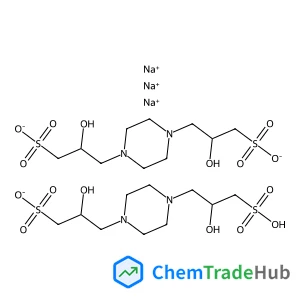
3,3'-(Piperazine-1,4-diyl)bis(2-hydroxypropane-1-sulfonic acid) Sodium Salt
CAS番号:
108321-08-0
分子式:
C20H41N4Na3O16S4
おすすめサプライヤー








免責事項
このページに表示される学術雑誌情報は、参考および研究目的のみを目的としています。当社は雑誌出版社とは提携しておらず、投稿の取り扱いも行っておりません。出版に関するお問い合わせは、各雑誌出版社に直接ご連絡ください。
表示されている情報に誤りがある場合は、support@chemtradehub.com までご連絡ください。迅速に確認し、対応いたします。