












Trends of intramolecular hydrogen bonding in substituted alcohols: a deeper investigation
文献情報
出版日
2017-06-05
DOI
10.1039/C7CP03572A
インパクトファクター
3.676
著者
Patrick R. Batista, Renan V. Viesser, Cláudio F. Tormena, Roberto Rittner, Paulo R. de Oliveira
原文を見る
要旨
Intramolecular hydrogen bonding (IAHB) is one of the most important intramolecular interactions and a critical element in adopted molecular arrangements. Moreover, slight substitution in a molecule can affect its strength to a great extent. It is well established that alkyl groups play a positive role in IAHB strength. However, the effects that drive it are specific to each system. To investigate the influence of IAHB and its strength dependency on different acyclic compounds, the conformational preferences of propane-1,3-diol, 3-methoxypropan-1-ol, 3-ethoxypropan-1-ol, 3-isopropoxypropan-1-ol, 3-(tert-butoxy)propan-1-ol, butane-1,3-diol, 3-methoxybutan-1-ol, 3-methylbutane-1-diol, and 3-methoxy-3-methylbutan-1-ol were evaluated experimentally using infrared spectroscopy theoretically supported by topological and natural bond orbital analyses. The most stable conformation of each compound exhibited IAHB and these conformers are more populated in the equilibrium for all studied compounds. Experimental infrared and topological data suggest that the strength of IAHB increases for each methyl group addition. NBO analyses indicate that methyl groups in different positions related to an OH moiety affect the charge transfer energy involved in intramolecular hydrogen bonding. This occurs mostly due to an increase in the spn-hybridized lone pair (LP1O) contribution to the charge transfer , which is a result of changes in s-character and orbital energy caused by geometrical rearrangements, rehybridization, and/or electronic effects.
おすすめジャーナル
関連文献
Gold self-relay catalysis for accessing functionalized cyclopentenones bearing an all-carbon quaternary stereocenter
Fan-Tao Meng, Jing-Long Chen, Xiao-Yan Qin, Tian-Shu Zhang, Shu-Jiang Tu, Bo Jiang, Wen-Juan Hao
2021-11-18
Research Article
DOI: 10.1039/D1QO01313K
A mechanistic study on the regioselective Ni-catalyzed methylation–alkenylation of alkyne with AlMe3 and allylic alcohol
Jiao Liu, Deguang Liu, Wan Nie, Haizhu Yu, Jing Shi
2021-11-17
Research Article
DOI: 10.1039/D1QO01580J
Gold-catalyzed C5-alkylation of indolines and sequential oxidative aromatization: access to C5-functionalized indoles
Wenzheng Zhang, Guangyang Xu, Lin Qiu, Jiangtao Sun
2018-05-02
Communication
DOI: 10.1039/C8OB00826D
A rhodamine-based turn-on nitric oxide sensor in aqueous medium with endogenous cell imaging: an unusual formation of nitrosohydroxylamine
Rabiul Alam, Abu Saleh Musha Islam, Mihir Sasmal, Atul Katarkar, Mahammad Ali
2018-04-30
Paper
DOI: 10.1039/C8OB00822A
Figure-eight arylene ethynylene macrocycles: facile synthesis and specific binding behavior toward Hg2+
Hui Nie, Qian-Hui Li, Siqi Zhang, Chuan-Ming Wang, Wen-Hui Lin, Ke Deng, Li-Jin Shu, Qing-Dao Zeng, Jun-Hua Wan
2021-09-29
Research Article
DOI: 10.1039/D1QO00812A
Streamlined chemoenzymatic total synthesis of prioritized ganglioside cancer antigens
Hai Yu, Abhishek Santra, Yanhong Li, John B. McArthur, Tamashree Ghosh, Xiaoxiao Yang, Peng G. Wang, Xi Chen
2018-05-14
Communication
DOI: 10.1039/C8OB01087K
Modular 2,3-diaryl-2H-azirine synthesis from ketoxime acetates via Cs2CO3-mediated cyclization
Wei Zhang, Xu-Cai Wang, Ying Zhang, De-Suo Yang, Zheng-Hui Guan
2018-05-22
Paper
DOI: 10.1039/C8OB00923F
Chelation-assisted C–N cross-coupling of phosphinamides and aryl boronic acids with copper powder at room temperature
Yao Peng, Jian Lei, Renhua Qiu, Lingteng Peng, Chak-Tong Au, Shuang-Feng Yin
2018-05-10
Communication
DOI: 10.1039/C8OB00907D
Ruthenium-catalyzed C–H allylation of arenes with allylic amines
Rui Yan
2018-05-07
Paper
DOI: 10.1039/C8OB00723C
Homolysis/mesolysis of alkoxyamines activated by chemical oxidation and photochemical-triggered radical reactions at room temperature
Gérard Audran, Mitchell T. Blyth, Michelle L. Coote, Georg Gescheidt, Micael Hardy, Jeffrey Havot, Maxence Holzritter, Samuel Jacoutot, Jean-Patrick Joly, Sylvain R. A. Marque, Tataye Moussounda Moussounda Koumba, Dmytro Neshchadin, Enzo Vaiedelich
2021-10-14
Research Article
DOI: 10.1039/D1QO01276B
こちらもおすすめ
化合物よくある質問
環戊烷-1,3-二甲酸甲酯はどのように合成されますか?
環戊烷-1,3-二甲酸甲酯は、環戊烷と塩酸によるヒンデンブルク反応を経由して合成されます。この反応では、環戊烷が塩酸と作用し、1,3-ジカルボキシ基が導入されま...
2435-36-1Dimethyl 1,3-cyclope...
化合物よくある質問
4-メトキシ-1,2,3-スチアゼ-3,5-ジオンとは何ですか?
4-メトキシ-1,2,3-スチアゼ-3,5-ジオンは、CAS番号107843-77-6の化合物で、(E)-ベンジル3-(3,4-ジヒドロキシフェニル) acry...
107843-77-6(E)-Benzyl 3-(3,4-di...
化合物よくある質問
プロスタグランジンA2について「に適用される法規ガイドラインは何ですか?'
プロスタグランジンA2 (CAS番号: 41691-92-3) は、化学物質の安全管理に関する規制として、GHS (危険物質の国際的ハザード分類・ラベル付けシス...
41691-92-316,16-DIMETHYL PROST...
化合物よくある質問
4-アミノ-1-ナフタレン sulfonic 酸についての物理化学的性質は何ですか?
4-アミノ-1-ナフタレン sulfonic 酸のCAS番号は84-86-6です。この化合物は結晶性で、分子量は212.15 g/molです。アルコールや水など...
84-86-64-Amino-1-naphthalen...
化合物よくある質問
N-GlcNAc-生物素を取り扱う際の実験室安全事項は何ですか?
N-GlcNAc-生物素は吸収性があり、皮膚や目への接触を避けることが重要です。PPE(個体保護具)は使用し、ドラフトチャンバーは必要に応じて使用します。漏洩時...
1272755-69-72-Acetamido-2-deoxy-...
化合物よくある質問
3-アミノメチルフローラノピペリジン-1-カルボニル酸テルブチルエステルとは何ですか?
CAS番号1209781-11-2の3-アミノメチルフローラノピペリジン-1-カルボニル酸テルブチルエステルは、有機化合物の一種で、化学式はC10H17FNO3...
1209781-11-22-Methyl-2-propanyl ...
化合物よくある質問
6-溴-1-甲基-1H-ベンゾ[d][1,2,3]三氮唑はどのように合成されますか?
6- bromo-1-methyl-1H-benzotriazoleは、ブロモフリオリンと1-メチル-1H-ベンゾ[d][1,2,3]三氮唑の反応により合成され...
944718-32-56-Bromo-1-methyl-1H-...
化合物よくある質問
4-硫代尿苷はどのように合成されますか?
4-硫代尿苷は、尿素とD-リボシルヒドロキシアルデヒドを用いてスルホン化反応を経て合成されます。通常は塩酸ヒドロキシチオニルスルホン酸などの触媒を使用し、選択性...
6741-73-71-(4-thio-beta-D-rib...
化合物よくある質問
ブレインナトリユリックペプチド32ラットとは何ですか?
ブレインナトリユリックペプチド32ラット(CAS番号: 133448-20-1)は、心臓で作られるホルモンの一つで、心不全の診断や予後評価に使用されます。
133448-20-1Brain Natriuretic Pe...
化合物よくある質問
1-(3-氮杂啶)-4-羟基哌啶双盐酸盐の物理化学的性質は何ですか?
CAS番号810680-60-5の1-(3-氮杂啶)-4-羟基哌啶双盐酸盐は、白色の結晶性粉末である。分子量は360.84 g/molで、水に溶けやすい。反応活...
810680-60-51-(3-Azetidinyl)-4-p...
掲載誌
Physical Chemistry Chemical Physics

CiteScore:
5.5
自己引用率:
10.3%
年間論文数:
3036
Physical Chemistry Chemical Physics (PCCP) is an international journal co-owned by 19 physical chemistry and physics societies from around the world. This journal publishes original, cutting-edge research in physical chemistry, chemical physics and biophysical chemistry. To be suitable for publication in PCCP, articles must include significant innovation and/or insight into physical chemistry; this is the most important criterion that reviewers and Editors will judge against when evaluating submissions. The journal has a broad scope and welcomes contributions spanning experiment, theory, computation and data science. Topical coverage includes spectroscopy, dynamics, kinetics, statistical mechanics, thermodynamics, electrochemistry, catalysis, surface science, quantum mechanics, quantum computing and machine learning. Interdisciplinary research areas such as polymers and soft matter, materials, nanoscience, energy, surfaces/interfaces, and biophysical chemistry are welcomed if they demonstrate significant innovation and/or insight into physical chemistry. Joined experimental/theoretical studies are particularly appreciated when complementary and based on up-to-date approaches.
おすすめ化合物
![N-[(5,6-Dichloro-1H-benzimidazol-2-yl)methyl]-9-(1-methyl-1H-pyrazol-4-yl)-2-(4-morpholinyl)-9H-purin-6-amine structure](https://static.chemtradehub.com/structs/238/2387704-62-1-25f4.webp "N-[(5,6-Dichloro-1H-benzimidazol-2-yl)methyl]-9-(1-methyl-1H-pyrazol-4-yl)-2-(4-morpholinyl)-9H-purin-6-amine structure")
![N,N'-1,2-Ethanediylbis[2-(vinylsulfonyl)acetamide] structure](https://static.chemtradehub.com/structs/667/66710-66-5-b556.webp "N,N'-1,2-Ethanediylbis[2-(vinylsulfonyl)acetamide] structure")
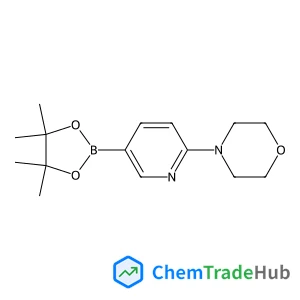
4-(5-(4,4,5,5-tetramethyl-1,3,2-dioxaborolan-2-yl)pyridin-2-yl)morpholine
CAS番号:
485799-04-0
分子式:
C15H23BN2O3
おすすめサプライヤー






免責事項
このページに表示される学術雑誌情報は、参考および研究目的のみを目的としています。当社は雑誌出版社とは提携しておらず、投稿の取り扱いも行っておりません。出版に関するお問い合わせは、各雑誌出版社に直接ご連絡ください。
表示されている情報に誤りがある場合は、support@chemtradehub.com までご連絡ください。迅速に確認し、対応いたします。