












Does Z′ equal 1 or 2? Enhanced powder NMR crystallography verification of a disordered room temperature crystal structure of a p38 inhibitor for chronic obstructive pulmonary disease
文献情報
出版日
2017-06-02
DOI
10.1039/C7CP02349A
インパクトファクター
3.676
著者
Cory M. Widdifield, Sten O. Nilsson Lill, Anders Broo, Maria Lindkvist, Anna Pettersen, Anna Svensk Ankarberg, Peter Aldred, Staffan Schantz, Lyndon Emsley
原文を見る
要旨
The crystal structure of the Form A polymorph of N-cyclopropyl-3-fluoro-4-methyl-5-[3-[[1-[2-[2-(methylamino)ethoxy]phenyl]cyclopropyl]amino]-2-oxo-pyrazin-1-yl]benzamide (i.e., AZD7624), determined using single-crystal X-ray diffraction (scXRD) at 100 K, contains two molecules in the asymmetric unit (Z′ = 2) and has regions of local static disorder. This substance has been in phase IIa drug development trials for the treatment of chronic obstructive pulmonary disease, a disease which affects over 300 million people and contributes to nearly 3 million deaths annually. While attempting to verify the crystal structure using nuclear magnetic resonance crystallography (NMRX), we measured 13C solid-state NMR (SSNMR) spectra at 295 K that appeared consistent with Z′ = 1 rather than Z′ = 2. To understand this surprising observation, we used multinuclear SSNMR (1H, 13C, 15N), gauge-including projector augmented-wave density functional theory (GIPAW DFT) calculations, crystal structure prediction (CSP), and powder XRD (pXRD) to determine the room temperature crystal structure. Due to the large size of AZD7624 (ca. 500 amu, 54 distinct 13C environments for Z′ = 2), static disorder at 100 K, and (as we show) dynamic disorder at ambient temperatures, NMR spectral assignment was a challenge. We introduce a method to enhance confidence in NMR assignments by comparing experimental 13C isotropic chemical shifts against site-specific DFT-calculated shift distributions established using CSP-generated crystal structures. The assignment and room temperature NMRX structure determination process also included measurements of 13C shift tensors and the observation of residual dipolar coupling between 13C and 14N. CSP generated ca. 90 reasonable candidate structures (Z′ = 1 and Z′ = 2), which when coupled with GIPAW DFT results, room temperature pXRD, and the assigned SSNMR data, establish Z′ = 2 at room temperature. We find that the polymorphic Form A of AZD7624 is maintained at room temperature, although dynamic disorder is present on the NMR timescale. Of the CSP-generated structures, 2 are found to be fully consistent with the SSNMR and pXRD data; within this pair, they are found to be structurally very similar (RMSD16 = 0.30 Å). We establish that the CSP structure in best agreement with the NMR data possesses the highest degree of structural similarity with the scXRD-determined structure (RMSD16 = 0.17 Å), and has the lowest DFT-calculated energy amongst all CSP-generated structures with Z′ = 2.
関連文献
Synthesis of functionalized diarylbenzofurans via Ru-catalyzed C–H activation and cyclization under air: rapid access to the polycyclic scaffold of diptoindonesin G
Lufeng Ouyang, Zhigeng Lin, Shiqi Li, Baoyin Chen, Jidan Liu, Wen-Jing Shi, Liyao Zheng
2021-11-04
Research Article
DOI: 10.1039/D1QO01242H
Unexpected cyclization of 2-(2-aminophenyl)indoles with nitroalkenes to furnish indolo[3,2-c]quinolines
Alexander V. Aksenov, Dmitrii A. Aksenov, Nicolai A. Aksenov, Leonid G. Voskressensky
2018-05-22
Paper
DOI: 10.1039/C8OB00588E
Donor–acceptor cyclopropanes as ortho-quinone methide equivalents in formal (4 + 2)-cycloaddition to alkenes
Konstantin L. Ivanov, Stanislav I. Bezzubov, Mikhail Ya. Melnikov, Ekaterina M. Budynina
2018-03-13
Paper
DOI: 10.1039/C8OB00377G
Activation of disulfide bond cleavage triggered by hydrophobization and lipophilization of functionalized dihydroasparagusic acid
Fuyuhiko Inagaki, Miyuki Momose, Naoya Maruyama, Kenkyo Matsuura, Tsukasa Matsunaga, Chisato Mukai
2018-05-24
Paper
DOI: 10.1039/C8OB01055B
Highly regioselective, electrophile induced cyclizations of 2-(prop-1-ynyl)benzamides
Bhavani Shankar Chinta, Harikrishna Sanapa, Kamala Prasad Vasikarla, Beeraiah Baire
2018-04-26
Paper
DOI: 10.1039/C8OB00434J
Ruthenium-catalyzed C–H allylation of arenes with allylic amines
Rui Yan
2018-05-07
Paper
DOI: 10.1039/C8OB00723C
Synthesis of N-indolated amino acids or peptides from 2-alkynylanilines via a dearomatization process
Weilian Qiu, Weiyi Wang, Yin Liu, Renhua Fan
2021-10-07
Research Article
DOI: 10.1039/D1QO01257F
Alkylsulfonium salts for the photochemical desulphurizative functionalization of heteroarenes
Xiaolong Zhu, Xuan Li, Enjie Zhu, Qirong Deng, Xiuyan Song, Jian Lv
2021-11-24
Research Article
DOI: 10.1039/D1QO01570B
Tetra-substituted furans by a gold-catalysed tandem C(sp3)–H alkynylation/oxy-alkynylation reaction
Chunyu Han, Xianhai Tian, Lina Song, Yaowen Liu
2021-10-05
Research Article
DOI: 10.1039/D1QO01401C
こちらもおすすめ
化合物よくある質問
環戊烷-1,3-二甲酸甲酯はどのように合成されますか?
環戊烷-1,3-二甲酸甲酯は、環戊烷と塩酸によるヒンデンブルク反応を経由して合成されます。この反応では、環戊烷が塩酸と作用し、1,3-ジカルボキシ基が導入されま...
2435-36-1Dimethyl 1,3-cyclope...
化合物よくある質問
4-メトキシ-1,2,3-スチアゼ-3,5-ジオンとは何ですか?
4-メトキシ-1,2,3-スチアゼ-3,5-ジオンは、CAS番号107843-77-6の化合物で、(E)-ベンジル3-(3,4-ジヒドロキシフェニル) acry...
107843-77-6(E)-Benzyl 3-(3,4-di...
化合物よくある質問
プロスタグランジンA2について「に適用される法規ガイドラインは何ですか?'
プロスタグランジンA2 (CAS番号: 41691-92-3) は、化学物質の安全管理に関する規制として、GHS (危険物質の国際的ハザード分類・ラベル付けシス...
41691-92-316,16-DIMETHYL PROST...
化合物よくある質問
4-アミノ-1-ナフタレン sulfonic 酸についての物理化学的性質は何ですか?
4-アミノ-1-ナフタレン sulfonic 酸のCAS番号は84-86-6です。この化合物は結晶性で、分子量は212.15 g/molです。アルコールや水など...
84-86-64-Amino-1-naphthalen...
化合物よくある質問
N-GlcNAc-生物素を取り扱う際の実験室安全事項は何ですか?
N-GlcNAc-生物素は吸収性があり、皮膚や目への接触を避けることが重要です。PPE(個体保護具)は使用し、ドラフトチャンバーは必要に応じて使用します。漏洩時...
1272755-69-72-Acetamido-2-deoxy-...
化合物よくある質問
3-アミノメチルフローラノピペリジン-1-カルボニル酸テルブチルエステルとは何ですか?
CAS番号1209781-11-2の3-アミノメチルフローラノピペリジン-1-カルボニル酸テルブチルエステルは、有機化合物の一種で、化学式はC10H17FNO3...
1209781-11-22-Methyl-2-propanyl ...
化合物よくある質問
6-溴-1-甲基-1H-ベンゾ[d][1,2,3]三氮唑はどのように合成されますか?
6- bromo-1-methyl-1H-benzotriazoleは、ブロモフリオリンと1-メチル-1H-ベンゾ[d][1,2,3]三氮唑の反応により合成され...
944718-32-56-Bromo-1-methyl-1H-...
化合物よくある質問
4-硫代尿苷はどのように合成されますか?
4-硫代尿苷は、尿素とD-リボシルヒドロキシアルデヒドを用いてスルホン化反応を経て合成されます。通常は塩酸ヒドロキシチオニルスルホン酸などの触媒を使用し、選択性...
6741-73-71-(4-thio-beta-D-rib...
化合物よくある質問
ブレインナトリユリックペプチド32ラットとは何ですか?
ブレインナトリユリックペプチド32ラット(CAS番号: 133448-20-1)は、心臓で作られるホルモンの一つで、心不全の診断や予後評価に使用されます。
133448-20-1Brain Natriuretic Pe...
化合物よくある質問
1-(3-氮杂啶)-4-羟基哌啶双盐酸盐の物理化学的性質は何ですか?
CAS番号810680-60-5の1-(3-氮杂啶)-4-羟基哌啶双盐酸盐は、白色の結晶性粉末である。分子量は360.84 g/molで、水に溶けやすい。反応活...
810680-60-51-(3-Azetidinyl)-4-p...
掲載誌
Physical Chemistry Chemical Physics

CiteScore:
5.5
自己引用率:
10.3%
年間論文数:
3036
Physical Chemistry Chemical Physics (PCCP) is an international journal co-owned by 19 physical chemistry and physics societies from around the world. This journal publishes original, cutting-edge research in physical chemistry, chemical physics and biophysical chemistry. To be suitable for publication in PCCP, articles must include significant innovation and/or insight into physical chemistry; this is the most important criterion that reviewers and Editors will judge against when evaluating submissions. The journal has a broad scope and welcomes contributions spanning experiment, theory, computation and data science. Topical coverage includes spectroscopy, dynamics, kinetics, statistical mechanics, thermodynamics, electrochemistry, catalysis, surface science, quantum mechanics, quantum computing and machine learning. Interdisciplinary research areas such as polymers and soft matter, materials, nanoscience, energy, surfaces/interfaces, and biophysical chemistry are welcomed if they demonstrate significant innovation and/or insight into physical chemistry. Joined experimental/theoretical studies are particularly appreciated when complementary and based on up-to-date approaches.
おすすめ化合物
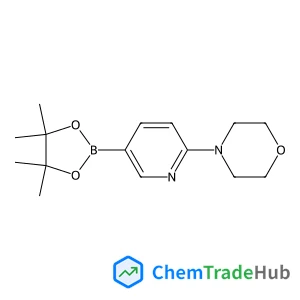
4-(5-(4,4,5,5-tetramethyl-1,3,2-dioxaborolan-2-yl)pyridin-2-yl)morpholine
CAS番号:
485799-04-0
分子式:
C15H23BN2O3
おすすめサプライヤー




免責事項
このページに表示される学術雑誌情報は、参考および研究目的のみを目的としています。当社は雑誌出版社とは提携しておらず、投稿の取り扱いも行っておりません。出版に関するお問い合わせは、各雑誌出版社に直接ご連絡ください。
表示されている情報に誤りがある場合は、support@chemtradehub.com までご連絡ください。迅速に確認し、対応いたします。