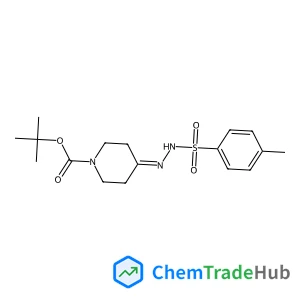
tert-Butyl 4-(2-(p-Tolylsulfonyl)hydrazono)piperidine-1-carboxylate
CAS番号:
1046478-89-0
分子式:
C17H25N3O4S
Chia-Yun Chen, Po-Hsuan Hsiao, Ta-Cheng Wei, Ting-Chen Chen, Chien-Hsin Tang
Recently, silicon (Si) nanowires have been intensively applied for a wide range of optoelectronic applications. Nevertheless, rare explorations considering the photodegradation of organic pollutants based on Si nanowires were performed, and they still require vast improvement, in particular for their degradation efficiency. In this study, broad-band and high efficiency photocatalytic systems were demonstrated through the good incorporation of Si nanowires with highly fluorescent carbon nanodots. The photodegradation rate of these intriguing heterostructure arrays under a 580 nm light illumination is approximately 6 times higher than that of sole Si nanowires, and more than 3.6 and 4.5 times higher than that of Si nanowire incorporated with silver and gold nanoparticles, respectively. Optimizing the luminescent behaviors of carbon nanodots leads to the involvement of multiple light sources that activate the photoexcitation of carriers within the Si nanowires. This feature was further elucidated by examining the corresponding photocurrents under light illumination, which presents currents 1.9 times higher than those with the sole Si nanowires. In combination with excellent wettability with dye solutions, the present heterostructured nanowire arrays have promised the robust photocatalytic capability with retained efficiency after cycling uses, which may open up unique opportunities for future pollutant detoxification and wastewater treatment.

Acta Metallurgica Sinica-English Letters

Journal of Asian Natural Products Research

Main Group Chemistry

Critical Reviews in Solid State and Materials Sciences

Colloid Journal

Polycyclic Aromatic Compounds

Medicinal Chemistry Research

NDT & E International

Biocatalysis and Biotransformation

Heteroatom Chemistry
Irene E. MacAllister, Michael G. Jakoby IV, Bruce Geryk, Roger L. Schneider, Donald M. Cropek
DOI: 10.1039/B802710B
Anees A. Ansari, Renu Singh, G. Sumana, B. D. Malhotra
DOI: 10.1039/B817562D
Arunas Ramanavicius, Almira Ramanaviciene
DOI: 10.1039/B801501E
Brandon Bartling, Lu Li, Chung-Chiun Liu
DOI: 10.1039/B900266A
Zhenyu Lin, Zhihuang Chen, Yan Liu, Jian Wang, Guonan Chen
DOI: 10.1039/B716281B
Rosaria Ciriminna, Mario Pagliaro
DOI: 10.1039/B819417C
Soyab A. Patel, Alan Barnes, Neil Loftus, Rachel Martin, Philip Sloan, Nalin Thakker, Royston Goodacre
DOI: 10.1039/B812533C
6- bromo-1-cyclopropyl-1H-benzimidazoleは、抗炎症、抗ウイルス作用を持つことが報告されており、新薬開発の研究対象として注目...
取り扱う際には、防護眼鏡と手袋を使用し、ドラフトチャンバー内で操作することを推奨します。漏洩時には適切な手順で処理し、安全データシートを常に参照してください。
2,2’-ジメチル-3,3’-ビピリジンは、ピリジンと2-メチルアクリルアミドを有機合成反応で合成します。この反応では、ピリジンと2-メチルアクリルアミドを含有...
6-甲基ピリジン-2-ボリック酸は、合成化学、医薬品合成、以及研究用途などに広く使用され、特に組換えDNA技術や分子生物学の研究において重要な役割を果たします。
(R)-3-(1-甲基-2-氧環己基)プロpano酸メチルは一定の安全性がありますが、直接的な皮膚接触や吸入は避けるべきです。使用する際は適切な個々の安全データ...
ketorolacは、密封して遮光容器に保管し、直射日光や高温を避けて保存してください。温度は常温で保存し、湿度をなるべく低く保つことが推奨されます。
L-2,3-二氨基丙酸二盐酸盐は腐食性が強く、皮膚や粘膜に刺激を与える可能性があります。取り扱う際は、防塵マスク、ゴーグル、手袋を使用し、適切な排気設備を使用し...
2-(4-溴ピリジン-2-基)乙腈のCAS番号は312325-73-8です。主に結晶形態で存在し、分子量は159.01 g/molです。この化合物は水に溶けやす...
この化合物は毒性は低いですが、直接的な接触や吸入に注意が必要です。PPE(個人防護具)を着用し、ドラフトチャンバーを使用して操作することを推奨します。また、漏洩...
3-(1-氧代-1,3-二氢-2H-2-异吲哚)丙酸は、薬理学研究や医薬品製造において広く用いられる化合物です。また、工業的な用途でも一部の化学反応の触媒や助剤...

Physical Chemistry Chemical Physics (PCCP) is an international journal co-owned by 19 physical chemistry and physics societies from around the world. This journal publishes original, cutting-edge research in physical chemistry, chemical physics and biophysical chemistry. To be suitable for publication in PCCP, articles must include significant innovation and/or insight into physical chemistry; this is the most important criterion that reviewers and Editors will judge against when evaluating submissions. The journal has a broad scope and welcomes contributions spanning experiment, theory, computation and data science. Topical coverage includes spectroscopy, dynamics, kinetics, statistical mechanics, thermodynamics, electrochemistry, catalysis, surface science, quantum mechanics, quantum computing and machine learning. Interdisciplinary research areas such as polymers and soft matter, materials, nanoscience, energy, surfaces/interfaces, and biophysical chemistry are welcomed if they demonstrate significant innovation and/or insight into physical chemistry. Joined experimental/theoretical studies are particularly appreciated when complementary and based on up-to-date approaches.