












Understanding iridium oxide nanoparticle surface sites by their interaction with catechol
文献情報
出版日
2017-05-24
DOI
10.1039/C7CP01516J
インパクトファクター
3.676
著者
Maxime Fournier, Dalvin D. Méndez-Hernández, Chengchen Guo, Thomas A. Moore, Ana L. Moore, Devens Gust, Jeffery L. Yarger
原文を見る
要旨
Iridium oxide (IrOx) is one of the best water splitting electrocatalysts, but its active site details are not well known. As with all heterogeneous catalysts, a strategy for counting the number of active sites is not clear, and understanding their nature and structure is remarkably difficult. In this work, we performed a combined study using optical spectroscopy, magnetic resonance and electrochemistry to characterize the interaction of IrOx nanoparticles (NPs) with a probe molecule, catechol. The catalyst is heterogeneous given that the substrate is in a different phase, but behaves as a homogeneous catalyst from the point of view of electrochemistry since it remains in colloidal suspension. We find two types of binding sites: centers A which bind catechol irreversibly making up 21% of the surface, and centers B which bind catechol reversibly making up 79% of the surface. UV-vis absorption spectroscopy shows that the A sites are responsible for the characteristic blue color of the NPs. Electrochemical experiments indicate that the B sites are catalytically active and we give the number of active sites per nanoparticle. We conclude by performing a survey of ligands used in solar cell architectures and show which ones bind well to the surface and which ones inhibit the catalytic activity when doing so, presenting quantitative guidelines for the correct handling of IrOx nanoparticles during their incorporation into multifunctional solar energy harvesting architectures. We suggest ligands binding on the surface oxygen atoms allow for large bound ligand densities with no detrimental effect on the catalytic activity.
関連文献
Imaging mass spectrometry using chemical inkjet printing reveals differential protein expression in human oral squamous cell carcinoma
Soyab A. Patel, Alan Barnes, Neil Loftus, Rachel Martin, Philip Sloan, Nalin Thakker, Royston Goodacre
2008-10-22
Paper
DOI: 10.1039/B812533C
The investigation of photo-induced chemiluminescence on Co2+-doped TiO2nanoparticles and its analytical application
Guixin Li, Hongyan Nan, Xingwang Zheng
2009-03-25
Paper
DOI: 10.1039/B816226C
Electrochemical studies on the oxidation of guanine and adenine at cyclodextrin modified electrodes
Abdolkarim Abbaspour, Abolhassan Noori
2008-09-02
Paper
DOI: 10.1039/B806920D
An electrochemiluminescent biosensor for uric acid based on the electrochemiluminescence of bis-[3,4,6-trichloro-2-(pentyloxycarbonyl)-phenyl] oxalate on an ITO electrode modified by an electropolymerized nickel phthalocyanine film
Zhenyu Lin, Zhihuang Chen, Yan Liu, Jian Wang, Guonan Chen
2008-03-20
Paper
DOI: 10.1039/B716281B
Electronic integrated multisensor tongue applied to grape juice and wine analysis
Lia Moreno i Codinachs, Antoni Baldi, Andrey Ipatov, Andrey Bratov, Cecilia Jiménez-Jorquera
2008-07-25
Paper
DOI: 10.1039/B801228H
Split hybridisation probes for electrochemical typing of single-nucleotide polymorphisms
Fausto Lucarelli, Silvia Capponcelli, Giovanna Marrazza, Luca Sangiorgi, Marco Mascini
2008-10-18
Paper
DOI: 10.1039/B806514D
Multifunctional magnetic bead-based electrochemical immunoassay for the detection ofaflatoxin B1 in food
Dianping Tang, Zhaoyang Zhong, Reinhard Niessner, Dietmar Knopp
2009-05-20
Paper
DOI: 10.1039/B902401H
Multiple sized europium(III) chelate-dyed polystyrene particles as donors in FRET – an application for sensitive protein quantification utilizing competitive adsorption
Antti Valanne, Jouko Peltonen, Tero Soukka, Pekka Hänninen, Harri Härmä
2009-03-02
Paper
DOI: 10.1039/B821210D
Renewable surface fluorescence sandwich immunoassay biosensor for rapid sensitive botulinum toxin detection in an automated fluidic format
Jay W. Grate, Marvin G. Warner, Richard M. Ozanich, Jr., Keith D. Miller, Heather A. Colburn, Brian Dockendorff, Kathryn C. Antolick, Norman C. Anheier Jr., Michael A. Lind, Jianlong Lou, James D. Marks, Cynthia J. Bruckner-Lea
2009-03-05
Paper
DOI: 10.1039/B900794F
こちらもおすすめ
化合物よくある質問
6- bromo-1-cyclopropyl-1H-benzimidazoleの市場動向や研究トレンドはどうですか?
6- bromo-1-cyclopropyl-1H-benzimidazoleは、抗炎症、抗ウイルス作用を持つことが報告されており、新薬開発の研究対象として注目...
1416713-53-56-Bromo-1-cyclopropy...
化合物よくある質問
環氧プロpanol-d5を取り扱う際の実験室安全事項は何ですか?
取り扱う際には、防護眼鏡と手袋を使用し、ドラフトチャンバー内で操作することを推奨します。漏洩時には適切な手順で処理し、安全データシートを常に参照してください。
1246819-20-4Glycidol-d5
化合物よくある質問
2,2’-ジメチル-3,3’-ビピリジンはどのように合成されますか?
2,2’-ジメチル-3,3’-ビピリジンは、ピリジンと2-メチルアクリルアミドを有機合成反応で合成します。この反応では、ピリジンと2-メチルアクリルアミドを含有...
86156-55-02,2’-Dimethyl-3,3’-b...
化合物よくある質問
6-甲基ピリジン-2-ボリック酸の主な用途は何ですか?
6-甲基ピリジン-2-ボリック酸は、合成化学、医薬品合成、以及研究用途などに広く使用され、特に組換えDNA技術や分子生物学の研究において重要な役割を果たします。
372963-50-3(6-Methyl-2-pyridiny...
化合物よくある質問
(R)-3-(1-甲基-2-氧環己基)プロpano酸メチルは安全ですか?
(R)-3-(1-甲基-2-氧環己基)プロpano酸メチルは一定の安全性がありますが、直接的な皮膚接触や吸入は避けるべきです。使用する際は適切な個々の安全データ...
94089-47-1methyl 3-[(1R)-1-met...
化合物よくある質問
ketorolacはどのように保存すればよいですか?
ketorolacは、密封して遮光容器に保管し、直射日光や高温を避けて保存してください。温度は常温で保存し、湿度をなるべく低く保つことが推奨されます。
74103-06-3rac Ketorolac
化合物よくある質問
L-2,3-二氨基丙酸二盐酸盐を取り扱う際の実験室安全事項は何ですか?
L-2,3-二氨基丙酸二盐酸盐は腐食性が強く、皮膚や粘膜に刺激を与える可能性があります。取り扱う際は、防塵マスク、ゴーグル、手袋を使用し、適切な排気設備を使用し...
19777-68-5(S)-2,3-Diaminopropa...
化合物よくある質問
2-(4-溴ピリジン-2-基)乙腈の物理化学的性質は何ですか?
2-(4-溴ピリジン-2-基)乙腈のCAS番号は312325-73-8です。主に結晶形態で存在し、分子量は159.01 g/molです。この化合物は水に溶けやす...
312325-73-8(4-Bromo-2-pyridinyl...
化合物よくある質問
3-フローロ-[1,1-ベンジレン]-3,4-ジカルボン酸を取り扱う際の実験室安全事項は何ですか?
この化合物は毒性は低いですが、直接的な接触や吸入に注意が必要です。PPE(個人防護具)を着用し、ドラフトチャンバーを使用して操作することを推奨します。また、漏洩...
1261915-32-53'-Fluoro-[1,1'-biph...
化合物よくある質問
3-(1-氧代-1,3-二氢-2H-2-异吲哚)丙酸の主な用途は何ですか?
3-(1-氧代-1,3-二氢-2H-2-异吲哚)丙酸は、薬理学研究や医薬品製造において広く用いられる化合物です。また、工業的な用途でも一部の化学反応の触媒や助剤...
83747-30-23-(1-Oxo-1,3-dihydro...
掲載誌
Physical Chemistry Chemical Physics

CiteScore:
5.5
自己引用率:
10.3%
年間論文数:
3036
Physical Chemistry Chemical Physics (PCCP) is an international journal co-owned by 19 physical chemistry and physics societies from around the world. This journal publishes original, cutting-edge research in physical chemistry, chemical physics and biophysical chemistry. To be suitable for publication in PCCP, articles must include significant innovation and/or insight into physical chemistry; this is the most important criterion that reviewers and Editors will judge against when evaluating submissions. The journal has a broad scope and welcomes contributions spanning experiment, theory, computation and data science. Topical coverage includes spectroscopy, dynamics, kinetics, statistical mechanics, thermodynamics, electrochemistry, catalysis, surface science, quantum mechanics, quantum computing and machine learning. Interdisciplinary research areas such as polymers and soft matter, materials, nanoscience, energy, surfaces/interfaces, and biophysical chemistry are welcomed if they demonstrate significant innovation and/or insight into physical chemistry. Joined experimental/theoretical studies are particularly appreciated when complementary and based on up-to-date approaches.
おすすめ化合物
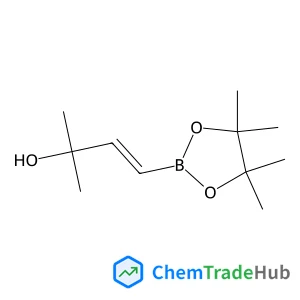
(E)-2-methyl-4-(4,4,5,5-tetramethyl-1,3,2-dioxaborolan-2-yl)but-3-en-2-ol
CAS番号:
581802-26-8
分子式:
C11H21BO3
おすすめサプライヤー



免責事項
このページに表示される学術雑誌情報は、参考および研究目的のみを目的としています。当社は雑誌出版社とは提携しておらず、投稿の取り扱いも行っておりません。出版に関するお問い合わせは、各雑誌出版社に直接ご連絡ください。
表示されている情報に誤りがある場合は、support@chemtradehub.com までご連絡ください。迅速に確認し、対応いたします。