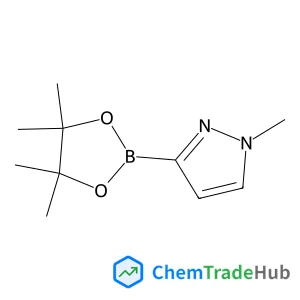
1-Methyl-3-(4,4,5,5-tetramethyl-1,3,2-dioxaborolan-2-yl)-1H-pyrazole
CAS番号:
1020174-04-2
分子式:
C10H17BN2O2
Jing Wan, Likui Yang, Ning Wei, Jiao Shi, Qing-Hua Qin
Due to weak interactions among phosphorus atoms in black phosphorene, a nanotube obtained by curling single-layer black phosphorus is not as stable as a carbon nanotube (CNT) at finite temperature. In the present work, we recommend a new 1D composite material with a double-walled nanotube (DWNT) from a black phosphorus nanotube (BPNT) and a CNT. The dynamic response of the composite DWNTs is simulated using a molecular dynamics approach. Effects of the factors including temperature, slenderness and configurations of DWNTs on dynamic behavior of the composite are discussed. Compared with a single-walled BPNT, the composite DWNTs under uniaxial compression show some unique properties. When a BPNT is embedded in a CNT which will not only isolate the BPNT from the ambient conditions, but also improve the capability of axial deformation of the BPNT, the system will not collapse rapidly even if the BPNT has been buckled.
Iakov Polyak, Eliot Boulanger, Kakali Sen, Walter Thiel
DOI: 10.1039/C3CP51669E
Li-Lin Tan, Hong-Yan Chen, Li-Feng Hao, Yong Shen, Li-Min Xiao, Jun-Min Liu, Dai-Bin Kuang, Cheng-Yong Su
DOI: 10.1039/C3CP51633D
Diana Paiva, Galya Ivanova, Maria do Carmo Pereira, Sandra Rocha
DOI: 10.1039/C3CP51215K
G. Ramos-Sanchez, P. B. Balbuena
DOI: 10.1039/C3CP51791H
Rita Nissim, Richard G. Compton
DOI: 10.1039/C3CP51732B
Jhenny F. Galan, Chi Ngong Tang, Shubhashis Chakrabarty, Zhiwei Liu, Vojislava Pophristic
DOI: 10.1039/C3CP50353D
Daniel R. Albert, H. Floyd Davis
DOI: 10.1039/C3CP51930A
Pyosang Kim, Sujin Ham, Juwon Oh, Hiroki Uoyama, Hajime Watanabe, Kazunari Tagawa, Hidemitsu Uno, Dongho Kim
DOI: 10.1039/C3CP50166C
Zhenhuan Lu, Xin Zhang, Chuanlang Zhan, Bo Jiang, Xinliang Zhang, Lili Chen, Jiannian Yao
DOI: 10.1039/C3CP51475G
2-メトキシ-4-(メチルスルフィニル)アミンは、主に医薬品および農薬の製造に使用されます。また、合成化学の一部として研究用材料としても利用されます。
代替品としては、4,6-二クロロピラミジンアミンや他のピラミジン系化合物が考えられます。ただし、目的と用途によって最適な代替品は異なります。
6-氯-4-甲基-1H-吲哚の廃棄物は、適切な容器に収集し、密閉して保管します。温度は常温、湿度は低く、直射日光を避けて保管することを推奨します。廃棄処理は専門...
2-フローユロ-4-(トリフルオロメチル)ベンゾイドのCAS番号は207974-08-1です。この化合物はGHS分類で毒性物質と有害な反応物質として分類されます...
4-ニトロフェニルN-[(ベンゼルオキシルカーボンイル]グリシングリシングリシン酸は、室温で暗所に保管し、乾燥した環境で保存することを推奨します。容器は密閉性の...
イソデスロラタドリンの代替品としては、デスロラタドリンや他の抗ヒスタミン薬が挙げられます。具体的には、デスロラタドリン、ラセカミド、フェルタドリンなどが、症状や...
5-甲氧基-1,2,3,4-四氢异喹啉盐酸盐の一般的な合成方法は、メタノール中で5-メトキシ-1,2,3,4-四ヒュドロイソキシンを塩酸で塩化します。この反応で...
CAS番号6471-78-9の4-アミノ-5-メトキシ-2-トルエンサルホニック酸は、GHS分類では corrosive(腐食性)と識別されます。EUのREAC...
甲基孕酮の取り扱いは、PPE(個人保護具)の使用が必要な重要な安全事項を伴います。防塵マスク、ゴーグル、手袋を着用することが推奨されます。ドラフトチャンバーを使...

Physical Chemistry Chemical Physics (PCCP) is an international journal co-owned by 19 physical chemistry and physics societies from around the world. This journal publishes original, cutting-edge research in physical chemistry, chemical physics and biophysical chemistry. To be suitable for publication in PCCP, articles must include significant innovation and/or insight into physical chemistry; this is the most important criterion that reviewers and Editors will judge against when evaluating submissions. The journal has a broad scope and welcomes contributions spanning experiment, theory, computation and data science. Topical coverage includes spectroscopy, dynamics, kinetics, statistical mechanics, thermodynamics, electrochemistry, catalysis, surface science, quantum mechanics, quantum computing and machine learning. Interdisciplinary research areas such as polymers and soft matter, materials, nanoscience, energy, surfaces/interfaces, and biophysical chemistry are welcomed if they demonstrate significant innovation and/or insight into physical chemistry. Joined experimental/theoretical studies are particularly appreciated when complementary and based on up-to-date approaches.