












Oxidative annulations triggered by a simple Lewis acid: facile synthesis of benzofurans
文献情報
出版日
2017-02-08
DOI
10.1039/C6QO00531D
インパクトファクター
5.281
著者
Chinnabattigalla Sreenivasulu, A. Gopi Krishna Reddy, G. Satyanarayana
原文を見る
要旨
The first example of Lewis acid promoted efficient one-pot synthesis of benzofurans is presented. Unlike previous reports on oxidative annulations between phenols and internal acetylenes, a simple and highly facile Lewis acid mediated protocol is presented. The Lewis acid (ZnCl2) played a crucial role to promote dual (C–H and O–H) bond formation, presumably via a six-membered cyclic transition state. Significantly, a variety of benzofurans were accomplished with symmetrical/unsymmetrical acetylenes.
関連文献
Basic photophysical analysis of a thermally activated delayed fluorescence copper(i) complex in the solid state: theoretical estimations from a polarizable continuum model (PCM)-tuned range-separated density functional approach
Lingling Lv, Kun Yuan, Yongcheng Wang
2018-02-02
Paper
DOI: 10.1039/C7CP08264A
A molecular dynamics study of the complete binding process of meropenem to New Delhi metallo-β-lactamase 1
Juan Duan, Chuncai Hu, Jiafan Guo, Lianxian Guo, Jia Sun, Zuguo Zhao
2018-02-14
Paper
DOI: 10.1039/C7CP07459J
Phenyl radical + propene: a prototypical reaction surface for aromatic-catalyzed 1,2-hydrogen-migration and subsequent resonance-stabilized radical formation
Zachary J. Buras, Te-Chun Chu, Adeel Jamal, Nathan W. Yee, Joshua E. Middaugh, William H. Green
2018-04-13
Paper
DOI: 10.1039/C8CP01159A
Conformational preferences and isomerization upon excitation/ionization of 2-methoxypyridine and 2-N-methylaminopyridine
Min Cheng, Yikui Du, Qihe Zhu
2018-01-24
Paper
DOI: 10.1039/C7CP07854D
Influence of the hydrogen-bond interactions on the excited-state dynamics of a push–pull azobenzene dye: the case of Methyl Orange
Christoph Nançoz, Giuseppe Licari, Joseph S. Beckwith, Magnus Soederberg, Bogdan Dereka, Arnulf Rosspeintner, Oleksandr Yushchenko, Romain Letrun, Sabine Richert, Bernhard Lang, Eric Vauthey
2018-02-15
Paper
DOI: 10.1039/C7CP08390D
Calculation of linear and nonlinear optical properties of azobenzene derivatives with Kohn–Sham and coupled-cluster methods
Arun K. Pal, Thomas J. Duignan, Jochen Autschbach
2018-02-06
Paper
DOI: 10.1039/C7CP08655E
Open flow non-enzymatic template catalysis and replication
Larwsk H. Gonçalves da Silva, David Hochberg
2018-05-11
Paper
DOI: 10.1039/C8CP01828F
Associative detachment (AD) paths for H and CN− in the gas-phase: astrophysical implications
Stanka V. Jerosimić, Franco A. Gianturco, Roland Wester
2017-10-17
Paper
DOI: 10.1039/C7CP05573K
The reactivity of cyclopropyl cyanide in titan's atmosphere: a possible pre-biotic mechanism
E. López, D. Ascenzi, P. Tosi, J. M. Bofill, J. de Andrés, M. Albertí, J. M. Lucas, A. Aguilar
2018-01-23
Paper
DOI: 10.1039/C7CP06911A
こちらもおすすめ
化合物よくある質問
4-アミノフェノール酸ナトリウム水和物とは何ですか?
4-アミノフェノール酸ナトリウム水和物は、CAS番号206557-08-6の化合物で、4-アミノフェノールとナトリウムが結合した塩と水和物です。この化合物は、白...
206557-08-64-Aminobenzoic acid ...
化合物よくある質問
Methyl 3-methyl-N-{[(2-methyl-2-propanyl)oxy]carbonyl}-L-histidinateの代替品はありますか?
この化合物は特定の合成プロセスに使用される可能性がありますが、代替品として、他の类似的な化合物、例えばMethyl 3-methyl-N-{[(2-methyl...
72212-51-2Methyl 3-methyl-N-{[...
化合物よくある質問
4-Boc-2-哌嗪甲酸の市場動向や研究トレンドはどうですか?
4-Boc-2-哌嗪甲酸は、薬品開発や合成化学分野で広く使用されており、その需要は継続的に推移しています。特に、新薬開発における合成化学分野での需要が高まってい...
192330-11-3(2R)-4-[(tert-butoxy...
化合物よくある質問
4,4'-二羟甲基联苯の物理化学的性質は何ですか?
4,4'-二羟甲基联苯のCAS番号は1667-12-5です。この化合物は白色の結晶粉末で、分子量は154.20です。水にわずかに溶けますが、アルコールや有機溶媒...
1667-12-54,4'-Biphenyldiyldim...
化合物よくある質問
5-甲硫基戊腈はどの業界で使用されていますか?
5-甲硫基戊腈は医薬品産業で使用される可能性があります。また、ポリマー合成の触媒として、センサー製造の一部として、半導体製造のプロセス改善に使用される可能性があ...
59121-25-45-(Methylsulfanyl)pe...
化合物よくある質問
CAS番号1311961-50-8の化合物はどのように合成されますか?
この化合物は、1-abieta-8,11,13-trien-19-イルと6'-メトキシシンコナナン-9-基を含有する窒素含有化合物から合成されます。一般的な合成...
1311961-50-81-Abieta-8,11,13-tri...
化合物よくある質問
6-ブロモベンジジミダゾール-2-カルビルデオキシドはどのように保存すればよいですか?
6-ブロモベンジジミダゾール-2-カルビルデオキシドは、避光・乾燥した容器(密閉容器)で-20℃~4℃の低温で保存してください。高温や直射日光、湿気は避けてくだ...
885280-26-25-Bromo-1H-benzimida...
化合物よくある質問
Boc-N-甲基氨甲环酸とは何ですか?
621-65-8のCAS番号を持つBoc-N-甲基氨甲环酸は、化学式C7H13NO5を有する化合物です。この化合物は白色の結晶性粉末で、吸湿性があります。
621-65-83-Hydroxy-1,2-propan...
化合物よくある質問
乙基三氟硼酸钾はどのように合成されますか?
乙基三氟硼酸钾は、トリフLUオール酸カリウムとエチルブロミドを反応させて合成されます。この反応は高い選択性と収率を持ち、触媒を用いることで効率的に進行します。
882871-21-8Potassium ethyltrifl...
化合物よくある質問
2-フロウロ-5-クロロ-4-アミノフェノールはどのように保存すればよいですか?
2-フロウロ-5-クロロ-4-アミノフェノールは、直射日光を避けて冷却された暗所で保存し、密閉容器に保管してください。温度は常温か低温が適しています。
847872-10-04-Amino-5-chloro-2-f...
掲載誌
Organic Chemistry Frontiers

CiteScore:
7.8
自己引用率:
8.7%
年間論文数:
724
Organic Chemistry Frontiers publishes high-quality research from across organic chemistry. Emphases are placed on studies that make significant contributions to the field of organic chemistry by reporting either new or significantly improved protocols or methodologies. Topics include, but are not limited to the following: Organic synthesis Development of synthetic methodologies Catalysis Natural products Functional organic materials Supramolecular and macromolecular chemistry Physical and computational organic chemistry
おすすめ化合物
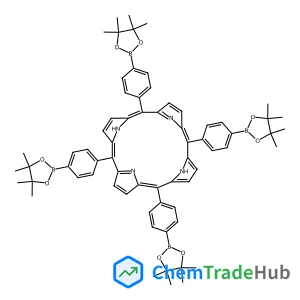
5,10,15,20-tetrakis(4-boronic acid pinacol ester phenyl) porphyrin
CAS番号:
1332748-00-1
分子式:
C68H74B4N4O8
![[3-(2,6-Dichlorophenyl)-5-isopropyl-1,2-oxazol-4-yl]methanol structure](https://static.chemtradehub.com/structs/278/278597-30-1-5c79.webp "[3-(2,6-Dichlorophenyl)-5-isopropyl-1,2-oxazol-4-yl]methanol structure")
おすすめサプライヤー






免責事項
このページに表示される学術雑誌情報は、参考および研究目的のみを目的としています。当社は雑誌出版社とは提携しておらず、投稿の取り扱いも行っておりません。出版に関するお問い合わせは、各雑誌出版社に直接ご連絡ください。
表示されている情報に誤りがある場合は、support@chemtradehub.com までご連絡ください。迅速に確認し、対応いたします。