












Pushing the limit for the grid-based treatment of Schrödinger's equation: a sparse Numerov approach for one, two and three dimensional quantum problems
文献情報
出版日
2016-10-20
DOI
10.1039/C6CP06698D
インパクトファクター
3.676
著者
Ulrich Kuenzer, Jan-Andrè Sorarù, Thomas S. Hofer
原文を見る
要旨
The general Numerov method employed to numerically solve ordinary differential equations of second order was adapted with a special focus on solving Schrödinger's equation. By formulating a hierarchy of novel stencil expressions for the numerical treatment of the Laplace operator in one, two and three dimensions the method could not only be simplified over the standard Numerov scheme. The improved framework enables the natural use of matrix sparsity to reduce the memory demand and the associated computing time, thus enabling the application of the method to larger problems. The performance of the adapted method is demonstrated using exemplary harmonic and Morse problems in one and two dimensions. Furthermore, the vibrational frequencies of molecular hydrogen and water are calculated, inherently considering the influence of anharmonicity, mode–mode coupling and nuclear quantum effects. The estimation of the tunneling splitting in malonaldehyde serves as an example for a two-dimensional problem.
関連文献
Bifunctional Ce1−xEuxO2 (0 ≤ x ≤ 0.3) nanoparticles for photoluminescence and photocatalyst applications: an X-ray absorption spectroscopy study
Aditya Sharma, Mayora Varshney, Jaehun Park, Tae Kyun Ha, Keun Hwa Chae, Hyun Joon Shin
2015-10-19
Paper
DOI: 10.1039/C5CP05251C
Ionogel based on biopolymer–silica interpenetrated networks: dynamics of confined ionic liquid with lithium salt
Carole V. Cerclier, Jean-Marc Zanotti, Jean Le Bideau
2015-10-13
Paper
DOI: 10.1039/C5CP04889C
Geometry controlled anomalous diffusion in random fractal geometries: looking beyond the infinite cluster
2015-10-07
Paper
DOI: 10.1039/C5CP03548A
The making of ring currents
Guglielmo Monaco, Riccardo Zanasi
2016-01-11
Paper
DOI: 10.1039/C5CP07250F
Theoretical evidence of charge transfer interaction between SO2 and deep eutectic solvents formed by choline chloride and glycerol
Hongping Li, Yonghui Chang, Wenshuai Zhu, Changwei Wang, Chao Wang, Sheng Yin, Ming Zhang
2015-09-22
Paper
DOI: 10.1039/C5CP04172D
Theoretical demonstration of the potentiality of boron nitride nanotubes to encapsulate anticancer molecule
Mohammed El Khalifi, Eric Duverger, Tijani Gharbi, Hatem Boulahdour, Fabien Picaud
2015-10-19
Paper
DOI: 10.1039/C5CP05148G
Roles of the scalar and vector components of the solvation effects on the vibrational properties of hydrogen- or halogen-bond accepting stretching modes
Saori Noge
2016-03-09
Paper
DOI: 10.1039/C5CP08008H
Improvement of the electron collection efficiency in porous hematite using a thin iron oxide underlayer: towards efficient all-iron based photoelectrodes
Nicola Dalle Carbonare, Stefano Carli, Roberto Argazzi, Michele Orlandi, Nicola Bazzanella, Antonio Miotello, Stefano Caramori, Carlo A. Bignozzi
2015-10-19
Paper
DOI: 10.1039/C5CP04152J
Stable n-type doping of graphene via high-molecular-weight ethylene amines
Insu Jo, Joonhee Moon, Subeom Park, Jin San Moon, Won Bae Park, Jeong Soo Lee, Byung Hee Hong
2015-10-13
Communication
DOI: 10.1039/C5CP03196F
Particularly strong C–H⋯π interactions between benzene and all-cis 1,2,3,4,5,6-hexafluorocyclohexane
Neil S. Keddie, Roberto Rittner, David O'Hagan, Michael Bühl
2015-10-21
Communication
DOI: 10.1039/C5CP04537A
こちらもおすすめ
化合物よくある質問
カルボニル基が付いた5-氰基-1-{[(2-メチル-2-プロpanyl)オキシ]カーボンイル}1H-吲哚-2-イリド-2-ボリン酸はどのように保存すればよいですか?
カルボニル基が付いた5-氰基-1-{[(2-メチル-2-プロpanyl)オキシ]カーボンイル}1H-吲哚-2-イリド-2-ボリン酸は、直射日光を避けて室温(15...
475102-15-9(5-Cyano-1-{[(2-meth...
化合物よくある質問
tert-ブチル2-クロロメチルピリジン-3-基炭酸エステルの市場動向や研究トレンドはどうですか?
この化合物は合成化学分野において、特にピリジン化合物の合成や改良に用いられます。最近の研究では、ピリジン化合物の新規合成法や特性の改良が注目されています。市場動...
1203498-98-9tert-Butyl 2-chloro-...
化合物よくある質問
聚二季戊四醇六丙烯酸酯はどの業界で使用されていますか?
聚二季戊四醇六丙烯酸酯は、医薬品、ポリマー、センサー、半導体などの業界で広く使用されています。特にポリマー業界では硬化剤として、医薬分野では医療機器の製造に使用...
29570-58-93-(Acryloyloxy)-2-({...
化合物よくある質問
1-氯-5-硝基异喹啉の市場動向や研究トレンドはどうですか?
1-氯-5-硝基异喹啉は、薬理学や合成化学の研究分野で注目されています。市場動向としては、その生物学的な活性や合成可能性を評価する研究が増えています。また、代替...
58142-97-51-Chloro-5-nitroisoq...
化合物よくある質問
2-チロール-5-メチルスルフェニル-3-trifルオルメチルベンゼンはどのように合成されますか?
2-チロール-5-メチルスルフェニル-3-trifルオルメチルベンゼンは、トリフルオロメチル化反応と硫化反応を経て合成されます。通常、トリフルオロメチル化剤と硫...
957066-04-51-Chloro-4-(methylsu...
化合物よくある質問
p-トールイルマグネシウムブロミドの物理化学的性質は何ですか?
p-トールイルマグネシウムブロミドのCAS番号は4294-57-9です。この化合物は白色の結晶性粉末で、分子量は204.32です。溶剤中で良好に溶解しますが、水...
4294-57-9p-Tolylmagnesium bro...
化合物よくある質問
1-(5-甲基-2-硫化素基)プロパン-1-酮の市場動向や研究トレンドはどうですか?
1-(5-甲基-2-硫化素基)プロパン-1-酮の市場動向は、化学産業全体の需要に影響を受けますが、最近では pharmaceutical 分野での応用が注目され...
59303-13-81-(5-Methyl-2-thieny...
化合物よくある質問
十一碳烯酰甘氨酸を取り扱う際の実験室安全事項は何ですか?
十一碳烯酰甘氨酸は吸入や皮膚から吸収されることがあり、取り扱う際には防塵マスクと手袋を使用してください。ドラフトチャンバーを用いて漏洩を処理し、適切なSDS(S...
54301-26-7N-10-Undecenoylglyci...
化合物よくある質問
1H,1H-全氟-3,6-二氧杂葵-1-醇を取り扱う際の実験室安全事項は何ですか?
この化合物は吸入や皮膚吸収による毒性があるため、防塵マスク、ゴーグル、防護手袋を使用する必要があります。ドラフトチャンバーでの操作が必要です。漏洩時には即座に換...
152914-73-32,2-Difluoro-2-[1,1,...
化合物よくある質問
3-(4-(フルオロメチルオキシ)フェニル)-1,2,4-オキサジアゾール-5-カルボハイドライドは安全ですか?
安全性は化合物の使用方法によります。直接的な毒性は報告されていませんが、吸入や皮膚接触には注意が必要です。適切な防護服を着用し、換気を図ることを推奨します。
883028-82-83-(4-(Trifluorometho...
掲載誌
Physical Chemistry Chemical Physics

CiteScore:
5.5
自己引用率:
10.3%
年間論文数:
3036
Physical Chemistry Chemical Physics (PCCP) is an international journal co-owned by 19 physical chemistry and physics societies from around the world. This journal publishes original, cutting-edge research in physical chemistry, chemical physics and biophysical chemistry. To be suitable for publication in PCCP, articles must include significant innovation and/or insight into physical chemistry; this is the most important criterion that reviewers and Editors will judge against when evaluating submissions. The journal has a broad scope and welcomes contributions spanning experiment, theory, computation and data science. Topical coverage includes spectroscopy, dynamics, kinetics, statistical mechanics, thermodynamics, electrochemistry, catalysis, surface science, quantum mechanics, quantum computing and machine learning. Interdisciplinary research areas such as polymers and soft matter, materials, nanoscience, energy, surfaces/interfaces, and biophysical chemistry are welcomed if they demonstrate significant innovation and/or insight into physical chemistry. Joined experimental/theoretical studies are particularly appreciated when complementary and based on up-to-date approaches.
おすすめ化合物



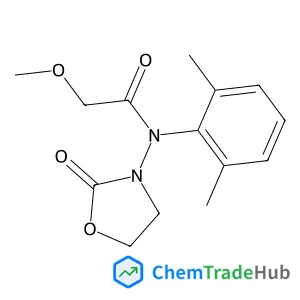
N-(2,6-Dimethylphenyl)-2-methoxy-N-(2-oxo-1,3-oxazolidin-3-yl)acetamide
CAS番号:
77732-09-3
分子式:
C14H18N2O4
おすすめサプライヤー



免責事項
このページに表示される学術雑誌情報は、参考および研究目的のみを目的としています。当社は雑誌出版社とは提携しておらず、投稿の取り扱いも行っておりません。出版に関するお問い合わせは、各雑誌出版社に直接ご連絡ください。
表示されている情報に誤りがある場合は、support@chemtradehub.com までご連絡ください。迅速に確認し、対応いたします。