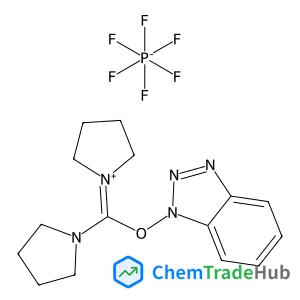
(1H-Benzotriazol-1-yloxy)(di-1-pyrrolidinyl)methylium hexafluorophosphate
CAS番号:
105379-24-6
分子式:
C15H21F6N5OP
Ana Rita R. Teles, Teresa B. V. Dinis, Emanuel V. Capela, Luís M. N. B. F. Santos, Simão P. Pinho, Mara G. Freire, João A. P. Coutinho
Herein, solubility experimental data for six monosaccharides, viz.D-(+)-glucose, D-(+)-mannose, D-(−)-fructose, D-(+)-galactose, D-(+)-xylose and L-(+)-arabinose, in four ionic liquids (ILs), at temperatures ranging from 288.2 to 348.2 K, were obtained aimed at gathering a better understanding of their solvation ability and molecular-level mechanisms which rule the dissolution process. To ascertain the chemical features that enhance the solubility of monosaccharides, ILs composed of dialkylimidazolium or tetraalkylphosphonium cations combined with the dicyanamide, dimethylphosphate or chloride anions were investigated. It was found that the ranking of the solubility of monosaccharides depends on the IL; yet, D-(+)-xylose is always the most soluble while D-(−)-fructose is the least soluble monosaccharide. The results obtained show that both the IL cation and the anion play a major role in the solubility of monosaccharides. Finally, from the determination of the respective thermodynamic properties of solution, it was found that enthalpic contributions are dominant in the solubilization process. However, the observed differences in the solubilities of monosaccharides in 1-butyl-3-methylimidazolium dicyanamide are ruled by a change in the entropy of solution.
Peter Sebald, Rainer Oswald, Peter Botschwina, Kentarou Kawaguchi
DOI: 10.1039/C3CP44236E
Pierre Terech, Minhao Yan, Manuel Maréchal, Guy Royal, Jose Galvez, Sabareesh K. P. Velu
DOI: 10.1039/C3CP50671A
Venkata Bharat Ram Boppana, Feng Jiao, Dave Newby, Jr., Jude Laverock, Kevin E. Smith, Jean Claude Jumas, Greg Hutchings, Raul F. Lobo
DOI: 10.1039/C3CP44635B
Deepansh Srivastava, R. Venkata SubbaRao, Ramesh Ramachandran
DOI: 10.1039/C3CP44296A
Bethany R. Lettiere, Gareth Seward, Nisha Verma, Yichi Zhang
DOI: 10.1039/C3CP50918D
Ji Chen, Qianfan Zhang, Angelos Michaelides, Enge Wang
DOI: 10.1039/C3CP50218J
Dominik Oschetzki, Xiaoqing Zeng, Helmut Beckers, Klaus Banert, Guntram Rauhut
DOI: 10.1039/C3CP50268F
Jens Reinisch, Frank Eckert, Jérôme Graton, Jean-Yves Le Questel
DOI: 10.1039/C3CP44611E
Stephan Menzel, Stefan Tappertzhofen, Ilia Valov
DOI: 10.1039/C3CP50738F
Dong Myung Jang, Hyung Soon Im, Yoon Myung, Yong Jae Cho, Han Sung Kim, Seung Hyuk Back, Jeunghee Park, Eun Hee Cha, Minyung Lee
DOI: 10.1039/C3CP50769F
2-溴-9,9-二苯基芴は、医薬品、工業材料、有機合成の研究分野で応用されます。特に、レーザー材料や機能性ポリマーの合成に使用されることがあります。また、蛍光色...
四氯化铱の市場は研究開発分野で注目されており、特にナノ技術や金属有機框架(MOFs)の分野での需要が増加傾向にあります。価格は安定しており、中国や韓国での生産が...
1-(4-溴-3-氟苯基)-2-氯乙酮 (CAS番号: 1260857-14-4) の廃棄物は専門的な廃棄処理が必要です。まず、廃棄物は密閉された容器に収集し、...
苦参酚Kは、CAS番号101236-49-1を持つ化合物で、主に天然由来の生薬から抽出されます。この化合物は、抗炎症作用や抗癌作用を持つことが報告されています。
POTASSIUM (1-(TERTBUTOXYCARBONYL)AZETIDIN-3-YL)TRIFLUOROBORATE を含む廃棄物は、まず安全なエント...
4-庚基-4’-聯苯羧酸は、特殊化学品や合成化学の分野で用いられる化学物質ですが、市場動向としては、研究開発の進展とともに需要が増加しています。また、環境配慮型...
6-ブロモ-3-メトキシ-1-フェニル-1H-インドゾールを含む廃棄物は、適切な化学廃棄処理が必要です。通常、廃棄物は密閉容器に収集され、専門の廃棄処理業者に引...
4,4-二甲基-2-吡咯烷酮は医薬、ポリマー、センサー、半導体などの業界で広く使用されています。特に溶媒としての性能が高く評価されています。

Physical Chemistry Chemical Physics (PCCP) is an international journal co-owned by 19 physical chemistry and physics societies from around the world. This journal publishes original, cutting-edge research in physical chemistry, chemical physics and biophysical chemistry. To be suitable for publication in PCCP, articles must include significant innovation and/or insight into physical chemistry; this is the most important criterion that reviewers and Editors will judge against when evaluating submissions. The journal has a broad scope and welcomes contributions spanning experiment, theory, computation and data science. Topical coverage includes spectroscopy, dynamics, kinetics, statistical mechanics, thermodynamics, electrochemistry, catalysis, surface science, quantum mechanics, quantum computing and machine learning. Interdisciplinary research areas such as polymers and soft matter, materials, nanoscience, energy, surfaces/interfaces, and biophysical chemistry are welcomed if they demonstrate significant innovation and/or insight into physical chemistry. Joined experimental/theoretical studies are particularly appreciated when complementary and based on up-to-date approaches.
![5-Acetyl-2,3-dihydrobenzo[b]furan structure](https://static.chemtradehub.com/structs/908/90843-31-5-eea4.webp "5-Acetyl-2,3-dihydrobenzo[b]furan structure")