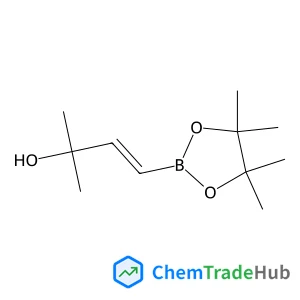
(E)-2-methyl-4-(4,4,5,5-tetramethyl-1,3,2-dioxaborolan-2-yl)but-3-en-2-ol
CAS番号:
581802-26-8
分子式:
C11H21BO3
Alberto Baggioli, Carlo A. Cavallotti, Antonino Famulari
From proteins and peptides to semiconducting polymers, aliphatic chains on aromatic groups are recurring motifs in macromolecules from very diverse application fields. Fields in which molecular folding and packing determine the macroscopic physical properties that make such advanced materials appealing in the first place. Within each macromolecule, the intrinsic structure of each unit defines how it interacts with its neighbours, ultimately opening up or denying certain backbone conformations. This eventually also determines how macromolecules interact with each other. This account deals specifically with the conformational problem of many common alkylaromatic units, examining the features of an intramolecular interaction involving a side chain with as few as three methylene groups. A set of 23 model compounds featuring an intramolecular interaction between an aliphatic X–H (X = C, N, O, and S) bond and an aromatic ring was considered. Quantitative computational analysis was made possible, thanks to complete basis set extrapolated CCSD(T) calculations and NCI topological analysis, the latter of which revealed an elaborate network of dispersive and steric interactions leading to somewhat unintuitive and unexpected results, such as the higher energetic stability of certain twisted conformational isomers over those with extended side chains. Vicinal covalent effects from polarizing groups and various heteroatoms, along with the occurrence of non-dispersive phenomena, were also investigated. The conclusions drawn from the investigation include a comprehensive set of guidelines intended to aid in the prediction of the most stable conformation for this class of building blocks. Our findings affect a variety of different research fields, including the tailoring of functional materials for organic electronics and photovoltaics, with insights into a rational treatment of conformational disorder, and the study of protein- and peptide-folding preferences, putting an emphasis on peculiar interactions between the backbone and aromatic residues.
Luiz Fernando Lepre, Laure Pison, Ines Otero, Arnaud Gautier, Julien Dévemy, Pascale Husson, Agilio A. H. Pádua, Margarida Costa Gomes
DOI: 10.1039/C9CP00593E
Philipp Honegger, Othmar Steinhauser
DOI: 10.1039/C9CP00053D
Olaf W. Morawski, Andrzej L. Sobolewski, Daniel T. Gryko
DOI: 10.1039/C9CP00978G
Yi Luo, Sake Wang, Kai Ren, Jyh-Pin Chou, Jin Yu, Zhengming Sun, Minglei Sun
DOI: 10.1039/C8CP06960C
Ting Wang, Guangtao Yu, Jingwei Liu, Xuri Huang, Wei Chen
DOI: 10.1039/C8CP06011H
Prateek Goel, Xiao-Gang Wang, Bo Chen, Xue-Bin Wang, Tao Zeng
DOI: 10.1039/C9CP01352K
He Dong, P. Hu
DOI: 10.1039/C8CP07806H
Amir A. Farajian, Reza Mortezaee, Tim H. Osborn, Olga V. Pupysheva, Michael Wang, Aruna Zhamu, Bor Z. Jang
DOI: 10.1039/C8CP07115B
Xue Yin, Xiao-Yong Lai, Xin Wang, Ying-Tao Liu
DOI: 10.1039/C9CP00512A
Jacek Wójcik, Andrzej Ejchart, Michał Nowakowski
DOI: 10.1039/C9CP00590K
6- bromo-1-cyclopropyl-1H-benzimidazoleは、抗炎症、抗ウイルス作用を持つことが報告されており、新薬開発の研究対象として注目...
取り扱う際には、防護眼鏡と手袋を使用し、ドラフトチャンバー内で操作することを推奨します。漏洩時には適切な手順で処理し、安全データシートを常に参照してください。
2,2’-ジメチル-3,3’-ビピリジンは、ピリジンと2-メチルアクリルアミドを有機合成反応で合成します。この反応では、ピリジンと2-メチルアクリルアミドを含有...
6-甲基ピリジン-2-ボリック酸は、合成化学、医薬品合成、以及研究用途などに広く使用され、特に組換えDNA技術や分子生物学の研究において重要な役割を果たします。
(R)-3-(1-甲基-2-氧環己基)プロpano酸メチルは一定の安全性がありますが、直接的な皮膚接触や吸入は避けるべきです。使用する際は適切な個々の安全データ...
ketorolacは、密封して遮光容器に保管し、直射日光や高温を避けて保存してください。温度は常温で保存し、湿度をなるべく低く保つことが推奨されます。
L-2,3-二氨基丙酸二盐酸盐は腐食性が強く、皮膚や粘膜に刺激を与える可能性があります。取り扱う際は、防塵マスク、ゴーグル、手袋を使用し、適切な排気設備を使用し...
2-(4-溴ピリジン-2-基)乙腈のCAS番号は312325-73-8です。主に結晶形態で存在し、分子量は159.01 g/molです。この化合物は水に溶けやす...
この化合物は毒性は低いですが、直接的な接触や吸入に注意が必要です。PPE(個人防護具)を着用し、ドラフトチャンバーを使用して操作することを推奨します。また、漏洩...
3-(1-氧代-1,3-二氢-2H-2-异吲哚)丙酸は、薬理学研究や医薬品製造において広く用いられる化合物です。また、工業的な用途でも一部の化学反応の触媒や助剤...

Physical Chemistry Chemical Physics (PCCP) is an international journal co-owned by 19 physical chemistry and physics societies from around the world. This journal publishes original, cutting-edge research in physical chemistry, chemical physics and biophysical chemistry. To be suitable for publication in PCCP, articles must include significant innovation and/or insight into physical chemistry; this is the most important criterion that reviewers and Editors will judge against when evaluating submissions. The journal has a broad scope and welcomes contributions spanning experiment, theory, computation and data science. Topical coverage includes spectroscopy, dynamics, kinetics, statistical mechanics, thermodynamics, electrochemistry, catalysis, surface science, quantum mechanics, quantum computing and machine learning. Interdisciplinary research areas such as polymers and soft matter, materials, nanoscience, energy, surfaces/interfaces, and biophysical chemistry are welcomed if they demonstrate significant innovation and/or insight into physical chemistry. Joined experimental/theoretical studies are particularly appreciated when complementary and based on up-to-date approaches.