












Formation of a thermally stable bilayer of coadsorbed intact and deprotonated thymine exploiting the surface corrugation of rutile TiO2(110)
文献情報
出版日
2016-07-05
DOI
10.1039/C6CP02541B
インパクトファクター
3.676
著者
J. H. K. Pfisterer, P. S. Deimel, R. G. Acres, M. Fritton, P. Feulner, J. V. Barth, F. Allegretti
原文を見る
要旨
The adsorption of thymine, a pyrimidine based nucleobase, was studied on the (110) termination of rutile titanium dioxide in order to understand the thermal stability and gross structural parameters of the interaction between a strongly polar adsorbate and a highly corrugated transition metal oxide surface. Near-edge X-ray absorption fine structure (NEXAFS), X-ray photoelectron spectroscopy (XPS), temperature programmed XPS and temperature programmed desorption indicated the growth of a room temperature stable bilayer, which could only be removed by annealing to 450 K. The remaining first layer was remarkably robust, surviving annealing up to 550 K before undergoing N–H bond scission. The comparison to XPS of a sub-monolayer exposure of 1-methyluracil shows that the origin of the room temperature stable bilayer is not intermolecular interactions. This discovery, alongside the deprotonation of one of the first layer's pyrimidinic nitrogen atoms at room temperature, suggests that the thymine molecules in the first layer bind to the undercoordinated surface Ti atoms, and the second layer thymine molecules coordinate with the bridging oxygen atoms which protrude above the Ti surface plane on the (110) surface. The NEXAFS results indicate an almost upright orientation of the molecules in both layers, with a 30 ± 10° tilt away from the surface normal.
関連文献
A facile protocol for the synthesis of 3-aminoimidazo-fused heterocycles via the Groebke–Blackburn–Bienayme reaction under catalyst-free and solvent-free conditions
Shinde Vidyacharan, Anand H. Shinde, Bishnupada Satpathi, Duddu S. Sharada
2013-12-05
Communication
DOI: 10.1039/C3GC42130A
Efficient and selective alcoholysis of furfuryl alcohol to alkyl levulinates catalyzed by double SO3H-functionalized ionic liquids
Guofeng Wang, Zhanquan Zhang, Linhua Song
2013-11-11
Paper
DOI: 10.1039/C3GC41693C
Cobalt-modified molybdenum carbide as an efficient catalyst for chemoselective reduction of aromatic nitro compounds
Zhongkui Zhao, Hongling Yang, Yu Li, Xinwen Guo
2013-11-08
Paper
DOI: 10.1039/C3GC42049C
Ruthenium on chitosan: a recyclable heterogeneous catalyst for aqueous hydration of nitriles to amides
R. B. Nasir Baig, Mallikarjuna N. Nadagouda, Rajender S. Varma
2013-12-19
Communication
DOI: 10.1039/C3GC42004C
Lignin fate and characterization during ionic liquid biomass pretreatment for renewable chemicals and fuels production
Noppadon Sathitsuksanoh, Kevin M. Holtman, Daniel J. Yelle, Trevor Morgan, Vitalie Stavila, Jeffrey Pelton
2013-11-18
Paper
DOI: 10.1039/C3GC42295J
Biodegradability of 27 pyrrolidinium, morpholinium, piperidinium, imidazolium and pyridinium ionic liquid cations under aerobic conditions
Jennifer Neumann, Stephanie Steudte, Chul-Woong Cho, Jorg Thöming
2014-01-15
Paper
DOI: 10.1039/C3GC41997E
Strategy of fabrication of controlled thermosetting gel based on soybean oil towards supercritical carbon dioxide foaming
Hong Liu, Zhong Yuan Lu
2013-10-15
Paper
DOI: 10.1039/C3GC41506F
Selective production of cyclohexanol and methanol from guaiacol over Ru catalyst combined with MgO
Yoshinao Nakagawa, Momoko Ishikawa, Masazumi Tamura, Keiichi Tomishige
2014-01-07
Paper
DOI: 10.1039/C3GC42322K
Clean and efficient assembly of functionalized benzofuro[2,3-c]pyridines via metal-free one-pot domino reactions
Yin Rao, Zhexian Li, Guodong Yin
2014-01-10
Paper
DOI: 10.1039/C3GC42234H
Journey on greener pathways: from the use of alternate energy inputs and benign reaction media to sustainable applications of nano-catalysts in synthesis and environmental remediation
2014-01-17
Perspective
DOI: 10.1039/C3GC42640H
こちらもおすすめ
化合物よくある質問
4-アミノフェノール酸ナトリウム水和物とは何ですか?
4-アミノフェノール酸ナトリウム水和物は、CAS番号206557-08-6の化合物で、4-アミノフェノールとナトリウムが結合した塩と水和物です。この化合物は、白...
206557-08-64-Aminobenzoic acid ...
化合物よくある質問
Methyl 3-methyl-N-{[(2-methyl-2-propanyl)oxy]carbonyl}-L-histidinateの代替品はありますか?
この化合物は特定の合成プロセスに使用される可能性がありますが、代替品として、他の类似的な化合物、例えばMethyl 3-methyl-N-{[(2-methyl...
72212-51-2Methyl 3-methyl-N-{[...
化合物よくある質問
4-Boc-2-哌嗪甲酸の市場動向や研究トレンドはどうですか?
4-Boc-2-哌嗪甲酸は、薬品開発や合成化学分野で広く使用されており、その需要は継続的に推移しています。特に、新薬開発における合成化学分野での需要が高まってい...
192330-11-3(2R)-4-[(tert-butoxy...
化合物よくある質問
4,4'-二羟甲基联苯の物理化学的性質は何ですか?
4,4'-二羟甲基联苯のCAS番号は1667-12-5です。この化合物は白色の結晶粉末で、分子量は154.20です。水にわずかに溶けますが、アルコールや有機溶媒...
1667-12-54,4'-Biphenyldiyldim...
化合物よくある質問
5-甲硫基戊腈はどの業界で使用されていますか?
5-甲硫基戊腈は医薬品産業で使用される可能性があります。また、ポリマー合成の触媒として、センサー製造の一部として、半導体製造のプロセス改善に使用される可能性があ...
59121-25-45-(Methylsulfanyl)pe...
化合物よくある質問
CAS番号1311961-50-8の化合物はどのように合成されますか?
この化合物は、1-abieta-8,11,13-trien-19-イルと6'-メトキシシンコナナン-9-基を含有する窒素含有化合物から合成されます。一般的な合成...
1311961-50-81-Abieta-8,11,13-tri...
化合物よくある質問
6-ブロモベンジジミダゾール-2-カルビルデオキシドはどのように保存すればよいですか?
6-ブロモベンジジミダゾール-2-カルビルデオキシドは、避光・乾燥した容器(密閉容器)で-20℃~4℃の低温で保存してください。高温や直射日光、湿気は避けてくだ...
885280-26-25-Bromo-1H-benzimida...
化合物よくある質問
Boc-N-甲基氨甲环酸とは何ですか?
621-65-8のCAS番号を持つBoc-N-甲基氨甲环酸は、化学式C7H13NO5を有する化合物です。この化合物は白色の結晶性粉末で、吸湿性があります。
621-65-83-Hydroxy-1,2-propan...
化合物よくある質問
乙基三氟硼酸钾はどのように合成されますか?
乙基三氟硼酸钾は、トリフLUオール酸カリウムとエチルブロミドを反応させて合成されます。この反応は高い選択性と収率を持ち、触媒を用いることで効率的に進行します。
882871-21-8Potassium ethyltrifl...
化合物よくある質問
2-フロウロ-5-クロロ-4-アミノフェノールはどのように保存すればよいですか?
2-フロウロ-5-クロロ-4-アミノフェノールは、直射日光を避けて冷却された暗所で保存し、密閉容器に保管してください。温度は常温か低温が適しています。
847872-10-04-Amino-5-chloro-2-f...
掲載誌
Physical Chemistry Chemical Physics

CiteScore:
5.5
自己引用率:
10.3%
年間論文数:
3036
Physical Chemistry Chemical Physics (PCCP) is an international journal co-owned by 19 physical chemistry and physics societies from around the world. This journal publishes original, cutting-edge research in physical chemistry, chemical physics and biophysical chemistry. To be suitable for publication in PCCP, articles must include significant innovation and/or insight into physical chemistry; this is the most important criterion that reviewers and Editors will judge against when evaluating submissions. The journal has a broad scope and welcomes contributions spanning experiment, theory, computation and data science. Topical coverage includes spectroscopy, dynamics, kinetics, statistical mechanics, thermodynamics, electrochemistry, catalysis, surface science, quantum mechanics, quantum computing and machine learning. Interdisciplinary research areas such as polymers and soft matter, materials, nanoscience, energy, surfaces/interfaces, and biophysical chemistry are welcomed if they demonstrate significant innovation and/or insight into physical chemistry. Joined experimental/theoretical studies are particularly appreciated when complementary and based on up-to-date approaches.
おすすめ化合物
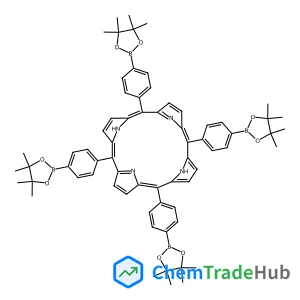
5,10,15,20-tetrakis(4-boronic acid pinacol ester phenyl) porphyrin
CAS番号:
1332748-00-1
分子式:
C68H74B4N4O8
おすすめサプライヤー





免責事項
このページに表示される学術雑誌情報は、参考および研究目的のみを目的としています。当社は雑誌出版社とは提携しておらず、投稿の取り扱いも行っておりません。出版に関するお問い合わせは、各雑誌出版社に直接ご連絡ください。
表示されている情報に誤りがある場合は、support@chemtradehub.com までご連絡ください。迅速に確認し、対応いたします。