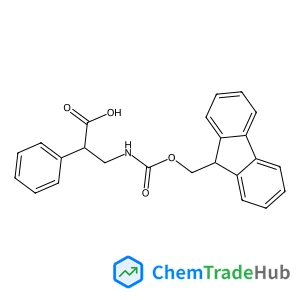
(S)-3-((((9H-Fluoren-9-yl)methoxy)carbonyl)amino)-2-phenylpropanoic acid
CAS番号:
1217663-60-9
分子式:
C24H21NO4
Andrej Junginger, Rigoberto Hernandez
The reaction dynamics of time-dependent systems can be resolved through a recrossing-free dividing surface associated with the transition state trajectory—that is, the unique trajectory which is bound to the barrier region for all time in response to a given time-dependent potential. A general procedure based on the minimization of Lagrangian descriptors has recently been developed by Craven and Hernandez [Phys. Rev. Lett., 2015, 115, 148301] to construct this particular trajectory without requiring perturbative expansions relative to the naive transition state point at the top of the barrier. The extension of the method to account for dissipation in the equations of motion requires additional considerations established in this paper because the calculation of the Lagrangian descriptor involves the integration of trajectories in forward and backward time. The two contributions are in general very different because the friction term can act as a source (in backward time) or sink (in forward time) of energy, leading to the possibility that information about the phase space structure may be lost due to the dominance of only one of the terms. To compensate for this effect, we introduce a weighting scheme within the Lagrangian descriptor and demonstrate that for thermal Langevin dynamics it preserves the essential phase space structures, while they are lost in the nonweighted case.
Md Habib, Ritabrata Sarkar, Santu Biswas, Anup Pramanik, Pranab Sarkar, Sougata Pal
DOI: 10.1039/C9CP00133F
Hailing Sun, Yi Lok Chan, K. W. Kwok
DOI: 10.1039/C9CP00324J
Enamul Haque, M. Anwar Hossain, Catherine Stampfl
DOI: 10.1039/C8CP07634K
David Zanuy, Carlos A. Ferreira
DOI: 10.1039/C9CP00567F
Weiliang Wang
DOI: 10.1039/C9CP01232J
Sreejith P. Babu, Perumal Elumalai
DOI: 10.1039/C8CP07500J
Michael D. LaCount, Mark T. Lusk
DOI: 10.1039/C9CP00329K
Xue Yin, Xiao-Yong Lai, Xin Wang, Ying-Tao Liu
DOI: 10.1039/C9CP00512A
J. T. A. Gilmour, N. Gaston
DOI: 10.1039/C9CP00323A
Sebastian Krickl, Thomas Buchecker, Gašper Jošt, Didier Touraud, Pierre Bauduin, Arno Pfitzner, Werner Kunz
DOI: 10.1039/C8CP07544A
6- bromo-1-cyclopropyl-1H-benzimidazoleは、抗炎症、抗ウイルス作用を持つことが報告されており、新薬開発の研究対象として注目...
取り扱う際には、防護眼鏡と手袋を使用し、ドラフトチャンバー内で操作することを推奨します。漏洩時には適切な手順で処理し、安全データシートを常に参照してください。
2,2’-ジメチル-3,3’-ビピリジンは、ピリジンと2-メチルアクリルアミドを有機合成反応で合成します。この反応では、ピリジンと2-メチルアクリルアミドを含有...
6-甲基ピリジン-2-ボリック酸は、合成化学、医薬品合成、以及研究用途などに広く使用され、特に組換えDNA技術や分子生物学の研究において重要な役割を果たします。
(R)-3-(1-甲基-2-氧環己基)プロpano酸メチルは一定の安全性がありますが、直接的な皮膚接触や吸入は避けるべきです。使用する際は適切な個々の安全データ...
ketorolacは、密封して遮光容器に保管し、直射日光や高温を避けて保存してください。温度は常温で保存し、湿度をなるべく低く保つことが推奨されます。
L-2,3-二氨基丙酸二盐酸盐は腐食性が強く、皮膚や粘膜に刺激を与える可能性があります。取り扱う際は、防塵マスク、ゴーグル、手袋を使用し、適切な排気設備を使用し...
2-(4-溴ピリジン-2-基)乙腈のCAS番号は312325-73-8です。主に結晶形態で存在し、分子量は159.01 g/molです。この化合物は水に溶けやす...
この化合物は毒性は低いですが、直接的な接触や吸入に注意が必要です。PPE(個人防護具)を着用し、ドラフトチャンバーを使用して操作することを推奨します。また、漏洩...
3-(1-氧代-1,3-二氢-2H-2-异吲哚)丙酸は、薬理学研究や医薬品製造において広く用いられる化合物です。また、工業的な用途でも一部の化学反応の触媒や助剤...

Physical Chemistry Chemical Physics (PCCP) is an international journal co-owned by 19 physical chemistry and physics societies from around the world. This journal publishes original, cutting-edge research in physical chemistry, chemical physics and biophysical chemistry. To be suitable for publication in PCCP, articles must include significant innovation and/or insight into physical chemistry; this is the most important criterion that reviewers and Editors will judge against when evaluating submissions. The journal has a broad scope and welcomes contributions spanning experiment, theory, computation and data science. Topical coverage includes spectroscopy, dynamics, kinetics, statistical mechanics, thermodynamics, electrochemistry, catalysis, surface science, quantum mechanics, quantum computing and machine learning. Interdisciplinary research areas such as polymers and soft matter, materials, nanoscience, energy, surfaces/interfaces, and biophysical chemistry are welcomed if they demonstrate significant innovation and/or insight into physical chemistry. Joined experimental/theoretical studies are particularly appreciated when complementary and based on up-to-date approaches.
![2-{[(1R,2S)-2-Aminocyclohexyl]amino}-4-{[3-(2H-1,2,3-triazol-2-yl)phenyl]amino}-5-pyrimidinecarboxamide structure](https://static.chemtradehub.com/structs/137/1370261-96-3-40df.webp "2-{[(1R,2S)-2-Aminocyclohexyl]amino}-4-{[3-(2H-1,2,3-triazol-2-yl)phenyl]amino}-5-pyrimidinecarboxamide structure")