


Electrochemical synthesis of poly(3-aminophenylboronic acid) in ethylene glycol without exogenous protons
文献情報
出版日
2016-03-11
DOI
10.1039/C6CP00800C
インパクトファクター
3.676
著者
Feifan Wang, Feixue Zou, Xinxin Yu, Zhenyu Feng, Na Du, Yaohua Zhong
原文を見る
要旨
A non-aqueous solution of tetra-n-butylammonium fluoride (TBAF) in ethylene glycol has been tried for the first time as a supporting electrolyte for the electropolymerization of 3-aminophenylboronic acid (APBA). Unlike the traditional acidic aqueous solution, the present medium needs no exogenous protons; moreover, the presence of CF3COOH is found to be unfavorable for the polymerization. The protons are in situ generated by the reaction between the boronic acid group on APBA and 1,2-dihydroxyl on ethylene glycol. So, ethylene glycol serves as not only the solvent but also the proton source. As a part of the supporting electrolyte, F− is found to be involved in the electrochemical synthesis of poly(3-aminophenylboronic acid) (PAPBA), but it is not indispensable. Studies on the electropolymerization process indicate that the size of the ions in the electrolyte affects the rate of the doping/dedoping process. The smaller the cation, the easier the doping/dedoping process, and the better the stability of the grown film. As demonstrated by Fourier transform infrared spectra, UV-vis spectra, and scanning electron microscopy, the obtained PAPBA is a cross-linked nanoporous polymer membrane that has a good adherence to the glassy carbon electrode.
おすすめジャーナル

Advanced Engineering Materials

Journal of Enzyme inhibition and Medicinal Chemistry

Coloration Technology

European Journal of Organic Chemistry

Photochemical & Photobiological Sciences

Physical Chemistry Chemical Physics

Angewandte Chemie International Edition

Nature Reviews Drug Discovery

Foundations of Chemistry

Environmental Toxicology and Pharmacology
関連文献
Synthesis of thioesters through copper-catalyzed coupling of aldehydes with thiols in water
Chih-Lun Yi, Yu-Ting Huang, Chin-Fa Lee
2013-06-28
Paper
DOI: 10.1039/C3GC40946E
A self-assembled Pd6L8 nanoball for Suzuki–Miyaura coupling reactions in both homogeneous and heterogeneous formats
Chao-Wei Zhao, Jian-Ping Ma, Qi-Kui Liu, Yang Yu, Peng Wang, Yan-An Li, Kui Wang, Yu-Bin Dong
2013-09-05
Communication
DOI: 10.1039/C3GC41154K
Characteristics and origin of char and coke from fast and slow, catalytic and thermal pyrolysis of biomass and relevant model compounds
Shoucheng Du, Julia A. Valla, George M. Bollas
2013-09-13
Paper
DOI: 10.1039/C3GC41581C
Exergetic sustainability assessment of batch versus continuous wet granulation based pharmaceutical tablet manufacturing: a cohesive analysis at three different levels
Wouter De Soete, Jo Dewulf, Philippe Cappuyns, Geert Van der Vorst, Bert Heirman, Wim Aelterman, Kris Schoeters, Herman Van Langenhove
2013-09-04
Paper
DOI: 10.1039/C3GC41185K
Lewis acid–surfactant-combined catalyzed synthesis of 4-aminocyclopentenones from glycals in water
Siming Wang, Ronny William, Kim Kui Georgina Estelle Seah, Xue-Wei Liu
2013-08-27
Communication
DOI: 10.1039/C3GC41032C
Reactions of p-coumaryl alcohol model compounds with dimethyl carbonate. Towards the upgrading of lignin building blocks
Maurizio Selva, Anthony F. Masters, Thomas Maschmeyer, Alvise Perosa
2013-09-06
Paper
DOI: 10.1039/C3GC40334C
Thiazolyl-phosphine hydrochloride salts: effective auxiliary ligands for ruthenium-catalyzed nitrile hydration reactions and related amide bond forming processes in water
Rocío García-Álvarez, Pascale Crochet, Carine Duhayon, Jean-Pierre Majoral, Victorio Cadierno
2013-07-22
Paper
DOI: 10.1039/C3GC41201F
Revisiting the Brønsted acid catalysed hydrolysis kinetics of polymeric carbohydrates in ionic liquids by in situ ATR-FTIR spectroscopy
Andreas J. Kunov-Kruse, Anders Riisager, Shunmugavel Saravanamurugan, Rolf W. Berg, Steffen B. Kristensen, Rasmus Fehrmann
2013-07-22
Paper
DOI: 10.1039/C3GC41174E
Ammoxidation of allyl alcohol – a sustainable route to acrylonitrile
Wolfgang F. Hölderich
2013-08-12
Communication
DOI: 10.1039/C3GC41089G
GAP chemistry for pyrrolyl coumarin derivatives: a highly efficient one-pot synthesis under catalyst-free conditions
Xuecheng Liu, Xian Feng, Zhibin Huang, Daqing Shi
2013-09-25
Communication
DOI: 10.1039/C3GC41799A
こちらもおすすめ
化合物よくある質問
2-ヒドロキシ-5-ニトロベンジンブロモイドの代替品はありますか?
2-ヒドロキシ-5-ニトロベンジンブロモイドは特定の化学反応に適しているため、代替品は限られています。しかし、同様の構造を持つ2-ヒドロキシ-4-ニトロベンジン...
772-33-82-(Bromomethyl)-4-ni...
化合物よくある質問
N-(2-ブロモフェニル)-1-チロール-3-オキソ-3-(ピペリジニル)プロペン-2-イル)ベンゼンアミドを取り扱う際の実験室安全事項は何ですか?
N-(2-ブロモフェニル)-1-チロール-3-オキソ-3-(ピペリジニル)プロペン-2-イル)ベンゼンアミドは有毒で、皮膚や粘膜に刺激を与える可能性があります。...
1800044-77-2N-[(1Z)-1-(2-Bromoph...
化合物よくある質問
1,3プロパンジオール,2-[2-(2アミノ-6クロロ-9Hピリミジン-9-イル)エチル-1,1,2,2-D4]-2,3-ジアセタートの市場動向や研究トレンドはどうですか?
この化合物は、新規治療薬の開発に注目されています。市場では、その有効性と安全性が評価され、研究分野では、分子生物学と医薬化学の新たな発見が期待されています。
1020718-81-31,3-Propanediol, 2-[...
579-44-2Ethanone, 2-hydroxy-...
化合物よくある質問
Succinimidyl-alanyl-phenylalanyl-prolyl-phenylalanine 4-nitroanilide はどの業界で使用されていますか?
Succinimidyl-alanyl-phenylalanyl-prolyl-phenylalanine 4-nitroanilide は主に医薬品開発やポ...
128802-73-3succinimidyl-alanyl-...
化合物よくある質問
メチル6-アミノ-5-クロロピリジン-2-カーボイル酸について、適用される法規ガイドラインは何ですか?
メチル6-アミノ-5-クロロピリジン-2-カーボイル酸(CAS番号: 1256794-05-4)の使用には、GHS( Globally Harmonized S...
1256794-05-4Methyl 6-amino-5-chl...
化合物よくある質問
エチル4-(シクロ Pentagonyl)アミノ-2-メチル硫化基ピリミジン-5-カルボキシレートを取り扱う際の実験室安全事項は何ですか?
取り扱いには、耐薬品性の容器を使用し、通気性の良い場所で操作することを推奨します。漏れ時は、SDS(安全データシート)を参照して適切な措置を取ること。手洗いと洗...
211245-62-4ethyl 4-(cyclopentyl...
化合物よくある質問
(S)-3-ベンZYルピペリジン塩酸塩とは何ですか?
(S)-3-ベンZYルピペリジン塩酸塩は、CAS番号1258940-00-9で表される化合物です。これは、(S)-3-苯基哌啶的盐酸盐であり、主に医薬品の原料と...
1258940-00-9(S)-3-Phenylpiperidi...
化合物よくある質問
3,5-二甲基金剛胺の主な用途は何ですか?
3,5-二甲基金剛胺は、主に医薬品の原料として使用され、また抗うつ薬や抗アルツハイマー薬の開発に利用されます。さらに、化粧品や食品添加物の製造でも重要な役割を果...
19988-45-52-(2,3-Dihydroxyphen...
化合物よくある質問
ビス(4-メチル-2-ペンチル)フェニルカルボン酸エステルの代替品はありますか?
ビス(4-メチル-2-ペンチル)フェニルカルボン酸エステル (CAS番号: 1398066-13-1) の代替品には、ビス(2-エチルヘキシル)フェノールカルボ...
1398066-13-1Bis(4-methyl-2-penty...
掲載誌
Physical Chemistry Chemical Physics
CiteScore:
5.5
自己引用率:
10.3%
年間論文数:
3036
Physical Chemistry Chemical Physics (PCCP) is an international journal co-owned by 19 physical chemistry and physics societies from around the world. This journal publishes original, cutting-edge research in physical chemistry, chemical physics and biophysical chemistry. To be suitable for publication in PCCP, articles must include significant innovation and/or insight into physical chemistry; this is the most important criterion that reviewers and Editors will judge against when evaluating submissions. The journal has a broad scope and welcomes contributions spanning experiment, theory, computation and data science. Topical coverage includes spectroscopy, dynamics, kinetics, statistical mechanics, thermodynamics, electrochemistry, catalysis, surface science, quantum mechanics, quantum computing and machine learning. Interdisciplinary research areas such as polymers and soft matter, materials, nanoscience, energy, surfaces/interfaces, and biophysical chemistry are welcomed if they demonstrate significant innovation and/or insight into physical chemistry. Joined experimental/theoretical studies are particularly appreciated when complementary and based on up-to-date approaches.
おすすめ化合物
![4-Chloro-3-(trifluoromethyl)-1H-pyrrolo[2,3-b]pyridine structure](https://static.chemtradehub.com/structs/869/869335-75-1-a9d0.webp "4-Chloro-3-(trifluoromethyl)-1H-pyrrolo[2,3-b]pyridine structure")
![2,6-Bis({(2R)-2-[hydroxy(diphenyl)methyl]-1-pyrrolidinyl}methyl)-4-methylphenol structure](https://static.chemtradehub.com/structs/877/877395-58-9-70bf.webp "2,6-Bis({(2R)-2-[hydroxy(diphenyl)methyl]-1-pyrrolidinyl}methyl)-4-methylphenol structure")
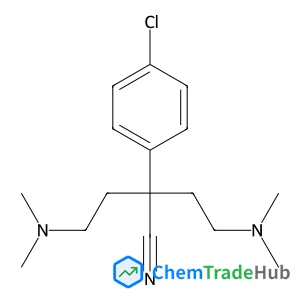
2-(4-Chlorophenyl)-4-(dimethylamino)-2-(2-(dimethylamino)ethyl)butanenitrile
CAS番号:
1246816-57-8
分子式:
C16H24ClN3
おすすめサプライヤー




免責事項
このページに表示される学術雑誌情報は、参考および研究目的のみを目的としています。当社は雑誌出版社とは提携しておらず、投稿の取り扱いも行っておりません。出版に関するお問い合わせは、各雑誌出版社に直接ご連絡ください。
表示されている情報に誤りがある場合は、support@chemtradehub.com までご連絡ください。迅速に確認し、対応いたします。