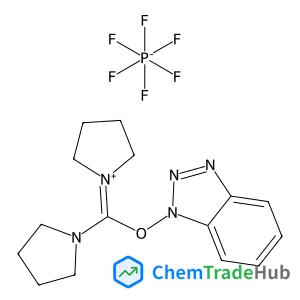
(1H-Benzotriazol-1-yloxy)(di-1-pyrrolidinyl)methylium hexafluorophosphate
CAS番号:
105379-24-6
分子式:
C15H21F6N5OP
The ability of a selected nanoparticle to form stable systems with superhalogens (i.e. AlF4, AlCl4, MgF3, MgCl3, LiF2, LiCl2, and LiI2) is examined on the basis of theoretical considerations supported by ab initio calculations. It is demonstrated that the C60 fullerene molecule should form stable and strongly bound (C60)˙+(superhalogen)− radical cation salts when combined with an appropriately chosen superhalogen radical (acting as an oxidizing agent). The conclusion is supported by providing: (i) the structural deformation of superhalogens and C60 nanoparticles upon ionization, (ii) predicted charge flow between the fullerene and each superhalogen (which allows estimating the amount of electron density withdrawn from the C60 molecule during the ionization process), (iii) the localization of the spin density distribution, and (iv) the interaction energies for the compounds obtained both at the B3LYP/6-31+G(d) level and at the B3LYP-D3/6-31+G(d) level. Solvent effects have been considered in the present study by means of the polarizable continuum model. It is found that the stability of C60/superhalogen species can be improved in solvents. We believe that the results provided in this contribution may likely be of prospective relevance in the future studies on the issue of binding and removal of this potentially risky nanoparticle.

Chinese Journal of Chemistry

Bioorganic & Medicinal Chemistry

Topics in Catalysis

Journal of Chemical Sciences

Bioorganic & Medicinal Chemistry Letters

Cellulose

Heteroatom Chemistry

Journal of Asian Natural Products Research

Critical Reviews in Solid State and Materials Sciences

Medicinal Chemistry Research
Alex Domingo, Martin Vérot, Fernando Mota, Juan J. Novoa, Vincent Robert
DOI: 10.1039/C3CP44647F
Cristina Puzzarini
DOI: 10.1039/C3CP44301A
Qing Jie, Hengzhi Wang, Weishu Liu, Hui Wang, Gang Chen, Zhifeng Ren
DOI: 10.1039/C3CP50327E
Giuseppe Graziano
DOI: 10.1039/C3CP50616A
M. Sadeghi
DOI: 10.1039/C3CP44563A
Sven Ernst, Kristopher R. Ward, Sarah E. Norman, Christopher Hardacre, Richard G. Compton
DOI: 10.1039/C3CP51004B
Kotaro Fujii, Hiroki Kato, Kazuki Omoto, Jun Chen, Xianran Xing
DOI: 10.1039/C3CP50236H
Lijia Liu, Tsun-Kong Sham, Weiqiang Han
DOI: 10.1039/C3CP50498K
Xi Zhang, Xuezhen Huang
DOI: 10.1039/C3CP51071A
Amitaksha Saha, Chellappan Vijila, Rajan Jose, Zhang Jie, Seeram Ramakrishna
DOI: 10.1039/C3CP50994J
2-溴-9,9-二苯基芴は、医薬品、工業材料、有機合成の研究分野で応用されます。特に、レーザー材料や機能性ポリマーの合成に使用されることがあります。また、蛍光色...
四氯化铱の市場は研究開発分野で注目されており、特にナノ技術や金属有機框架(MOFs)の分野での需要が増加傾向にあります。価格は安定しており、中国や韓国での生産が...
1-(4-溴-3-氟苯基)-2-氯乙酮 (CAS番号: 1260857-14-4) の廃棄物は専門的な廃棄処理が必要です。まず、廃棄物は密閉された容器に収集し、...
苦参酚Kは、CAS番号101236-49-1を持つ化合物で、主に天然由来の生薬から抽出されます。この化合物は、抗炎症作用や抗癌作用を持つことが報告されています。
POTASSIUM (1-(TERTBUTOXYCARBONYL)AZETIDIN-3-YL)TRIFLUOROBORATE を含む廃棄物は、まず安全なエント...
4-庚基-4’-聯苯羧酸は、特殊化学品や合成化学の分野で用いられる化学物質ですが、市場動向としては、研究開発の進展とともに需要が増加しています。また、環境配慮型...
6-ブロモ-3-メトキシ-1-フェニル-1H-インドゾールを含む廃棄物は、適切な化学廃棄処理が必要です。通常、廃棄物は密閉容器に収集され、専門の廃棄処理業者に引...
4,4-二甲基-2-吡咯烷酮は医薬、ポリマー、センサー、半導体などの業界で広く使用されています。特に溶媒としての性能が高く評価されています。

Physical Chemistry Chemical Physics (PCCP) is an international journal co-owned by 19 physical chemistry and physics societies from around the world. This journal publishes original, cutting-edge research in physical chemistry, chemical physics and biophysical chemistry. To be suitable for publication in PCCP, articles must include significant innovation and/or insight into physical chemistry; this is the most important criterion that reviewers and Editors will judge against when evaluating submissions. The journal has a broad scope and welcomes contributions spanning experiment, theory, computation and data science. Topical coverage includes spectroscopy, dynamics, kinetics, statistical mechanics, thermodynamics, electrochemistry, catalysis, surface science, quantum mechanics, quantum computing and machine learning. Interdisciplinary research areas such as polymers and soft matter, materials, nanoscience, energy, surfaces/interfaces, and biophysical chemistry are welcomed if they demonstrate significant innovation and/or insight into physical chemistry. Joined experimental/theoretical studies are particularly appreciated when complementary and based on up-to-date approaches.