


![(R)-N-[(S)-1-[2-(Diphenylphosphino)phenyl]ethyl]-2-methylpropane-2-sulfinamide structure](https://static.chemtradehub.com/structs/159/1595319-98-4-33e7.webp "(R)-N-[(S)-1-[2-(Diphenylphosphino)phenyl]ethyl]-2-methylpropane-2-sulfinamide structure")
Electrochromic sensing platform based on steric hindrance effects for CEA detection
文献情報
出版日
2016-04-26
DOI
10.1039/C6AN00675B
インパクトファクター
4.616
著者
Yong Xia, Jing Li, Erkang Wang
原文を見る
要旨
In this work, an electrochromic sensing platform with prussian blue (PB) as the indicator was proposed for signaling carcinoembryonic antigen (CEA) using the bipolar electrode (BPE) system. The CEA aptamer was pre-anchored on the anode pole of the BPE for capturing CEA through strong binding affinity. The presence of CEA induced the increase of steric hindrance and led to lower electrochemical currents. Due to the quantitative relationship between the two reactions occurring at both ends of the BPE, the amount of deposited PB in situ can be used as an indicator for reporting target protein concentration. Using CEA concentration in normal human serum as a reference (5 ng mL−1), this electrochromic sensing platform can be used for distinguishing persons with cancer from normal humans easily and quickly, which is very important for subsequent treatment of patients. This novel electrochromic platform has great selectivity for target tumor proteins and provides a fast, visual method for CEA detection. Finally, the proposed biosensor can be applied to detect CEA in human serum, which holds great potential for point-of-care diagnostics combined with the advantage of the closed BPE system.
おすすめジャーナル

Cellulose

Acta Metallurgica Sinica-English Letters

Chinese Journal of Chemistry

Critical Reviews in Solid State and Materials Sciences

NDT & E International

Polycyclic Aromatic Compounds

Medicinal Chemistry Research

Atomization and Sprays

Biocatalysis and Biotransformation

Herald of the Russian Academy of Sciences
関連文献
A functional electrolyte containing propyl 4-methylbenzene sulfonate (PMBS) additive to improve the cycling performance of the LiNi0.8Co0.1Mn0.1O2/graphite full cell under the low temperature of −10 °C
Haijia Li, Jian Cai, Jianping Liao, Yiting Li, Xueyi Zeng, Xin He, Chaojun Fan, Zhen Ma, Junmin Nan
2023-11-10
Paper
DOI: 10.1039/D3TA04535H
Carrier density and delocalization signatures in doped carbon nanotubes from quantitative magnetic resonance
M. Alejandra Hermosilla-Palacios, Marissa Martinez, Evan A. Doud, Tobias Hertel, Alexander M. Spokoyny, Sofie Cambré, Wim Wenseleers, Yong-Hyun Kim, Andrew J. Ferguson, Jeffrey L. Blackburn
2023-11-22
Communication
DOI: 10.1039/D3NH00480E
Defect engineering enhances plasmonic-hot electrons exploitation for CO2 reduction over polymeric catalysts
Zhehao Sun, Kaili Liu, Ary Anggara Wibowo, Julien Langley, Chao Zhang, Sandra E. Saji, Felipe Kremer, Dmitri Golberg, Hieu T. Nguyen, Nicholas Cox
2023-09-05
Communication
DOI: 10.1039/D3NH00348E
Correction: Hydrothermal synthesis of α-MnO2 and β-MnO2 nanorods as high capacity cathode materials for sodium ion batteries
Dawei Su, Hyo-Jun Ahn
2023-11-13
Correction
DOI: 10.1039/D3TA90111D
Metal–organic framework-derived CuO catalysts for the efficient hydrogenolysis of hardwood lignin into phenolic monomers
Qian Xu, Qiang Wang, Ling-Ping Xiao, Xiao-Ying Li, Xi Xiao, Meng-Xin Li, Meng-Ran Lin, Yu-Man Zhao, Run-Cang Sun
2023-10-24
Paper
DOI: 10.1039/D3TA04927B
Recent progress of MXene as an energy storage material
Yuqiang Wu, Mengtao Sun
2024-01-05
Minireview
DOI: 10.1039/D3NH00402C
van der Waals 2D transition metal dichalcogenide/organic hybridized heterostructures: recent breakthroughs and emerging prospects of the device
Sherif Kamal, Yahya Khan, Marko Kralj
2023-10-30
Review Article
DOI: 10.1039/D3NH00310H
Improving the electrochemical performance of Li2S cathodes based on point defect control with cation/anion dual doping
Wenli Pan, Nobuya Machida, Toshiyuki Matsunaga, Mukesh Kumar, Neha Thakur, Toshiki Watanabe, Atsushi Sakuda, Akitoshi Hayashi, Masahiro Tatsumisago, Yoshiharu Uchimoto
2023-10-26
Paper
DOI: 10.1039/D3TA05426H
Coupling post-modification with reconstruction over Co-based metal–organic frameworks for electrochemical collective value-added recycling of nitrate and sulfion in wastewater
Tianlun Ren, Huizhen Wang, Shan Xu, Hongjie Yu, Kai Deng, Ziqiang Wang, Hongjing Wang, Liang Wang, You Xu
2023-10-24
Paper
DOI: 10.1039/D3TA04629J
Mechanical disassembly of human picobirnavirus like particles indicates that cargo retention is tuned by the RNA–coat protein interaction
Javier M. Rodríguez
2023-10-05
Communication
DOI: 10.1039/D3NH00195D
こちらもおすすめ
化合物よくある質問
2,3-スチオエポキシマドルを取り扱う際の実験室安全事項は何ですか?
取り扱いにはPPE(プロテクティブ・パーソナル・エイド)が必要で、防ぐ手袋と保護眼鏡を着用してください。ドラフトチャンバーの使用を推奨します。漏洩した場合は、適...
4267-80-52,3-Thioepoxy Madol
53981-25-22-Amino-6-fluorophen...
化合物よくある質問
BOC-S-3-アミニ-4-(4-メチオキシベンチル)-ブタン酸の代替品はありますか?
この化合物の代替品としては、BOC保護基を有さないアミノ酸やその他の保護基化合物が考えられます。また、メチオキシ基を有しない他の芳香族アミノ酸も代替品として挙げ...
126800-59-7(3S)-4-(4-Methoxyphe...
化合物よくある質問
Methyl 2-(chloromethyl)-3-nitrobenzoate(1218910-61-2)の代替品はありますか?
Methyl 2-(chloromethyl)-3-nitrobenzoate(1218910-61-2)の代替品としては、化学組成を変えることで効果を達成する...
1218910-61-2Methyl 2-(chlorometh...
化合物よくある質問
(2R)-2-アミノ-N-ベンジル-3-ヒドロキシプロパナミドを含む廃棄物はどのように処理すべきですか?
(2R)-2-アミノ-N-ベンジル-3-ヒドロキシプロパナミドを含む廃棄物は、適切な廃棄物管理ガイドラインに基づき処理する必要があります。まず、廃棄物を適切に収...
175481-39-7(2R)-2-amino-N-benzy...
化合物よくある質問
6,7-二氢-咪唑並[1,2-a]ピリドイン-8(5h)-酮はどのように合成されますか?
6,7-二氢-咪唑並[1,2-a]ピリドイン-8(5h)-酮は、2-ブロモフェニルアセトインとリン酸ハロゲン化物を反応させることで合成できます。この反応は高温で...
457949-09-66,7-Dihydroimidazo[1...
化合物よくある質問
エチル(3R)-3-ピロリジニル酢酸水和塩とは何ですか?
エチル(3R)-3-ピロリジニル酢酸水和塩は、CAS番号1332459-32-1の化合物で、(R)-乙基2-(ピロリジン-3-基)酢酸塩水和塩と呼ばれます。この...
1332459-32-1Ethyl (3R)-3-pyrroli...
化合物よくある質問
(2S)-{[(2-メチルエチルオキシ]カルボニル}アミノ)[2-(トリアフルオロメチルフェニル]エチカシック酸の物理化学的性質は何ですか?
(2S)-{[(2-メチルエチルオキシ]カルボニル}アミノ)[2-(トリアフルオロメチルフェニル]エチカシック酸のCAS番号は1203454-45-8です。この...
1203454-45-8(2S)-({[(2-Methyl-2-...
化合物よくある質問
2-ブロモ-1-(2-メチル-2-プロパニル)-4-ニトロベンゼンはどのように保存すればよいですか?
2-ブロモ-1-(2-メチル-2-プロパニル)-4-ニトロベンゼンは、直射日光を避けて暗所で、室温(約15℃〜25℃)、乾燥した場所に保存する必要があります。ま...
6310-17-42-Bromo-1-(2-methyl-...
化合物よくある質問
1-[(4-硝基フェニル)スルホニル]-1H-1,2,4-三唑の市場動向や研究トレンドはどうですか?
市場動向としては、1-[(4-硝基フェニル)スルホニル]-1H-1,2,4-三唑は主に農業用除草剤や合成化学製品の原料として利用されています。研究トレンドとして...
57777-84-11-[(4-Nitrophenyl)su...
掲載誌
Analyst

CiteScore:
7.8
自己引用率:
5.6%
年間論文数:
653
Analyst publishes analytical and bioanalytical research that reports premier fundamental discoveries and inventions, and the applications of those discoveries, unconfined by traditional discipline barriers.
おすすめ化合物
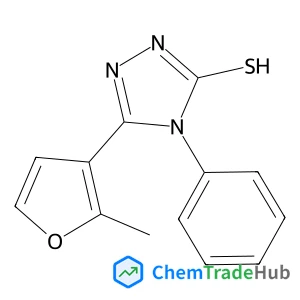
5-(2-Methyl-3-furyl)-4-phenyl-2,4-dihydro-3H-1,2,4-triazole-3-thione
CAS番号:
346464-59-3
分子式:
C13H11N3OS
![Ethyl 4-[8-chloro(5,5,6,6,7-~2~H_5_)-5,6-dihydro-11H-benzo[5,6]cyclohepta[1,2-b]pyridin-11-ylidene]-1-piperidinecarboxylate structure](https://static.chemtradehub.com/structs/102/1020719-57-6-37e2.webp "Ethyl 4-[8-chloro(5,5,6,6,7-~2~H_5_)-5,6-dihydro-11H-benzo[5,6]cyclohepta[1,2-b]pyridin-11-ylidene]-1-piperidinecarboxylate structure")
おすすめサプライヤー





免責事項
このページに表示される学術雑誌情報は、参考および研究目的のみを目的としています。当社は雑誌出版社とは提携しておらず、投稿の取り扱いも行っておりません。出版に関するお問い合わせは、各雑誌出版社に直接ご連絡ください。
表示されている情報に誤りがある場合は、support@chemtradehub.com までご連絡ください。迅速に確認し、対応いたします。