












![[(2R)-6,6-Dimethyl-2-morpholinyl]methanol hydrochloride (1:1) structure](https://static.chemtradehub.com/structs/141/1416444-88-6-e06a.webp "[(2R)-6,6-Dimethyl-2-morpholinyl]methanol hydrochloride (1:1) structure")
Live-cell quantification and comparison of mammalian oocyte cytosolic lipid content between species, during development, and in relation to body composition using nonlinear vibrational microscopy
文献情報
出版日
2016-06-01
DOI
10.1039/C6AN00629A
インパクトファクター
4.616
著者
Joshua Jasensky, Andrew P. Boughton, Alexander Khmaladze, Jun Ding, Chi Zhang, Jason E. Swain, George W. Smith
原文を見る
要旨
Cytosolic lipids participate in the growth, development, and overall health of mammalian oocytes including many roles in cellular homeostasis. Significant emphasis has been placed on the study of lipids as a dynamic organelle, which in turn requires the development of tools and techniques to quantitate and compare how lipid content relates to cellular structure, function, and normalcy. Objectives of this study were to determine if nonlinear vibrational microscopy (e.g., coherent anti-Stokes Raman scattering or CARS microscopy) could be used for live-cell imaging to quantify and compare lipid content in mammalian oocytes during development and in relation to body composition; and compare its efficacy to methods involving cellular fixation and staining protocols. Results of this study demonstrate that CARS is able to identify lipids in live mammalian oocytes, and there exists quantifiable and consistent differences in percent lipid composition across ooctyes of different species, developmental stages, and in relation to body composition. Such a method of live-cell lipid quantification has (i) experimental power in basic cell biology, (ii) practical utility for identifying developmental predictive biomarkers while advancing biology-based oocyte/embryo selection, and (iii) ability to yield rationally supporting technology for decision-making in rodents, domestic species, and human assisted reproduction and/or fertility preservation.
おすすめジャーナル
関連文献
Coke relocation and Mo immobilization in donut-shaped Mo/HZSM-5 catalysts for methane dehydroaromatization
Ming Cheng, Hugo Cruchade, Ludovic Pinard, Eddy Dib, Honghai Liu, Jiujiang Wang, Xinmei Liu, Zi-Feng Yan, Zhengxing Qin, Svetlana Mintova
2023-11-10
Paper
DOI: 10.1039/D3TA05418G
Self-organized defect-rich RuMOx epitaxial layers (M = Mn, Fe, Co, Ni, Cu) for catalytic applications
Risa Ichihashi, Yuta Yamamoto, Kyoichi Sawabe
2023-10-12
Paper
DOI: 10.1039/D3TA05078E
Enhanced catalytic performance of Co3O4/Eu2O3 with sulfur-modification in activating peroxymonosulfate for removal of methylene blue
Haili Shen, Ying Wei, Qiang Xia, Jun Shen
2024-01-09
Paper
DOI: 10.1039/D3NJ02953K
Magnetic field-responsive graphene oxide photonic liquids
Yi-Tao Xu, Amanda J. Ackroyd, Arash Momeni, Mohamed Oudah
2024-01-10
Communication
DOI: 10.1039/D3NH00412K
High-throughput design of energetic molecules
Jian Liu, Shicao Zhao, Bowen Duan, Xudong He, Chunming Yang, Xuemei Pu, Xinben Zhang, Yonghao Xiao, Fude Nie, Wen Qian, Geng Li
2023-11-02
Paper
DOI: 10.1039/D3TA05002E
Tumor microenvironment-responsive degradable silica nanoparticles: design principles and precision theranostic applications
Kaiyuan Tang, Zilu Liu, Zhijing Zhang, Shufan Duan, Hui Wang, Hui Yang, Dongliang Yang, Wenpei Fan
2023-11-29
Review Article
DOI: 10.1039/D3NH00388D
Simple phenylpropanoids: recent advances in biological activities, biosynthetic pathways, and microbial production
Zhanpin Zhu, Ruibing Chen
2023-10-09
Review Article
DOI: 10.1039/D3NP00012E
siRNA-loaded DNA nanostructures restore endothelial leakiness
Arun Richard Chandrasekaran
2023-10-04
Editorial
DOI: 10.1039/D3NH90040A
In situ formation of a ZnS/In interphase for reversible Zn metal anodes at ultrahigh currents and capacities
Chengwu Yang, Pattaraporn Woottapanit, Jin Cao, Yilei Yue, Dongdong Zhang, Jin Yi, Zhiyuan Zeng, Xinyu Zhang, Jiaqian Qin, Yonggang Wang
2023-10-31
Paper
DOI: 10.1039/D3TA05650C
Metal–organic framework-derived CuO catalysts for the efficient hydrogenolysis of hardwood lignin into phenolic monomers
Qian Xu, Qiang Wang, Ling-Ping Xiao, Xiao-Ying Li, Xi Xiao, Meng-Xin Li, Meng-Ran Lin, Yu-Man Zhao, Run-Cang Sun
2023-10-24
Paper
DOI: 10.1039/D3TA04927B
こちらもおすすめ
化合物よくある質問
2,3-スチオエポキシマドルを取り扱う際の実験室安全事項は何ですか?
取り扱いにはPPE(プロテクティブ・パーソナル・エイド)が必要で、防ぐ手袋と保護眼鏡を着用してください。ドラフトチャンバーの使用を推奨します。漏洩した場合は、適...
4267-80-52,3-Thioepoxy Madol
53981-25-22-Amino-6-fluorophen...
化合物よくある質問
BOC-S-3-アミニ-4-(4-メチオキシベンチル)-ブタン酸の代替品はありますか?
この化合物の代替品としては、BOC保護基を有さないアミノ酸やその他の保護基化合物が考えられます。また、メチオキシ基を有しない他の芳香族アミノ酸も代替品として挙げ...
126800-59-7(3S)-4-(4-Methoxyphe...
化合物よくある質問
Methyl 2-(chloromethyl)-3-nitrobenzoate(1218910-61-2)の代替品はありますか?
Methyl 2-(chloromethyl)-3-nitrobenzoate(1218910-61-2)の代替品としては、化学組成を変えることで効果を達成する...
1218910-61-2Methyl 2-(chlorometh...
化合物よくある質問
(2R)-2-アミノ-N-ベンジル-3-ヒドロキシプロパナミドを含む廃棄物はどのように処理すべきですか?
(2R)-2-アミノ-N-ベンジル-3-ヒドロキシプロパナミドを含む廃棄物は、適切な廃棄物管理ガイドラインに基づき処理する必要があります。まず、廃棄物を適切に収...
175481-39-7(2R)-2-amino-N-benzy...
化合物よくある質問
6,7-二氢-咪唑並[1,2-a]ピリドイン-8(5h)-酮はどのように合成されますか?
6,7-二氢-咪唑並[1,2-a]ピリドイン-8(5h)-酮は、2-ブロモフェニルアセトインとリン酸ハロゲン化物を反応させることで合成できます。この反応は高温で...
457949-09-66,7-Dihydroimidazo[1...
化合物よくある質問
エチル(3R)-3-ピロリジニル酢酸水和塩とは何ですか?
エチル(3R)-3-ピロリジニル酢酸水和塩は、CAS番号1332459-32-1の化合物で、(R)-乙基2-(ピロリジン-3-基)酢酸塩水和塩と呼ばれます。この...
1332459-32-1Ethyl (3R)-3-pyrroli...
化合物よくある質問
(2S)-{[(2-メチルエチルオキシ]カルボニル}アミノ)[2-(トリアフルオロメチルフェニル]エチカシック酸の物理化学的性質は何ですか?
(2S)-{[(2-メチルエチルオキシ]カルボニル}アミノ)[2-(トリアフルオロメチルフェニル]エチカシック酸のCAS番号は1203454-45-8です。この...
1203454-45-8(2S)-({[(2-Methyl-2-...
化合物よくある質問
2-ブロモ-1-(2-メチル-2-プロパニル)-4-ニトロベンゼンはどのように保存すればよいですか?
2-ブロモ-1-(2-メチル-2-プロパニル)-4-ニトロベンゼンは、直射日光を避けて暗所で、室温(約15℃〜25℃)、乾燥した場所に保存する必要があります。ま...
6310-17-42-Bromo-1-(2-methyl-...
化合物よくある質問
1-[(4-硝基フェニル)スルホニル]-1H-1,2,4-三唑の市場動向や研究トレンドはどうですか?
市場動向としては、1-[(4-硝基フェニル)スルホニル]-1H-1,2,4-三唑は主に農業用除草剤や合成化学製品の原料として利用されています。研究トレンドとして...
57777-84-11-[(4-Nitrophenyl)su...
掲載誌
Analyst

CiteScore:
7.8
自己引用率:
5.6%
年間論文数:
653
Analyst publishes analytical and bioanalytical research that reports premier fundamental discoveries and inventions, and the applications of those discoveries, unconfined by traditional discipline barriers.
おすすめ化合物
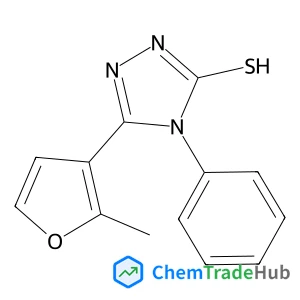
5-(2-Methyl-3-furyl)-4-phenyl-2,4-dihydro-3H-1,2,4-triazole-3-thione
CAS番号:
346464-59-3
分子式:
C13H11N3OS

![N-[2-(2-Pyridinyl)ethyl]-1-propanamine structure](https://static.chemtradehub.com/structs/554/55496-57-6-22b4.webp "N-[2-(2-Pyridinyl)ethyl]-1-propanamine structure")
![(R)-N-[(S)-1-[2-(Diphenylphosphino)phenyl]ethyl]-2-methylpropane-2-sulfinamide structure](https://static.chemtradehub.com/structs/159/1595319-98-4-33e7.webp "(R)-N-[(S)-1-[2-(Diphenylphosphino)phenyl]ethyl]-2-methylpropane-2-sulfinamide structure")
おすすめサプライヤー





免責事項
このページに表示される学術雑誌情報は、参考および研究目的のみを目的としています。当社は雑誌出版社とは提携しておらず、投稿の取り扱いも行っておりません。出版に関するお問い合わせは、各雑誌出版社に直接ご連絡ください。
表示されている情報に誤りがある場合は、support@chemtradehub.com までご連絡ください。迅速に確認し、対応いたします。