












Thermo-responsive polymer aided spheroid culture in cryogel based platform for high throughput drug screening
文献情報
出版日
2016-03-30
DOI
10.1039/C6AN00356G
インパクトファクター
4.616
著者
J. Sarkar, A. Kumar
原文を見る
要旨
In high throughput cell culture, the paradigm is now shifting from 2D to 3D systems. However, in 3D cell culture systems, it is important that the cells form spheroids with robust cell–cell interactions. We fabricated poly(N-isopropylacrylamide-co-gelatin) cryogel scaffolds for cell culture and inserted them into open-ended 96-well plates that formed a drainage and leakage protected, easy to handle high throughput platform. This platform was used to screen for the optimal concentration of poly(N-isopropylacrylamide) (pNIPAAm) as an external aid to the formation of cellular spheroids. It was found that hepatic cells (Hep G2) seeded in the presence of 0.03% pNIPAAm formed better hepatic spheroids in terms of morphology (as assessed by microscopic analysis and formation of bile canaliculi-like structures) and functionality by day 5 of culture. An increase of 44.22%, 15.75%, 36.44%, 32.05% and 27.02% was observed in glucose consumption (1.925 mM per day per 104 cells), albumin synthesis (164.18 ng per day per 104 cells), CYP1A1 (304.92 pg per min per 104 cells), CYP2A6 (441.23 nM per min per 104 cells) and phase II metabolic activity (386.18 nM per min−1 per 104 cells), respectively, upon using 0.03% pNIPAAm, as compared to the 3D control. The platform was tested with other cells such as breast and lung cancer cells and found to be compatible. The cell spheroids were subjected to drug toxicity screening in cryogel based open-ended platforms. It was observed that the spheroids were more resistant to anticancer drugs, as compared to 2D and 3D controls, with approximately 11%–67% increase in the IC50 values of tamoxifen and paclitaxel. The platform also showed dose dependent and reproducible responses to drugs.
おすすめジャーナル
関連文献
Extending the scope of the carbonyl facilitated triplet excited state towards visible light excitation
Shinaj K. Rajagopal, Nagaraj K., Somadrita Deb, Vinayak Bhat, Devika Sasikumar, Ebin Sebastian, Mahesh Hariharan
2018-06-18
Paper
DOI: 10.1039/C8CP01023D
Effect of intermediate phases on the optical properties of PbI2-rich CH3NH3PbI3 organic–inorganic hybrid perovskite
Alonso W. P. Sanches, Marco A. T. da Silva, Neusmar J. A. Cordeiro, Alexandre Urbano, Sidney A. Lourenço
2019-02-11
Paper
DOI: 10.1039/C8CP06916F
Three-dimensional pulsed field gradient NMR measurements of self-diffusion in anisotropic materials for energy storage applications
L. E. Marbella, N. M. Trease, M. De Volder, C. P. Grey
2019-01-28
Paper
DOI: 10.1039/C8CP07776B
Theoretical study of the adsorption of hydrogen on cobalt clusters
Kevin García-Díez, Julio Fernández-Fernández, María J. López
2018-07-20
Paper
DOI: 10.1039/C8CP03048K
Tuning the magnetic properties of beryllium chains
Noelia Faginas-Lago, Thierry Leininger, Stefano Evangelisti
2019-02-27
Paper
DOI: 10.1039/C8CP07159D
Laser and electron beam-induced formation of Ag/Cr structures on Ag2CrO4
Lemos P. S., Silva G. S., Roca R. A., Assis M., Torres-Mendieta R., Beltrán-Mir H., Mínguez-Vega G., Cordoncillo E., Andrés J., Longo E.
2019-02-07
Paper
DOI: 10.1039/C8CP07263A
Effect of an external electric field on capillary filling of water in hydrophilic silica nanochannels
Andres Rojano Crisson, Enrique Wagemann, Harvey A. Zambrano
2018-06-22
Paper
DOI: 10.1039/C8CP03186J
Raising glass transition temperature of polymer nanofilms as a function of negative interface energy
Xue Yao, Yaru Wang, Xingyou Lang, Yongfu Zhu, Qing Jiang
2019-02-07
Paper
DOI: 10.1039/C8CP07267A
Evidence of the O–Pd–O and Pd–O4 structure units as oxide seeds and their origin on Pd(211): revealing the mechanism of surface oxide formation
Xiran Cheng, Ziyun Wang, Yu Mao, P. Hu
2019-02-19
Paper
DOI: 10.1039/C8CP06224B
Quantitative analysis of 14N quadrupolar coupling using 1H detected 14N solid-state NMR
James A. Jarvis, Maria Concistre, Richard W. Bounds, Ilya Kuprov, Marina Carravetta, Philip T. F. Williamson
2019-02-27
Paper
DOI: 10.1039/C8CP06276E
こちらもおすすめ
化合物よくある質問
2-ブロモ-9,9-ジフェニル-9H-フルオレンの主な用途は何ですか?
2-溴-9,9-二苯基芴は、医薬品、工業材料、有機合成の研究分野で応用されます。特に、レーザー材料や機能性ポリマーの合成に使用されることがあります。また、蛍光色...
474918-32-62-Bromo-9,9-diphenyl...
化合物よくある質問
四氯化铱の市場動向や研究トレンドはどうですか?
四氯化铱の市場は研究開発分野で注目されており、特にナノ技術や金属有機框架(MOFs)の分野での需要が増加傾向にあります。価格は安定しており、中国や韓国での生産が...
207399-11-9Tetrachloroiridium h...
882-06-44-Nitrocinnamic acid
化合物よくある質問
1-(4-溴-3-氟苯基)-2-氯乙酮を含む廃棄物はどのように処理すべきですか?
1-(4-溴-3-氟苯基)-2-氯乙酮 (CAS番号: 1260857-14-4) の廃棄物は専門的な廃棄処理が必要です。まず、廃棄物は密閉された容器に収集し、...
1260857-14-41-(4-Bromo-3-fluorop...
化合物よくある質問
苦参酚Kとは何ですか?
苦参酚Kは、CAS番号101236-49-1を持つ化合物で、主に天然由来の生薬から抽出されます。この化合物は、抗炎症作用や抗癌作用を持つことが報告されています。
101236-49-1Kushenol K
化合物よくある質問
POTASSIUM (1-(TERTBUTOXYCARBONYL)AZETIDIN-3-YL)TRIFLUOROBORATE を含む廃棄物はどのように処理すべきですか?
POTASSIUM (1-(TERTBUTOXYCARBONYL)AZETIDIN-3-YL)TRIFLUOROBORATE を含む廃棄物は、まず安全なエント...
1430219-73-0Potassium (1-(tert-b...
化合物よくある質問
4-庚基-4’-联苯羧酸の市場動向や研究トレンドはどうですか?
4-庚基-4’-聯苯羧酸は、特殊化学品や合成化学の分野で用いられる化学物質ですが、市場動向としては、研究開発の進展とともに需要が増加しています。また、環境配慮型...
58573-94-74'-Heptyl-4-biphenyl...
化合物よくある質問
6-ブロモ-3-メトキシ-1-フェニル-1H-インドゾールを含む廃棄物はどのように処理すべきですか?
6-ブロモ-3-メトキシ-1-フェニル-1H-インドゾールを含む廃棄物は、適切な化学廃棄処理が必要です。通常、廃棄物は密閉容器に収集され、専門の廃棄処理業者に引...
1332527-03-36-Bromo-3-methoxy-1-...
化合物よくある質問
4,4-二甲基-2-吡咯烷酮はどの業界で使用されていますか?
4,4-二甲基-2-吡咯烷酮は医薬、ポリマー、センサー、半導体などの業界で広く使用されています。特に溶媒としての性能が高く評価されています。
66899-02-34,4-dimethylpyrrolid...
51312-42-6Sodium Phosphotungst...
掲載誌
Analyst

CiteScore:
7.8
自己引用率:
5.6%
年間論文数:
653
Analyst publishes analytical and bioanalytical research that reports premier fundamental discoveries and inventions, and the applications of those discoveries, unconfined by traditional discipline barriers.
おすすめ化合物
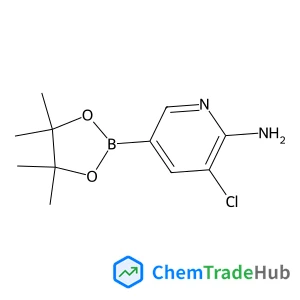
3-Chloro-5-(4,4,5,5-tetramethyl-1,3,2-dioxaborolan-2-yl)-2-pyridinamine
CAS番号:
1032758-99-8
分子式:
C11H16BClN2O2
![5-Methyl-4,5,6,7-tetrahydropyrazolo[1,5-a]pyrazin-2-amine structure](https://static.chemtradehub.com/structs/122/1227210-33-4-8d64.webp "5-Methyl-4,5,6,7-tetrahydropyrazolo[1,5-a]pyrazin-2-amine structure")
おすすめサプライヤー





免責事項
このページに表示される学術雑誌情報は、参考および研究目的のみを目的としています。当社は雑誌出版社とは提携しておらず、投稿の取り扱いも行っておりません。出版に関するお問い合わせは、各雑誌出版社に直接ご連絡ください。
表示されている情報に誤りがある場合は、support@chemtradehub.com までご連絡ください。迅速に確認し、対応いたします。