












A novel DNA tetrahedron–hairpin probe for in situ “off–on” fluorescence imaging of intracellular telomerase activity
文献情報
出版日
2016-03-08
DOI
10.1039/C6AN00241B
インパクトファクター
4.616
著者
Qiu-Mei Feng, Meng-Jiao Zhu, Ting-Ting Zhang, Jing-Juan Xu, Hong-Yuan Chen
原文を見る
要旨
A novel three-dimensionally structured DNA probe is reported to realize in situ “off–on” imaging of intracellular telomerase activity. The probe consists of a DNA tetrahedron and a hairpin DNA on one of the vertices of the DNA tetrahedron. It is composed of four modified DNA segments: S1–Au nanoparticle (NP) inserting a telomerase strand primer (TSP) and S2–S4, three Cy5 dye modified DNA segments. Fluorescence of Cy5 at three vertices of the DNA tetrahedron is quenched by the Au NP at the other vertex due to the effective fluorescence resonance energy transfer (FRET) (“off” state). When the probe meets telomerase, the hairpin structure changes to rod-like through complementary hybridization with the telomerase-triggered stem elongation product, resulting in a large distance between the Au NP and Cy5 and the recovery of Cy5 fluorescence (“on” state). The molar ratio of 3 : 1 between the reporter (Cy5) and the target related TSP makes the probe show high sensitivity and recovery efficiency of Cy5 in the presence of telomerase extracted from HeLa cells. Given the functional and compact nanostructure, the mechanically stable and noncytotoxic nature of the DNA tetrahedron, this FRET-based probe provides more opportunities for biosensing, molecular imaging and drug delivery.
関連文献
Deep core photoionization of iodine in CH3I and CF3I molecules: how deep down does the chemical shift reach?
Nacer Boudjemia, Kari Jänkälä, Kenji Tamasaku, Marko Huttula, Masaki Oura
2019-02-11
Paper
DOI: 10.1039/C8CP07307D
Tuning polaronic redox behavior in olivine phosphate
Yue Gu, Mouyi Weng, Gaofeng Teng, Hua Zeng, Jianshu Jie, Weiji Xiao, Jiaxin Zheng, Feng Pan
2019-01-31
Paper
DOI: 10.1039/C8CP06083E
Neural network force fields for simple metals and semiconductors: construction and application to the calculation of phonons and melting temperatures
Mário R. G. Marques, Jakob Wolff, Conrad Steigemann, Miguel A. L. Marques
2019-03-07
Paper
DOI: 10.1039/C8CP05771K
The impact of chemical order on defect transport in mixed pyrochlores
Blas P. Uberuaga, Romain Perriot, Ghanshyam Pilania
2019-02-19
Paper
DOI: 10.1039/C8CP07597B
Rotational (de)-excitation of linear C3O by collision with He
Fehmi Khadri, Kamel Hammami
2019-01-29
Paper
DOI: 10.1039/C8CP07409G
Excitation of singlet–triplet coherences in pairs of nearly-equivalent spins
Christian Bengs, Joseph T. Hill-Cousins, Lynda J. Brown, Richard C. D. Brown, Giuseppe Pileio, Malcolm H. Levitt
2019-02-18
Paper
DOI: 10.1039/C9CP00451C
Theoretical study of the adsorption of hydrogen on cobalt clusters
Kevin García-Díez, Julio Fernández-Fernández, María J. López
2018-07-20
Paper
DOI: 10.1039/C8CP03048K
Electron localization in niobium doped CaMnO3 due to the energy difference of electronic states of Mn and Nb
Yi Li, Jian Liu, Ji-Chao Li, Yu-Fei Chen, Xin-Miao Zhang, Xue-Jin Wang, Fu-Ning Wang, Wen-Bin Su, Lan-Ling Zhao, Chun-Lei Wang
2018-07-23
Paper
DOI: 10.1039/C8CP02783H
Quantitative analysis of 14N quadrupolar coupling using 1H detected 14N solid-state NMR
James A. Jarvis, Maria Concistre, Richard W. Bounds, Ilya Kuprov, Marina Carravetta, Philip T. F. Williamson
2019-02-27
Paper
DOI: 10.1039/C8CP06276E
こちらもおすすめ
化合物よくある質問
2-ブロモ-9,9-ジフェニル-9H-フルオレンの主な用途は何ですか?
2-溴-9,9-二苯基芴は、医薬品、工業材料、有機合成の研究分野で応用されます。特に、レーザー材料や機能性ポリマーの合成に使用されることがあります。また、蛍光色...
474918-32-62-Bromo-9,9-diphenyl...
化合物よくある質問
四氯化铱の市場動向や研究トレンドはどうですか?
四氯化铱の市場は研究開発分野で注目されており、特にナノ技術や金属有機框架(MOFs)の分野での需要が増加傾向にあります。価格は安定しており、中国や韓国での生産が...
207399-11-9Tetrachloroiridium h...
882-06-44-Nitrocinnamic acid
化合物よくある質問
1-(4-溴-3-氟苯基)-2-氯乙酮を含む廃棄物はどのように処理すべきですか?
1-(4-溴-3-氟苯基)-2-氯乙酮 (CAS番号: 1260857-14-4) の廃棄物は専門的な廃棄処理が必要です。まず、廃棄物は密閉された容器に収集し、...
1260857-14-41-(4-Bromo-3-fluorop...
化合物よくある質問
苦参酚Kとは何ですか?
苦参酚Kは、CAS番号101236-49-1を持つ化合物で、主に天然由来の生薬から抽出されます。この化合物は、抗炎症作用や抗癌作用を持つことが報告されています。
101236-49-1Kushenol K
化合物よくある質問
POTASSIUM (1-(TERTBUTOXYCARBONYL)AZETIDIN-3-YL)TRIFLUOROBORATE を含む廃棄物はどのように処理すべきですか?
POTASSIUM (1-(TERTBUTOXYCARBONYL)AZETIDIN-3-YL)TRIFLUOROBORATE を含む廃棄物は、まず安全なエント...
1430219-73-0Potassium (1-(tert-b...
化合物よくある質問
4-庚基-4’-联苯羧酸の市場動向や研究トレンドはどうですか?
4-庚基-4’-聯苯羧酸は、特殊化学品や合成化学の分野で用いられる化学物質ですが、市場動向としては、研究開発の進展とともに需要が増加しています。また、環境配慮型...
58573-94-74'-Heptyl-4-biphenyl...
化合物よくある質問
6-ブロモ-3-メトキシ-1-フェニル-1H-インドゾールを含む廃棄物はどのように処理すべきですか?
6-ブロモ-3-メトキシ-1-フェニル-1H-インドゾールを含む廃棄物は、適切な化学廃棄処理が必要です。通常、廃棄物は密閉容器に収集され、専門の廃棄処理業者に引...
1332527-03-36-Bromo-3-methoxy-1-...
化合物よくある質問
4,4-二甲基-2-吡咯烷酮はどの業界で使用されていますか?
4,4-二甲基-2-吡咯烷酮は医薬、ポリマー、センサー、半導体などの業界で広く使用されています。特に溶媒としての性能が高く評価されています。
66899-02-34,4-dimethylpyrrolid...
51312-42-6Sodium Phosphotungst...
掲載誌
Analyst

CiteScore:
7.8
自己引用率:
5.6%
年間論文数:
653
Analyst publishes analytical and bioanalytical research that reports premier fundamental discoveries and inventions, and the applications of those discoveries, unconfined by traditional discipline barriers.
おすすめ化合物
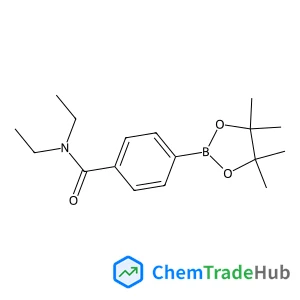
N,N-Diethyl-4-(4,4,5,5-tetramethyl-1,3,2-dioxaborolan-2-yl)benzamide
CAS番号:
325142-99-2
分子式:
C17H26BNO3
おすすめサプライヤー






免責事項
このページに表示される学術雑誌情報は、参考および研究目的のみを目的としています。当社は雑誌出版社とは提携しておらず、投稿の取り扱いも行っておりません。出版に関するお問い合わせは、各雑誌出版社に直接ご連絡ください。
表示されている情報に誤りがある場合は、support@chemtradehub.com までご連絡ください。迅速に確認し、対応いたします。