



Real-time monitoring of calcification process by Sporosarcina pasteurii biofilm
文献情報
出版日
2016-02-29
DOI
10.1039/C6AN00007J
インパクトファクター
4.616
著者
Dustin Harris, Jyothir Ganesh Ummadi, Andrew R. Thurber, Yvan Allau, Circe Verba, Frederick Colwell, Marta E. Torres, Dipankar Koley
原文を見る
要旨
Sporosarcina pasteurii is known to produce calcite or biocement in the presence of urea and Ca2+. Herein, we report the use of novel ultramicrosensors such as pH, Ca2+, and redox sensors, along with a scanning electrochemical microscope (SECM), to monitor a real-time, bacteria-mediated urea hydrolysis process and subsequent changes in morphology due to CaCO3 precipitation. We report that the surface pH of a live biofilm changed rapidly from 7.4 to 9.2 within 2 min, whereas similar fast depletion (10 min) of Ca2+ was observed from 85 mM to 10 mM in the presence of a high urea (10 g L−1) brine solution at 23 °C. Both the pH and the Ca2+ concentration profiles were extended up to 600 μm from the biofilm surface, whereas the bulk chemical composition of the brine solution remained constant over the entire 4 h of SECM experiments. In addition, we observed a change in biofilm surface morphology and an increase in overall biofilm height of 50 μm after 4 h of precipitation. Electron microscopy confirmed the changes in surface morphology and formation of CaCO3 crystals. Development of the Ca2+ profile took 10 min, whereas that of the pH profile took 2 min. This finding indicates that the initial urea hydrolysis process is fast and limited by urease or number of bacteria, whereas later CaCO3 formation and growth of crystals is a slow chemical process. The ultramicrosensors and approaches employed here are capable of accurately characterizing bioremediation on temporal and spatial scales pertinent to the microbial communities and the processes they mediate.
おすすめジャーナル

Chemical Communications

Russian Journal of General Chemistry

Organic Process Research & Development

New Journal of Chemistry

Russian Journal of Coordination Chemistry

Journal of Saudi Chemical Society

Russian Journal of Applied Chemistry

Saudi Pharmaceutical Journal

Drug Discovery Today

Current Opinion in Colloid & Interface Science
関連文献
On the benchmarking of multi-junction photoelectrochemical fuel generating devices
David Lackner, Jens Ohlmann, Frank Dimroth, Roel van de Krol, Thomas Hannappel, Klaus Schwarzburg
2017-01-25
Paper
DOI: 10.1039/C6SE00083E
Conversion of landfill gas to liquid fuels through a TriFTS (tri-reforming and Fischer–Tropsch synthesis) process: a feasibility study
Xianhui Zhao, Ahmad Naqi, Devin M. Walker, Tim Roberge, Matthew Kastelic
2018-12-26
Paper
DOI: 10.1039/C8SE00344K
The use of silver nanoparticles for the recovery of uranium from seawater by means of biofouling mitigation
Margaret Flicker Byers, Sheldon Landsberger, Erich Schneider
2018-08-17
Paper
DOI: 10.1039/C8SE00228B
The improved ion clustering and conductivity of a di-quaternized poly(arylene ether ketone sulfone)-based alkaline fuel cell membrane
2017-04-11
Paper
DOI: 10.1039/C7SE00097A
Performance evaluation of a yeast biorefinery as a sustainable model for co-production of biomass, bioemulsifier, lipid, biodiesel and animal-feed components using inexpensive raw materials
RaviRanjan Kumar, Gunaseelan Dhanarajan, Moumita Bhaumik, Ramkrishna Sen
2017-04-24
Paper
DOI: 10.1039/C7SE00010C
こちらもおすすめ
化合物よくある質問
カルボニル基が付いた5-氰基-1-{[(2-メチル-2-プロpanyl)オキシ]カーボンイル}1H-吲哚-2-イリド-2-ボリン酸はどのように保存すればよいですか?
カルボニル基が付いた5-氰基-1-{[(2-メチル-2-プロpanyl)オキシ]カーボンイル}1H-吲哚-2-イリド-2-ボリン酸は、直射日光を避けて室温(15...
475102-15-9(5-Cyano-1-{[(2-meth...
化合物よくある質問
tert-ブチル2-クロロメチルピリジン-3-基炭酸エステルの市場動向や研究トレンドはどうですか?
この化合物は合成化学分野において、特にピリジン化合物の合成や改良に用いられます。最近の研究では、ピリジン化合物の新規合成法や特性の改良が注目されています。市場動...
1203498-98-9tert-Butyl 2-chloro-...
化合物よくある質問
聚二季戊四醇六丙烯酸酯はどの業界で使用されていますか?
聚二季戊四醇六丙烯酸酯は、医薬品、ポリマー、センサー、半導体などの業界で広く使用されています。特にポリマー業界では硬化剤として、医薬分野では医療機器の製造に使用...
29570-58-93-(Acryloyloxy)-2-({...
化合物よくある質問
1-氯-5-硝基异喹啉の市場動向や研究トレンドはどうですか?
1-氯-5-硝基异喹啉は、薬理学や合成化学の研究分野で注目されています。市場動向としては、その生物学的な活性や合成可能性を評価する研究が増えています。また、代替...
58142-97-51-Chloro-5-nitroisoq...
化合物よくある質問
2-チロール-5-メチルスルフェニル-3-trifルオルメチルベンゼンはどのように合成されますか?
2-チロール-5-メチルスルフェニル-3-trifルオルメチルベンゼンは、トリフルオロメチル化反応と硫化反応を経て合成されます。通常、トリフルオロメチル化剤と硫...
957066-04-51-Chloro-4-(methylsu...
化合物よくある質問
p-トールイルマグネシウムブロミドの物理化学的性質は何ですか?
p-トールイルマグネシウムブロミドのCAS番号は4294-57-9です。この化合物は白色の結晶性粉末で、分子量は204.32です。溶剤中で良好に溶解しますが、水...
4294-57-9p-Tolylmagnesium bro...
化合物よくある質問
1-(5-甲基-2-硫化素基)プロパン-1-酮の市場動向や研究トレンドはどうですか?
1-(5-甲基-2-硫化素基)プロパン-1-酮の市場動向は、化学産業全体の需要に影響を受けますが、最近では pharmaceutical 分野での応用が注目され...
59303-13-81-(5-Methyl-2-thieny...
化合物よくある質問
十一碳烯酰甘氨酸を取り扱う際の実験室安全事項は何ですか?
十一碳烯酰甘氨酸は吸入や皮膚から吸収されることがあり、取り扱う際には防塵マスクと手袋を使用してください。ドラフトチャンバーを用いて漏洩を処理し、適切なSDS(S...
54301-26-7N-10-Undecenoylglyci...
化合物よくある質問
1H,1H-全氟-3,6-二氧杂葵-1-醇を取り扱う際の実験室安全事項は何ですか?
この化合物は吸入や皮膚吸収による毒性があるため、防塵マスク、ゴーグル、防護手袋を使用する必要があります。ドラフトチャンバーでの操作が必要です。漏洩時には即座に換...
152914-73-32,2-Difluoro-2-[1,1,...
化合物よくある質問
3-(4-(フルオロメチルオキシ)フェニル)-1,2,4-オキサジアゾール-5-カルボハイドライドは安全ですか?
安全性は化合物の使用方法によります。直接的な毒性は報告されていませんが、吸入や皮膚接触には注意が必要です。適切な防護服を着用し、換気を図ることを推奨します。
883028-82-83-(4-(Trifluorometho...
掲載誌
Analyst

CiteScore:
7.8
自己引用率:
5.6%
年間論文数:
653
Analyst publishes analytical and bioanalytical research that reports premier fundamental discoveries and inventions, and the applications of those discoveries, unconfined by traditional discipline barriers.
おすすめ化合物

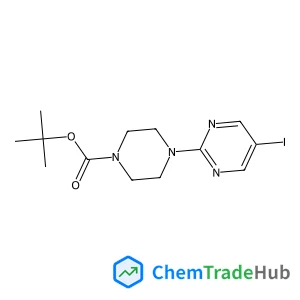
2-Methyl-2-propanyl 4-(5-iodo-2-pyrimidinyl)-1-piperazinecarboxylate
CAS番号:
1027616-32-5
分子式:
C13H19IN4O2

おすすめサプライヤー




免責事項
このページに表示される学術雑誌情報は、参考および研究目的のみを目的としています。当社は雑誌出版社とは提携しておらず、投稿の取り扱いも行っておりません。出版に関するお問い合わせは、各雑誌出版社に直接ご連絡ください。
表示されている情報に誤りがある場合は、support@chemtradehub.com までご連絡ください。迅速に確認し、対応いたします。