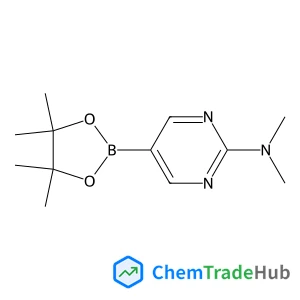
N,N-Dimethyl-5-(4,4,5,5-tetramethyl-1,3,2-dioxaborolan-2-yl)-2-pyrimidinamine
CAS番号:
1032759-30-0
分子式:
C12H20BN3O2
Bobing Hu, Yunlong Wang, Zhuoying Zhu, Changrong Xia
The oxygen release kinetics of mixed-conducting Sr2Fe1.5Mo0.5O6−δ–Sm0.2Ce0.8O2−δ (SFM–SDC) dual-phase composites has been investigated, at 750 °C, as a function of the SDC phase volume fraction using electrical conductivity relaxation (ECR) under reducing atmospheres, extending our previous work on the oxygen incorporation kinetics of these composites under oxidizing conditions. Gas mixtures of H2/H2O and CO/CO2 were used to control step changes in the oxygen partial pressure (pO2) in the range 10−24 to 10−20 atm. At the conditions of the experiments, oxygen re-equilibration is entirely controlled by the surface exchange kinetics. A model is developed which allows deconvolution of the effective time constant of the relaxation process in terms of the intrinsic contributions of the components to oxygen surface exchange and synergetic contributions caused by heterogeneous interfaces. The oxygen surface exchange kinetics under H2/H2O atmosphere is found to be a weighted average of the intrinsic contributions of SFM and SDC phases. No evidence is found for an enhanced exchange rate at the SFM–SDC–gas triple phase boundaries (TPB). Synergetic contributions arise under CO/CO2 atmosphere, enhancing the rate of oxygen surface exchange up to a factor of 2.4. The obtained results are discussed in terms of the surface microstructure of the composites from image analysis. Overall, the results of this and our previous study confirm that the triple phase boundaries in SFM–SDC composites significantly accelerate the oxygen incorporation kinetics under oxidizing conditions, but only modestly, or even negligibly, influence the oxygen release kinetics under reducing conditions.

Science Progress

Journal of Physics and Chemistry of Solids

Molecular Pharmacology

European Journal of Wood and Wood Products

Proceedings of the National Academy of Sciences of the United States of America

Russian Chemical Reviews

Journal of Catalysis

Journal of Medicinal Chemistry

Kinetics and Catalysis

Fibre Chemistry
Yao Huang, Wen-Jing Pan
DOI: 10.1039/C9QO00489K
Bo Wang, Yuankai Wang, Zixuan Wang
DOI: 10.1039/C9QO00403C
Xiao-Wen Zhang, Di Wu, Zheng-Hui Guan, Wen-Bo Liu
DOI: 10.1039/C9QO00017H
Xu-Qing Wang, Wei Wang, Wei-Jian Li, Yi Qin, Wei-Ling Jiang, Xiaopeng Li, Shuai Wu, Hai-Bo Yang
DOI: 10.1039/C9QO00308H
Xiao-Rui Ren, Jun-Bing Lin, Xiu-Qin Hu, Peng-Fei Xu
DOI: 10.1039/C9QO00357F
Jen-Chieh Hsieh, Ya-Chun Hong, Chun-Ming Yang, Subramaniyan Mannathan, Chien-Hong Cheng
DOI: 10.1039/C7QO00321H
Kang-Hua Rui
DOI: 10.1039/C9QO00343F
Surabhi Gupta, Siddharth Baranwal, Priyanka Chaudhary, Jeyakumar Kandasamy
DOI: 10.1039/C9QO00469F
Wan Gao, Jian-Shuang Jiang, Zhong Chen, Ya-Nan Yang, Zi-Ming Feng, Xu Zhang, Xiang Yuan, Pei-Cheng Zhang
DOI: 10.1039/C9QO00279K
6- bromo-1-cyclopropyl-1H-benzimidazoleは、抗炎症、抗ウイルス作用を持つことが報告されており、新薬開発の研究対象として注目...
取り扱う際には、防護眼鏡と手袋を使用し、ドラフトチャンバー内で操作することを推奨します。漏洩時には適切な手順で処理し、安全データシートを常に参照してください。
2,2’-ジメチル-3,3’-ビピリジンは、ピリジンと2-メチルアクリルアミドを有機合成反応で合成します。この反応では、ピリジンと2-メチルアクリルアミドを含有...
6-甲基ピリジン-2-ボリック酸は、合成化学、医薬品合成、以及研究用途などに広く使用され、特に組換えDNA技術や分子生物学の研究において重要な役割を果たします。
(R)-3-(1-甲基-2-氧環己基)プロpano酸メチルは一定の安全性がありますが、直接的な皮膚接触や吸入は避けるべきです。使用する際は適切な個々の安全データ...
ketorolacは、密封して遮光容器に保管し、直射日光や高温を避けて保存してください。温度は常温で保存し、湿度をなるべく低く保つことが推奨されます。
L-2,3-二氨基丙酸二盐酸盐は腐食性が強く、皮膚や粘膜に刺激を与える可能性があります。取り扱う際は、防塵マスク、ゴーグル、手袋を使用し、適切な排気設備を使用し...
2-(4-溴ピリジン-2-基)乙腈のCAS番号は312325-73-8です。主に結晶形態で存在し、分子量は159.01 g/molです。この化合物は水に溶けやす...
この化合物は毒性は低いですが、直接的な接触や吸入に注意が必要です。PPE(個人防護具)を着用し、ドラフトチャンバーを使用して操作することを推奨します。また、漏洩...
3-(1-氧代-1,3-二氢-2H-2-异吲哚)丙酸は、薬理学研究や医薬品製造において広く用いられる化合物です。また、工業的な用途でも一部の化学反応の触媒や助剤...

Journal of Materials Chemistry A, B & C cover high quality studies across all fields of materials chemistry. The journals focus on those theoretical or experimental studies that report new understanding, applications, properties and synthesis of materials. The journals have a strong history of publishing quality reports of interest to interdisciplinary communities and providing an efficient and rigorous service through peer review and publication. The journals are led by an international team of Editors-in-Chief and Associate Editors who are all active researchers in their fields. Journal of Materials Chemistry A, B & C are separated by the intended application of the material studied. Broadly, applications in energy and sustainability are of interest to Journal of Materials Chemistry A, applications in biology and medicine are of interest to Journal of Materials Chemistry B, and applications in optical, magnetic and electronic devices are of interest to Journal of Materials Chemistry C. More than one Journal of Materials Chemistry journal may be suitable for certain fields and researchers are encouraged to submit their paper to the journal that they feel best fits for their particular article. Example topic areas within the scope of Journal of Materials Chemistry A are listed below. This list is neither exhaustive nor exclusive. Artificial photosynthesis Batteries Carbon dioxide conversion Catalysis Fuel cells Gas capture/separation/storage Green/sustainable materials Hydrogen generation Hydrogen storage Photocatalysis Photovoltaics Self-cleaning materials Self-healing materials Sensors Supercapacitors Thermoelectrics Water splitting Water treatment
![4-[(3-Chloro-2-fluorophenyl)amino]-7-methoxy-6-quinazolinyl acetate structure](https://static.chemtradehub.com/structs/740/740081-22-5-f58f.webp "4-[(3-Chloro-2-fluorophenyl)amino]-7-methoxy-6-quinazolinyl acetate structure")
![6-Bromo-2,3-dihydro-1H-pyrido[2,3-b][1,4]oxazine structure](https://static.chemtradehub.com/structs/120/1203499-17-5-b4d1.webp "6-Bromo-2,3-dihydro-1H-pyrido[2,3-b][1,4]oxazine structure")