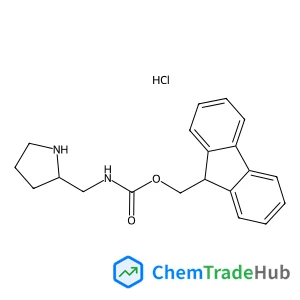
(S)-(9H-Fluoren-9-yl)methyl (pyrrolidin-2-ylmethyl)carbamate hydrochloride
CAS番号:
1217813-15-4
分子式:
C20H23ClN2O2
Filipe Gomes, Vanessa Narbonne, Florent Blanchard
We developed a simple and convenient method to assemble biaryls exploiting a photoredox catalyst and visible light. Diazonium salts generate aryl radicals that could then add on unactivated (hetero)arenes and the sequence eventually delivers products via formal homolytic aromatic substitutions. The direct C–H arylation of these usually unreactive substrates is achieved at room temperature using low catalyst loadings and shows broad functional group tolerance.

Chinese Journal of Chemistry

NDT & E International

Biocatalysis and Biotransformation

Critical Reviews in Solid State and Materials Sciences

Herald of the Russian Academy of Sciences

Polycyclic Aromatic Compounds

Medicinal Chemistry Research

Journal of the Indian Institute of Science

Bioorganic & Medicinal Chemistry

Atomization and Sprays
Saikat Guria, Mirja Md Mahamudul Hassan, Buddhadeb Chattopadhyay
DOI: 10.1039/D3QO01931D
Ganesh Sambasivam, Karthikeyan Sivashanmugam
DOI: 10.1039/D3OB90144K
Adrián Luguera Ruiz, Elena Mariani, Stefano Protti, Maurizio Fagnoni
DOI: 10.1039/D3QO01856C
Zi-Jun Lei, Yue-Yue Zhang, Hui-Ling Lu, Fu-Gang Zhao, Jian-Hai Zhou, Xiaogang Peng
DOI: 10.1039/D3QO01560B
Baihui Liang, Xiangya Cai, JingYu Liu, Jie Huang, Youzhi Chen, Haiyin Deng, Quanquan Zhou, Tianxiang Chen, Xiuwen Chen, Zhongzhi Zhu
DOI: 10.1039/D3QO01565C
Jingli Zhang, Weipeng Xu, Du Wang, Ye Yuan, Yongqi Bai, Minyan Wang, Taolei Sun
DOI: 10.1039/D3QO01776A
Naveen Sihag, Hemaang Bhartiya, M. Ramu Yadav
DOI: 10.1039/D3QO01603J
Vincent Silber, Marion Jean, Nicolas Vanthuyne, Natalia Del Rio, Paola Matozzo, Jeanne Crassous, Romain Ruppert
DOI: 10.1039/D3OB01459B
Xiao-Di Su, Qing-Shuang Zhang, Bei-Bei Zhang, Lin He, Qiang Liu, Xiang-Yu Chen
DOI: 10.1039/D3QO01719B
6-苄基-6,7-二氢-5H-吡咯并3,4-b吡啶は、CAS番号109966-30-5の化合物です。これは、6-ベンジル基を持つ6,7-二氢-5H-吡咯並みの化...
半硫酸奎宁单水水合物は、乾燥した涼しい場所に保管し、直射日光や湿気を避ける必要があります。保存温度は常温(15〜25℃)が適切で、湿度は40%以下を維持すること...
D-核糖-5-リン酸二ナトリウムは、CAS番号18265-46-8を有する化合物で、D-核糖の5位付加部位にリン酸基が結合した化合物です。この化合物は、水溶性で...
3-乙酰基-4-羟基喹啉-2(1H)-酮は、ハイドロキノンと酢酸アセトイルアミドのアミド化反応により合成されます。この反応は塩基触媒を用いて行われ、選択性は良好...
5-溴-4-甲基-1H-吲唑は、CAS番号1082041-34-6の化学物質で、化学式はC10H9BrNです。この化合物は淡黄色の結晶性粉末で、吸湿性があります...
3-(4メトキシフェニル)オキテナン-3カーボイル酸の代替品は、その用途により異なりますが、例えば4-(メトキシフェニル)オキテナン-3カーボイル酸や、他のオキ...
3-イリドオキシピロロ[2,3-b]ピリジン-5-カルボキシlic酸は危険な化合物ではありませんが、適切な手袋や保護眼鏡の使用を推奨します。誤って摂取または接触...
3-氟-4- iodobenolは可燃性を有し、強力な反応性を持つため、取り扱いには注意が必要です。PPE(個人保護具)の着用、ドラフトチャンバーの使用、漏洩時...

Organic Chemistry Frontiers publishes high-quality research from across organic chemistry. Emphases are placed on studies that make significant contributions to the field of organic chemistry by reporting either new or significantly improved protocols or methodologies. Topics include, but are not limited to the following: Organic synthesis Development of synthetic methodologies Catalysis Natural products Functional organic materials Supramolecular and macromolecular chemistry Physical and computational organic chemistry
![[(5-Methyl-1,3,4-thiadiazol-2-yl)sulfanyl]acetic acid structure](https://static.chemtradehub.com/structs/509/50918-26-8-4ce8.webp "[(5-Methyl-1,3,4-thiadiazol-2-yl)sulfanyl]acetic acid structure")