












Time-resolved fluctuation during the photochemical reaction of a photoreceptor protein: phototropin1LOV2-linker
文献情報
出版日
2016-01-27
DOI
10.1039/C5CP07472J
インパクトファクター
3.676
著者
Kunisato Kuroi, Francielle Sato, Yusuke Nakasone, Kazunori Zikihara, Satoru Tokutomi, Masahide Terazima
原文を見る
要旨
Although the relationship between structural fluctuations and reactions is important for elucidating reaction mechanisms, experimental data describing such fluctuations of reaction intermediates are sparse. In order to investigate structural fluctuations during a protein reaction, the compressibilities of intermediate species after photoexcitation of a phot1LOV2-linker, which is a typical LOV domain protein with the C-terminal linker including the J-α helix and used recently for optogenetics, were measured in the time-domain by the transient grating and transient lens methods with a high pressure optical cell. The yield of covalent bond formation between the chromophore and a Cys residue (S state formation) relative to that at 0.1 MPa decreased very slightly with increasing pressure. The fraction of the reactive species that yields the T state (linker-unfolded state) decreased almost proportionally with pressure (0.1–200 MPa) to about 65%. Interestingly, the volume change associated with the reaction was much more pressure sensitive. By combining these data, the compressibility changes for the short lived intermediate (S state) and the final product (T state) formation were determined. The compressibility of the S state was found to increase compared with the dark (D) state, and the compressibility decreased during the transition from the S state to the T state. The compressibility change is discussed in terms of cavities inside the protein. By comparing the crystal structures of the phot1LOV2-linker at dark and light states, we concluded that the cavity volumes between the LOV domain and the linker domain increase in the S state, which explains the enhanced compressibility.
関連文献
Robust porphyrincatalysts immobilized on biogenous iron oxide for the repetitive conversions of epoxides and CO2 into cyclic carbonates
Tadashi Ema, Yuki Miyazaki, Tomoya Taniguchi, Jun Takada
2013-07-18
Paper
DOI: 10.1039/C3GC41055B
H2O2-mediated oxidative formation of amides from aromatic amines and 1,3-diketones as acylation agents via C–C bond cleavage at room temperature in water under metal-free conditions
Xi Sun, Min Wang, Pinhua Li
2013-09-16
Communication
DOI: 10.1039/C3GC41260A
Direct, one-pot synthesis of POCOP-type pincer complexes from metallic nickel
Boris Vabre, Fabien Lindeperg, Davit Zargarian
2013-07-22
Paper
DOI: 10.1039/C3GC40968F
Lewis acid–surfactant-combined catalyzed synthesis of 4-aminocyclopentenones from glycals in water
Siming Wang, Ronny William, Kim Kui Georgina Estelle Seah, Xue-Wei Liu
2013-08-27
Communication
DOI: 10.1039/C3GC41032C
Thiazolyl-phosphine hydrochloride salts: effective auxiliary ligands for ruthenium-catalyzed nitrile hydration reactions and related amide bond forming processes in water
Rocío García-Álvarez, Pascale Crochet, Carine Duhayon, Jean-Pierre Majoral, Victorio Cadierno
2013-07-22
Paper
DOI: 10.1039/C3GC41201F
Catalyst-free facile synthesis of 2-substituted benzothiazoles
Siva S. Panda, Alexander A. Oliferenko
2013-08-09
Communication
DOI: 10.1039/C3GC41255E
Ru-based magnetic nanoparticles (MNP) for succinic acid synthesis from levulinic acid
Iunia Podolean, Victor Kuncser, Nicoleta Gheorghe, Dan Macovei, Vasile I. Parvulescu, Simona M. Coman
2013-08-14
Paper
DOI: 10.1039/C3GC41120F
Photocatalytic selective oxidation of the terminal methyl group of dodecane with molecular oxygen over atomically dispersed Ti in a mesoporous SiO2 matrix
Jae Yul Kim, Ji-Wook Jang, Duck Hyun Youn, Eun Sun Kim, Sun Hee Choi, Tae Joo Shin, Jae Sung Lee
2013-09-12
Paper
DOI: 10.1039/C3GC41343H
Direct oxidation of secondary alcohol to ester by performic acid
Xiao-Hong Li, Xiang-Guang Meng, Ying Liu, Xiao Peng
2013-09-25
Paper
DOI: 10.1039/C3GC41198B
THF co-solvent enhances hydrocarbon fuel precursor yields from lignocellulosic biomass
Rajeev Kumar
2013-08-14
Communication
DOI: 10.1039/C3GC41214H
こちらもおすすめ
化合物よくある質問
2-ヒドロキシ-5-ニトロベンジンブロモイドの代替品はありますか?
2-ヒドロキシ-5-ニトロベンジンブロモイドは特定の化学反応に適しているため、代替品は限られています。しかし、同様の構造を持つ2-ヒドロキシ-4-ニトロベンジン...
772-33-82-(Bromomethyl)-4-ni...
化合物よくある質問
N-(2-ブロモフェニル)-1-チロール-3-オキソ-3-(ピペリジニル)プロペン-2-イル)ベンゼンアミドを取り扱う際の実験室安全事項は何ですか?
N-(2-ブロモフェニル)-1-チロール-3-オキソ-3-(ピペリジニル)プロペン-2-イル)ベンゼンアミドは有毒で、皮膚や粘膜に刺激を与える可能性があります。...
1800044-77-2N-[(1Z)-1-(2-Bromoph...
化合物よくある質問
1,3プロパンジオール,2-[2-(2アミノ-6クロロ-9Hピリミジン-9-イル)エチル-1,1,2,2-D4]-2,3-ジアセタートの市場動向や研究トレンドはどうですか?
この化合物は、新規治療薬の開発に注目されています。市場では、その有効性と安全性が評価され、研究分野では、分子生物学と医薬化学の新たな発見が期待されています。
1020718-81-31,3-Propanediol, 2-[...
579-44-2Ethanone, 2-hydroxy-...
化合物よくある質問
Succinimidyl-alanyl-phenylalanyl-prolyl-phenylalanine 4-nitroanilide はどの業界で使用されていますか?
Succinimidyl-alanyl-phenylalanyl-prolyl-phenylalanine 4-nitroanilide は主に医薬品開発やポ...
128802-73-3succinimidyl-alanyl-...
化合物よくある質問
メチル6-アミノ-5-クロロピリジン-2-カーボイル酸について、適用される法規ガイドラインは何ですか?
メチル6-アミノ-5-クロロピリジン-2-カーボイル酸(CAS番号: 1256794-05-4)の使用には、GHS( Globally Harmonized S...
1256794-05-4Methyl 6-amino-5-chl...
化合物よくある質問
エチル4-(シクロ Pentagonyl)アミノ-2-メチル硫化基ピリミジン-5-カルボキシレートを取り扱う際の実験室安全事項は何ですか?
取り扱いには、耐薬品性の容器を使用し、通気性の良い場所で操作することを推奨します。漏れ時は、SDS(安全データシート)を参照して適切な措置を取ること。手洗いと洗...
211245-62-4ethyl 4-(cyclopentyl...
化合物よくある質問
(S)-3-ベンZYルピペリジン塩酸塩とは何ですか?
(S)-3-ベンZYルピペリジン塩酸塩は、CAS番号1258940-00-9で表される化合物です。これは、(S)-3-苯基哌啶的盐酸盐であり、主に医薬品の原料と...
1258940-00-9(S)-3-Phenylpiperidi...
化合物よくある質問
3,5-二甲基金剛胺の主な用途は何ですか?
3,5-二甲基金剛胺は、主に医薬品の原料として使用され、また抗うつ薬や抗アルツハイマー薬の開発に利用されます。さらに、化粧品や食品添加物の製造でも重要な役割を果...
19988-45-52-(2,3-Dihydroxyphen...
化合物よくある質問
ビス(4-メチル-2-ペンチル)フェニルカルボン酸エステルの代替品はありますか?
ビス(4-メチル-2-ペンチル)フェニルカルボン酸エステル (CAS番号: 1398066-13-1) の代替品には、ビス(2-エチルヘキシル)フェノールカルボ...
1398066-13-1Bis(4-methyl-2-penty...
掲載誌
Physical Chemistry Chemical Physics

CiteScore:
5.5
自己引用率:
10.3%
年間論文数:
3036
Physical Chemistry Chemical Physics (PCCP) is an international journal co-owned by 19 physical chemistry and physics societies from around the world. This journal publishes original, cutting-edge research in physical chemistry, chemical physics and biophysical chemistry. To be suitable for publication in PCCP, articles must include significant innovation and/or insight into physical chemistry; this is the most important criterion that reviewers and Editors will judge against when evaluating submissions. The journal has a broad scope and welcomes contributions spanning experiment, theory, computation and data science. Topical coverage includes spectroscopy, dynamics, kinetics, statistical mechanics, thermodynamics, electrochemistry, catalysis, surface science, quantum mechanics, quantum computing and machine learning. Interdisciplinary research areas such as polymers and soft matter, materials, nanoscience, energy, surfaces/interfaces, and biophysical chemistry are welcomed if they demonstrate significant innovation and/or insight into physical chemistry. Joined experimental/theoretical studies are particularly appreciated when complementary and based on up-to-date approaches.
おすすめ化合物
![Methyl 4-({[(2-methyl-2-propanyl)oxy]carbonyl}amino)bicyclo[2.2.2]octane-1-carboxylate structure](https://static.chemtradehub.com/structs/943/943845-74-7-b7e5.webp "Methyl 4-({[(2-methyl-2-propanyl)oxy]carbonyl}amino)bicyclo[2.2.2]octane-1-carboxylate structure")
![2,6-Bis({(2R)-2-[hydroxy(diphenyl)methyl]-1-pyrrolidinyl}methyl)-4-methylphenol structure](https://static.chemtradehub.com/structs/877/877395-58-9-70bf.webp "2,6-Bis({(2R)-2-[hydroxy(diphenyl)methyl]-1-pyrrolidinyl}methyl)-4-methylphenol structure")
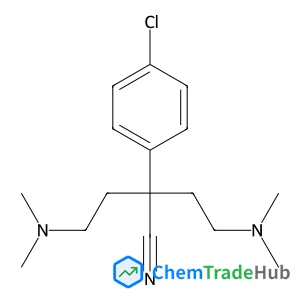
2-(4-Chlorophenyl)-4-(dimethylamino)-2-(2-(dimethylamino)ethyl)butanenitrile
CAS番号:
1246816-57-8
分子式:
C16H24ClN3
おすすめサプライヤー





免責事項
このページに表示される学術雑誌情報は、参考および研究目的のみを目的としています。当社は雑誌出版社とは提携しておらず、投稿の取り扱いも行っておりません。出版に関するお問い合わせは、各雑誌出版社に直接ご連絡ください。
表示されている情報に誤りがある場合は、support@chemtradehub.com までご連絡ください。迅速に確認し、対応いたします。