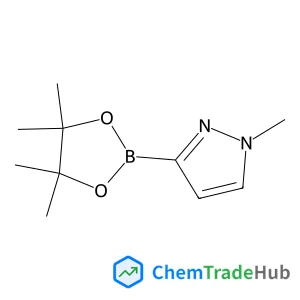
1-Methyl-3-(4,4,5,5-tetramethyl-1,3,2-dioxaborolan-2-yl)-1H-pyrazole
CAS番号:
1020174-04-2
分子式:
C10H17BN2O2
An ab initio quantum dynamics study has been performed to explore the distinct structural symmetry of C(CH3)4+ in the ground electronic state compared to CH4+. Additionally, the underlying details of the highly diffuse and complex vibronic structure of the first photoelectron band of C(CH3)4 have been investigated. Associated potential energy surfaces over the two-dimensional space of nuclear coordinates, subject to the T2 ⊗ (e + t2) Jahn–Teller effect, are established from extensive electronic structure calculations and (then) the nuclear dynamics calculations are done on them via wave packet propagation including the nonadiabatic coupling of the three electronic sheets. The theoretical results are in good agreement with experimental observations. The JT stabilization energies due to T2 ⊗ e, T2 ⊗ t2 and T2 ⊗ (e + t2) distortions in the 2T2 electronic manifold of C(CH3)4+ illustrate that the highest stabilization occurs through the T2 ⊗ t2-JT distortion (in the ground state of C(CH3)4+). However, CH4+ gains such maximum stabilization due to T2 ⊗ (e + t2)-JT distortion. From this novel result and applying the epikernel principle, we propose that the structural evolution of C(CH3)4+ from Td to C3v minimum energy configuration occurs via JT active vibrations of t2 symmetry, whereas CH4+ rearranges to the C2v structure through a combination of JT active e and t2 bending vibrations.

Bioorganic & Medicinal Chemistry Letters

Biocatalysis and Biotransformation

Medicinal Chemistry Research

Herald of the Russian Academy of Sciences

Colloid Journal

Journal of the Indian Institute of Science

Journal of Chemical Sciences

Acta Metallurgica Sinica-English Letters

Critical Reviews in Solid State and Materials Sciences

Heteroatom Chemistry
Danuta Kruk, Christian Goesweiner, Elzbieta Masiewicz, Evrim Umut, Carina Sampl, Hermann Scharfetter
DOI: 10.1039/C8CP03848A
Kyunggu Kim, Hochun Lee
DOI: 10.1039/C8CP03155J
Jingyu Jin, Xiaoyan Li, Jiafeng Geng, Dengwei Jing
DOI: 10.1039/C8CP01838C
Matteo Maestri, Enrique Iglesia
DOI: 10.1039/C8CP01615A
Pengxiang Xu, Jiaping Lin, Liangshun Zhang
DOI: 10.1039/C8CP02062K
Hyunkyung Park, Do Hwan Kim
DOI: 10.1039/C8CP00246K
Ying-Tao Liu, Xue Yin, Xiao-Yong Lai, Xin Wang
DOI: 10.1039/C8CP01069B
Zhichao Chen, Zhigang He, Kaijun Yuan, Dongxu Dai, Xueming Yang, Guorong Wu
DOI: 10.1039/C8CP00883C
Diana Hötger, Markus Etzkorn, Benjamin Wurster, Jan Dreiser, Sebastian Stepanow, Doris Grumelli, Rico Gutzler
DOI: 10.1039/C8CP07463A
2-溴-9,9-二苯基芴は、医薬品、工業材料、有機合成の研究分野で応用されます。特に、レーザー材料や機能性ポリマーの合成に使用されることがあります。また、蛍光色...
四氯化铱の市場は研究開発分野で注目されており、特にナノ技術や金属有機框架(MOFs)の分野での需要が増加傾向にあります。価格は安定しており、中国や韓国での生産が...
1-(4-溴-3-氟苯基)-2-氯乙酮 (CAS番号: 1260857-14-4) の廃棄物は専門的な廃棄処理が必要です。まず、廃棄物は密閉された容器に収集し、...
苦参酚Kは、CAS番号101236-49-1を持つ化合物で、主に天然由来の生薬から抽出されます。この化合物は、抗炎症作用や抗癌作用を持つことが報告されています。
POTASSIUM (1-(TERTBUTOXYCARBONYL)AZETIDIN-3-YL)TRIFLUOROBORATE を含む廃棄物は、まず安全なエント...
4-庚基-4’-聯苯羧酸は、特殊化学品や合成化学の分野で用いられる化学物質ですが、市場動向としては、研究開発の進展とともに需要が増加しています。また、環境配慮型...
6-ブロモ-3-メトキシ-1-フェニル-1H-インドゾールを含む廃棄物は、適切な化学廃棄処理が必要です。通常、廃棄物は密閉容器に収集され、専門の廃棄処理業者に引...
4,4-二甲基-2-吡咯烷酮は医薬、ポリマー、センサー、半導体などの業界で広く使用されています。特に溶媒としての性能が高く評価されています。

Physical Chemistry Chemical Physics (PCCP) is an international journal co-owned by 19 physical chemistry and physics societies from around the world. This journal publishes original, cutting-edge research in physical chemistry, chemical physics and biophysical chemistry. To be suitable for publication in PCCP, articles must include significant innovation and/or insight into physical chemistry; this is the most important criterion that reviewers and Editors will judge against when evaluating submissions. The journal has a broad scope and welcomes contributions spanning experiment, theory, computation and data science. Topical coverage includes spectroscopy, dynamics, kinetics, statistical mechanics, thermodynamics, electrochemistry, catalysis, surface science, quantum mechanics, quantum computing and machine learning. Interdisciplinary research areas such as polymers and soft matter, materials, nanoscience, energy, surfaces/interfaces, and biophysical chemistry are welcomed if they demonstrate significant innovation and/or insight into physical chemistry. Joined experimental/theoretical studies are particularly appreciated when complementary and based on up-to-date approaches.
![N-[(Benzyloxy)carbonyl]serine structure](https://static.chemtradehub.com/structs/276/2768-56-1-77f7.webp "N-[(Benzyloxy)carbonyl]serine structure")
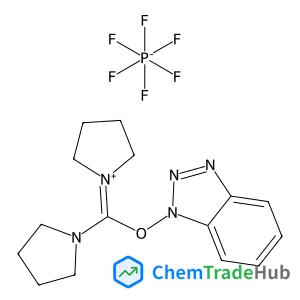
![1,2-Diphenyl-4-[2-(phenylsulfinyl)ethyl]-3,5-pyrazolidinedione structure](https://static.chemtradehub.com/structs/57-/57-96-5-efcc.webp "1,2-Diphenyl-4-[2-(phenylsulfinyl)ethyl]-3,5-pyrazolidinedione structure")