












Quantum mechanical study of the β- and δ-lyase reactions during the base excision repair process: application to FPG
文献情報
出版日
2015-09-02
DOI
10.1039/C5CP04250J
インパクトファクター
3.676
著者
Shahin Sowlati-Hashjin, Stacey D. Wetmore
原文を見る
要旨
Bacterial FPG (or MutM) is a bifunctional DNA glycosylase that is primarily responsible for excising 8-oxoguanine (OG) from the genome by cleaving the glycosidic bond and the DNA backbone at the 3′- and 5′-phosphates of the damaged nucleoside. In the present work, quantum mechanical methods (SMD-M06-2X/6-311+G(2df,2p)//IEF-PCM-B3LYP/6-31G(d)) and a ring-opened Schiff base model that includes both the 3′- and 5′-phosphate groups are used to investigate the β- and δ-elimination reactions facilitated by FPG. Both the β- and δ-elimination reactions are shown to proceed through an E1cB mechanism that involves proton abstraction prior to the phosphate–ribose bond cleavage. Since transition states for the phosphate elimination reactions could not be characterized in the absence of leaving group protonation, our work confirms that the phosphate elimination reactions require protonation by a residue in the FPG active site, and can likely be further activated by additional active-site interactions. Furthermore, our model suggests that 5′-PO4 activation may proceed through a nearly isoenergetic direct (intramolecular) proton transfer involving the O4′ proton of the deoxyribose of the damaged nucleoside. Regardless, our model predicts that both 3′- and 5′-phosphate protonation and elimination steps occur in a concerted reaction. Most importantly, our calculated barriers for the phosphate cleavage reactions reveal inherent differences between the β- and δ-elimination steps. Indeed, our calculations provide a plausible explanation for why the δ-elimination rather than the β-elimination is the rate-determining step in the BER facilitated by FPG, and why some bifunctional glycosylases (including the human counterpart, hOgg1) lack δ-lyase activity. Together, the new mechanistic features revealed by our work can be used in future large-scale modeling of the DNA–protein system to unveil the roles of key active sites residues in these relatively unexplored BER steps.
関連文献
Effects of substituents on fluorometric detection of cyanide anions by indolium–coumarin dyads
Masaya Nakamura, Takayuki Hirai
2015-08-27
Paper
DOI: 10.1039/C5CP03877D
Study of switching in spin transition compounds within the mechanoelastic model with realistic parameters
Cristian Enachescu, Andreas Hauser
2016-06-29
Paper
DOI: 10.1039/C6CP02806C
Vertical heterostructures of MoS2 and graphene nanoribbons grown by two-step chemical vapor deposition for high-gain photodetectors
Rozan Mohamad Yunus, Hiroko Endo
2015-09-01
Paper
DOI: 10.1039/C5CP03958D
The quest for rationalizing the magnetism in purely organic semiquinone-bridged bisdithiazolyl molecular magnets
Mercè Deumal
2016-06-23
Paper
DOI: 10.1039/C6CP02699K
A rational synthesis of hierarchically porous, N-doped carbon from Mg-based MOFs: understanding the link between nitrogen content and oxygen reduction electrocatalysis
David Eisenberg, Wowa Stroek, Norbert J. Geels, Stefania Tanase, Marilena Ferbinteanu, Simon J. Teat, Pierre Mettraux, Ning Yan, Gadi Rothenberg
2016-07-08
Paper
DOI: 10.1039/C6CP04132A
Double deuterated acetylacetone in neon matrices: infrared spectroscopy, photoreactivity and the tunneling process
Michèle Chevalier, Claudine Crépin
2016-06-27
Paper
DOI: 10.1039/C6CP02796B
Probing of molecular replication and accumulation in shallow heat gradients through numerical simulations
Lorenz Keil, Michael Hartmann, Simon Lanzmich, Dieter Braun
2016-05-06
Paper
DOI: 10.1039/C6CP00577B
A novel crystalline SiCO compound
Miriam Marqués, Angel Morales-García, José Manuel Menéndez, Valentín G. Baonza, José Manuel Recio
2015-08-20
Paper
DOI: 10.1039/C5CP03673A
Predicting suitable optoelectronic properties of monoclinic VON semiconductor crystals for photovoltaics using accurate first-principles computations
2015-08-26
Paper
DOI: 10.1039/C5CP03924J
Smooth heuristic optimization on a complex chemical subspace
Jennifer M. Elward, B. Christopher Rinderspacher
2015-08-26
Paper
DOI: 10.1039/C5CP02177D
こちらもおすすめ
化合物よくある質問
4-アミノフェノール酸ナトリウム水和物とは何ですか?
4-アミノフェノール酸ナトリウム水和物は、CAS番号206557-08-6の化合物で、4-アミノフェノールとナトリウムが結合した塩と水和物です。この化合物は、白...
206557-08-64-Aminobenzoic acid ...
化合物よくある質問
Methyl 3-methyl-N-{[(2-methyl-2-propanyl)oxy]carbonyl}-L-histidinateの代替品はありますか?
この化合物は特定の合成プロセスに使用される可能性がありますが、代替品として、他の类似的な化合物、例えばMethyl 3-methyl-N-{[(2-methyl...
72212-51-2Methyl 3-methyl-N-{[...
化合物よくある質問
4-Boc-2-哌嗪甲酸の市場動向や研究トレンドはどうですか?
4-Boc-2-哌嗪甲酸は、薬品開発や合成化学分野で広く使用されており、その需要は継続的に推移しています。特に、新薬開発における合成化学分野での需要が高まってい...
192330-11-3(2R)-4-[(tert-butoxy...
化合物よくある質問
4,4'-二羟甲基联苯の物理化学的性質は何ですか?
4,4'-二羟甲基联苯のCAS番号は1667-12-5です。この化合物は白色の結晶粉末で、分子量は154.20です。水にわずかに溶けますが、アルコールや有機溶媒...
1667-12-54,4'-Biphenyldiyldim...
化合物よくある質問
5-甲硫基戊腈はどの業界で使用されていますか?
5-甲硫基戊腈は医薬品産業で使用される可能性があります。また、ポリマー合成の触媒として、センサー製造の一部として、半導体製造のプロセス改善に使用される可能性があ...
59121-25-45-(Methylsulfanyl)pe...
化合物よくある質問
CAS番号1311961-50-8の化合物はどのように合成されますか?
この化合物は、1-abieta-8,11,13-trien-19-イルと6'-メトキシシンコナナン-9-基を含有する窒素含有化合物から合成されます。一般的な合成...
1311961-50-81-Abieta-8,11,13-tri...
化合物よくある質問
6-ブロモベンジジミダゾール-2-カルビルデオキシドはどのように保存すればよいですか?
6-ブロモベンジジミダゾール-2-カルビルデオキシドは、避光・乾燥した容器(密閉容器)で-20℃~4℃の低温で保存してください。高温や直射日光、湿気は避けてくだ...
885280-26-25-Bromo-1H-benzimida...
化合物よくある質問
Boc-N-甲基氨甲环酸とは何ですか?
621-65-8のCAS番号を持つBoc-N-甲基氨甲环酸は、化学式C7H13NO5を有する化合物です。この化合物は白色の結晶性粉末で、吸湿性があります。
621-65-83-Hydroxy-1,2-propan...
化合物よくある質問
乙基三氟硼酸钾はどのように合成されますか?
乙基三氟硼酸钾は、トリフLUオール酸カリウムとエチルブロミドを反応させて合成されます。この反応は高い選択性と収率を持ち、触媒を用いることで効率的に進行します。
882871-21-8Potassium ethyltrifl...
化合物よくある質問
2-フロウロ-5-クロロ-4-アミノフェノールはどのように保存すればよいですか?
2-フロウロ-5-クロロ-4-アミノフェノールは、直射日光を避けて冷却された暗所で保存し、密閉容器に保管してください。温度は常温か低温が適しています。
847872-10-04-Amino-5-chloro-2-f...
掲載誌
Physical Chemistry Chemical Physics

CiteScore:
5.5
自己引用率:
10.3%
年間論文数:
3036
Physical Chemistry Chemical Physics (PCCP) is an international journal co-owned by 19 physical chemistry and physics societies from around the world. This journal publishes original, cutting-edge research in physical chemistry, chemical physics and biophysical chemistry. To be suitable for publication in PCCP, articles must include significant innovation and/or insight into physical chemistry; this is the most important criterion that reviewers and Editors will judge against when evaluating submissions. The journal has a broad scope and welcomes contributions spanning experiment, theory, computation and data science. Topical coverage includes spectroscopy, dynamics, kinetics, statistical mechanics, thermodynamics, electrochemistry, catalysis, surface science, quantum mechanics, quantum computing and machine learning. Interdisciplinary research areas such as polymers and soft matter, materials, nanoscience, energy, surfaces/interfaces, and biophysical chemistry are welcomed if they demonstrate significant innovation and/or insight into physical chemistry. Joined experimental/theoretical studies are particularly appreciated when complementary and based on up-to-date approaches.
おすすめ化合物
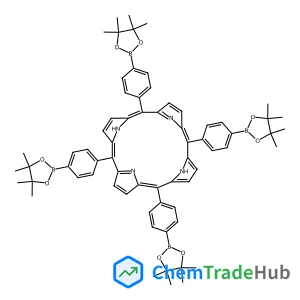
5,10,15,20-tetrakis(4-boronic acid pinacol ester phenyl) porphyrin
CAS番号:
1332748-00-1
分子式:
C68H74B4N4O8
おすすめサプライヤー





免責事項
このページに表示される学術雑誌情報は、参考および研究目的のみを目的としています。当社は雑誌出版社とは提携しておらず、投稿の取り扱いも行っておりません。出版に関するお問い合わせは、各雑誌出版社に直接ご連絡ください。
表示されている情報に誤りがある場合は、support@chemtradehub.com までご連絡ください。迅速に確認し、対応いたします。