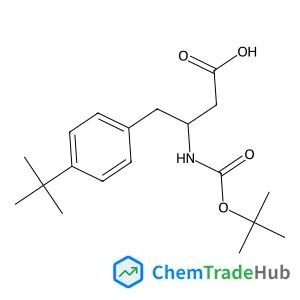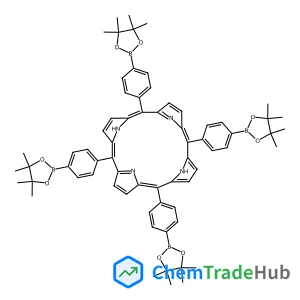
5,10,15,20-tetrakis(4-boronic acid pinacol ester phenyl) porphyrin
CAS番号:
1332748-00-1
分子式:
C68H74B4N4O8
Rozan Mohamad Yunus, Hiroko Endo
Heterostructures of two-dimensional (2D) layered materials have attracted growing interest due to their unique properties and possible applications in electronics, photonics, and energy. Reduction of the dimensionality from 2D to one-dimensional (1D), such as graphene nanoribbons (GNRs), is also interesting due to the electron confinement effect and unique edge effects. Here, we demonstrate a bottom-up approach to grow vertical heterostructures of MoS2 and GNRs by a two-step chemical vapor deposition (CVD) method. Single-layer GNRs were first grown by ambient pressure CVD on an epitaxial Cu(100) film, followed by the second CVD process to grow MoS2 over the GNRs. The MoS2 layer was found to grow preferentially on the GNR surface, while the coverage could be further tuned by adjusting the growth conditions. The MoS2/GNR nanostructures show clear photosensitivity to visible light with an optical response much higher than that of a 2D MoS2/graphene heterostructure. The ability to grow a novel 1D heterostructure of layered materials by a bottom-up CVD approach will open up a new avenue to expand the dimensionality of the material synthesis and applications.

Journal of Computer-Aided Molecular Design

Cement and Concrete Composites

Main Group Metal Chemistry

Construction and Building Materials

Bio-Medical Materials and Engineering

Advanced Powder Technology

Heterocyclic Communications

Advanced Composite Materials

Diamond and Related Materials

Journal of Physical Organic Chemistry
Zhongkui Zhao, Hongling Yang, Yu Li, Xinwen Guo
DOI: 10.1039/C3GC42049C
José Luis Núñez-Rico, Héctor Fernández-Pérez
DOI: 10.1039/C3GC42132E
Siew Ping Teong, Guangshun Yi, Yugen Zhang
DOI: 10.1039/C3GC42018C
Sivasubramanian Muthusaravanan, Chinnathambi Sasikumar, Balasubramanian Devi Bala, Subbu Perumal
DOI: 10.1039/C3GC42150C
Krzysztof Skowerski, Jacek Białecki, Andrzej Tracz, Tomasz K. Olszewski
DOI: 10.1039/C3GC41943F
Wouter Schutyser, Steven-Friso Koelewijn, Michiel Dusselier, Joice Thomas, Feng Yu, Maria Josefina Carbone, Mario Smet, Peter Van Puyvelde, Wim Dehaen, Bert F. Sels
DOI: 10.1039/C4GC00250D
Wilmarie Medina-Ramos, Mike A. Mojica, Elizabeth D. Cope, Ryan J. Hart
DOI: 10.1039/C3GC42569J
Yin Rao, Zhexian Li, Guodong Yin
DOI: 10.1039/C3GC42234H
Marina Díez-Municio, Antonia Montilla, F. Javier Moreno, Miguel Herrero
DOI: 10.1039/C3GC42246A
Brandon A. Rodriguez, Chris C. Stowers, Viet Pham, Brad M. Cox
DOI: 10.1039/C3GC42000K
4-アミノフェノール酸ナトリウム水和物は、CAS番号206557-08-6の化合物で、4-アミノフェノールとナトリウムが結合した塩と水和物です。この化合物は、白...
この化合物は特定の合成プロセスに使用される可能性がありますが、代替品として、他の类似的な化合物、例えばMethyl 3-methyl-N-{[(2-methyl...
4-Boc-2-哌嗪甲酸は、薬品開発や合成化学分野で広く使用されており、その需要は継続的に推移しています。特に、新薬開発における合成化学分野での需要が高まってい...
4,4'-二羟甲基联苯のCAS番号は1667-12-5です。この化合物は白色の結晶粉末で、分子量は154.20です。水にわずかに溶けますが、アルコールや有機溶媒...
5-甲硫基戊腈は医薬品産業で使用される可能性があります。また、ポリマー合成の触媒として、センサー製造の一部として、半導体製造のプロセス改善に使用される可能性があ...
この化合物は、1-abieta-8,11,13-trien-19-イルと6'-メトキシシンコナナン-9-基を含有する窒素含有化合物から合成されます。一般的な合成...
6-ブロモベンジジミダゾール-2-カルビルデオキシドは、避光・乾燥した容器(密閉容器)で-20℃~4℃の低温で保存してください。高温や直射日光、湿気は避けてくだ...
621-65-8のCAS番号を持つBoc-N-甲基氨甲环酸は、化学式C7H13NO5を有する化合物です。この化合物は白色の結晶性粉末で、吸湿性があります。
乙基三氟硼酸钾は、トリフLUオール酸カリウムとエチルブロミドを反応させて合成されます。この反応は高い選択性と収率を持ち、触媒を用いることで効率的に進行します。
2-フロウロ-5-クロロ-4-アミノフェノールは、直射日光を避けて冷却された暗所で保存し、密閉容器に保管してください。温度は常温か低温が適しています。

Physical Chemistry Chemical Physics (PCCP) is an international journal co-owned by 19 physical chemistry and physics societies from around the world. This journal publishes original, cutting-edge research in physical chemistry, chemical physics and biophysical chemistry. To be suitable for publication in PCCP, articles must include significant innovation and/or insight into physical chemistry; this is the most important criterion that reviewers and Editors will judge against when evaluating submissions. The journal has a broad scope and welcomes contributions spanning experiment, theory, computation and data science. Topical coverage includes spectroscopy, dynamics, kinetics, statistical mechanics, thermodynamics, electrochemistry, catalysis, surface science, quantum mechanics, quantum computing and machine learning. Interdisciplinary research areas such as polymers and soft matter, materials, nanoscience, energy, surfaces/interfaces, and biophysical chemistry are welcomed if they demonstrate significant innovation and/or insight into physical chemistry. Joined experimental/theoretical studies are particularly appreciated when complementary and based on up-to-date approaches.
![N-{3-[Benzyl(methyl)amino]propyl}-9-chloro-5,6,7,8-tetrahydro-2-acridinecarboxamide structure](https://static.chemtradehub.com/structs/142/1426944-49-1-1e4c.webp "N-{3-[Benzyl(methyl)amino]propyl}-9-chloro-5,6,7,8-tetrahydro-2-acridinecarboxamide structure")