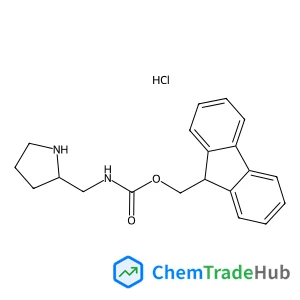
(S)-(9H-Fluoren-9-yl)methyl (pyrrolidin-2-ylmethyl)carbamate hydrochloride
CAS番号:
1217813-15-4
分子式:
C20H23ClN2O2
Hyuksang Kwon, Junhee Hahn
We fabricate mixed halide perovskite films through dual-source vacuum deposition of PbX2 (X = Cl, Br, and I) and methyl ammonium iodide (MAI) precursors with various deposition ratios. Vacuum deposition is an optimal way for film fabrication because it gives a uniform perovskite film which is free from contamination such as metallic phase lead, residual solvent, and moisture. The ionization potential and bandgap of MAPb(I1−yBry)3 film are controlled by changing the halide composition and lattice constant. In contrast, MAPb(I1−yCly)3 film shows negligible difference from MAPbI3 in terms of structural and electronic properties, which is due to poor Cl incorporation in the film from the MACl removal during crystal formation. An excess supply of MAI is necessary to form a perovskite crystal structure. Based on the elemental stoichiometry analysis, the additional methyl ammonium cation with respect to Pb in the film plays a critical role in changing the electron affinity and energy level alignment.
Jonathan S. Ellis, Michael Thompson
DOI: 10.1039/B402822H
Lihua Bi, Firasat Hussain, Ulrich Kortz, Masahiro Sadakane, Michael H. Dickman
DOI: 10.1039/B403902E
Ichiro Hayakawa, Daisuke Uemura
DOI: 10.1039/B402130D
Fabio Ragaini, Michela Gasperini, Emma Gallo, Piero Macchi
DOI: 10.1039/B415767B
Grzegorz A. Orlowski, Somenath Chowdhury, Yi-Tao Long, Todd C. Sutherland, Heinz-Bernhard Kraatz
DOI: 10.1039/B415278F
Yoko Tanaka, Masaru Yamashita
DOI: 10.1039/B402427C
Lin Zhang, Yu-Hua Niu, Alex K.-Y. Jen, Wenbin Lin
DOI: 10.1039/B413708F
Martyn J. Earle, Ullastiina Hakala, Barry J. McAuley, Mark Nieuwenhuyzen, Alwar Ramani, Kenneth R. Seddon
DOI: 10.1039/B403650F
Sara E. Edison, Richard P. Hotz, Michael J. Baldwin
DOI: 10.1039/B403668A
Montserrat Diéguez, Oscar Pamies, Carmen Claver
DOI: 10.1039/B416514D
2-メトキシ-4-(メチルスルフィニル)アミンは、主に医薬品および農薬の製造に使用されます。また、合成化学の一部として研究用材料としても利用されます。
代替品としては、4,6-二クロロピラミジンアミンや他のピラミジン系化合物が考えられます。ただし、目的と用途によって最適な代替品は異なります。
6-氯-4-甲基-1H-吲哚の廃棄物は、適切な容器に収集し、密閉して保管します。温度は常温、湿度は低く、直射日光を避けて保管することを推奨します。廃棄処理は専門...
2-フローユロ-4-(トリフルオロメチル)ベンゾイドのCAS番号は207974-08-1です。この化合物はGHS分類で毒性物質と有害な反応物質として分類されます...
4-ニトロフェニルN-[(ベンゼルオキシルカーボンイル]グリシングリシングリシン酸は、室温で暗所に保管し、乾燥した環境で保存することを推奨します。容器は密閉性の...
イソデスロラタドリンの代替品としては、デスロラタドリンや他の抗ヒスタミン薬が挙げられます。具体的には、デスロラタドリン、ラセカミド、フェルタドリンなどが、症状や...
5-甲氧基-1,2,3,4-四氢异喹啉盐酸盐の一般的な合成方法は、メタノール中で5-メトキシ-1,2,3,4-四ヒュドロイソキシンを塩酸で塩化します。この反応で...
CAS番号6471-78-9の4-アミノ-5-メトキシ-2-トルエンサルホニック酸は、GHS分類では corrosive(腐食性)と識別されます。EUのREAC...
甲基孕酮の取り扱いは、PPE(個人保護具)の使用が必要な重要な安全事項を伴います。防塵マスク、ゴーグル、手袋を着用することが推奨されます。ドラフトチャンバーを使...

Physical Chemistry Chemical Physics (PCCP) is an international journal co-owned by 19 physical chemistry and physics societies from around the world. This journal publishes original, cutting-edge research in physical chemistry, chemical physics and biophysical chemistry. To be suitable for publication in PCCP, articles must include significant innovation and/or insight into physical chemistry; this is the most important criterion that reviewers and Editors will judge against when evaluating submissions. The journal has a broad scope and welcomes contributions spanning experiment, theory, computation and data science. Topical coverage includes spectroscopy, dynamics, kinetics, statistical mechanics, thermodynamics, electrochemistry, catalysis, surface science, quantum mechanics, quantum computing and machine learning. Interdisciplinary research areas such as polymers and soft matter, materials, nanoscience, energy, surfaces/interfaces, and biophysical chemistry are welcomed if they demonstrate significant innovation and/or insight into physical chemistry. Joined experimental/theoretical studies are particularly appreciated when complementary and based on up-to-date approaches.
![2-(7,7-Difluorobicyclo[4.1.0]hept-1-yl)ethanamine structure](https://static.chemtradehub.com/structs/209/2098065-08-6-ff24.webp "2-(7,7-Difluorobicyclo[4.1.0]hept-1-yl)ethanamine structure")