












The role of alkoxy radicals in the heterogeneous reaction of two structural isomers of dimethylsuccinic acid
文献情報
出版日
2015-08-27
DOI
10.1039/C5CP03791C
インパクトファクター
3.676
著者
Chiu Tung Cheng, Kevin R. Wilson
原文を見る
要旨
A key challenge in understanding the transformation chemistry of organic aerosols is to quantify how changes in molecular structure alter heterogeneous reaction mechanisms. Here we use two model systems to investigate how the relative locations of branched methyl groups control the heterogeneous reaction of OH with two isomers of dimethylsuccinic acid (C6H10O4). 2,2-Dimethylsuccinic acid (2,2-DMSA) and 2,3-dimethylsuccinic acid (2,3-DMSA) differ only in the location of the two branched methyl groups, thus enabling a closer inspection of how the distribution of carbon reaction sites impacts the chemical evolution of the aerosol. The heterogeneous reaction of OH with 2,3-DMSA (reactive OH uptake coefficient, γ = 0.99 ± 0.16) is found to be ∼2 times faster than that of 2,2-DMSA (γ = 0.41 ± 0.07), which is attributed to the larger stability of the tertiary alkyl radical produced by the initial OH abstraction reaction. While changes in the average aerosol oxidation state (OSC) and the carbon number (NC) are similar for both isomers upon reaction, significant differences are observed in the underlying molecular distribution of reaction products. The reaction of OH with the 2,3-DMSA isomer produces two major reaction products: a product containing a new alcohol functional group (C6H10O5) formed by intermolecular hydrogen abstraction and a C5 compound formed via carbon–carbon (C–C) bond scission. Both of these reaction products are explained by the formation and subsequent reaction of a tertiary alkoxy radical. In contrast, the OH reaction with the 2,2-DMSA isomer forms four dominant reaction products, the majority of which are C5 scission products. The difference in the quantity of C–C bond scission products for these two isomers is unexpected since decomposition is assumed to be favored for the isomer with the most tertiary carbon sites (i.e. 2,3-DMSA). For both isomers, there is a much larger abundance of C6 alcohol relative to C6 ketone products, which suggests that the presence of the two branched methyl groups favors alkoxy formation from peroxy radical self-reactions. These results reveal how the isomeric structure ultimately controls the overall competition between functionalization and fragmentation in these model systems.
関連文献
Glycerol: a solvent and a building block of choice for microwave and ultrasound irradiation procedures
P. Cintas, S. Tagliapietra, E. Calcio Gaudino, G. Palmisano, G. Cravotto
2013-12-09
Critical Review
DOI: 10.1039/C3GC41955J
An attempt to provide an environmentally friendly solvent selection guide for olefin metathesis
Krzysztof Skowerski, Jacek Białecki, Andrzej Tracz, Tomasz K. Olszewski
2013-11-06
Communication
DOI: 10.1039/C3GC41943F
Catalyst-free transformation of levulinic acid into pyrrolidinones with formic acid
Yawen Wei, Chao Wang, Xue Jiang, Dong Xue, Zhao-Tie Liu
2013-11-11
Communication
DOI: 10.1039/C3GC42125B
Acceleration of Suzuki coupling reactions by abundant and non-toxic salt particles
Binbin Zhang, Jinliang Song, Huizhen Liu, Jinghua Shi, Jun Ma, Honglei Fan, Weitao Wang, Peng Zhang, Buxing Han
2013-10-23
Paper
DOI: 10.1039/C3GC42088D
Aerobic oxidation of isosorbide and isomannide employing TEMPO/laccase
Johannes Gross, Katharina Tauber, Michael Fuchs, Nina G. Schmidt, Aashrita Rajagopalan, Kurt Faber, Walter M. F. Fabian, Jan Pfeffer, Thomas Haas, Wolfgang Kroutil
2014-01-30
Communication
DOI: 10.1039/C3GC41855C
Biocatalysis in bio-derived solvents: an improved approach for medium optimisation
Giulia Paggiola, Andrew J. Hunt, Con R. McElroy, James Sherwood, James H. Clark
2014-01-20
Communication
DOI: 10.1039/C3GC42526F
Hydrolysis of green-tide forming Ulva spp. by microwave irradiation with polyoxometalate clusters
Shuntaro Tsubaki, Kiriyo Oono, Masanori Hiraoka, Tadaharu Ueda, Ayumu Onda, Kazumichi Yanagisawa, Jun-ichi Azuma
2013-12-12
Paper
DOI: 10.1039/C3GC42027B
Comparison of catalysis by haloalkane dehalogenases in aqueous solutions of deep eutectic and organic solvents
Radka Chaloupkova
2014-02-12
Paper
DOI: 10.1039/C4GC00117F
Synthesis of polyacrylonitrile copolymers as potential carbon fibre precursors in CO2
Vladimir V. Bagrov, Peter S. Timashev
2013-11-21
Paper
DOI: 10.1039/C3GC41677A
Organocatalysis in biorefining for biomass conversion and upgrading
Eugene Y.-X. Chen
2013-11-12
Critical Review
DOI: 10.1039/C3GC41934G
こちらもおすすめ
化合物よくある質問
4-アミノフェノール酸ナトリウム水和物とは何ですか?
4-アミノフェノール酸ナトリウム水和物は、CAS番号206557-08-6の化合物で、4-アミノフェノールとナトリウムが結合した塩と水和物です。この化合物は、白...
206557-08-64-Aminobenzoic acid ...
化合物よくある質問
Methyl 3-methyl-N-{[(2-methyl-2-propanyl)oxy]carbonyl}-L-histidinateの代替品はありますか?
この化合物は特定の合成プロセスに使用される可能性がありますが、代替品として、他の类似的な化合物、例えばMethyl 3-methyl-N-{[(2-methyl...
72212-51-2Methyl 3-methyl-N-{[...
化合物よくある質問
4-Boc-2-哌嗪甲酸の市場動向や研究トレンドはどうですか?
4-Boc-2-哌嗪甲酸は、薬品開発や合成化学分野で広く使用されており、その需要は継続的に推移しています。特に、新薬開発における合成化学分野での需要が高まってい...
192330-11-3(2R)-4-[(tert-butoxy...
化合物よくある質問
4,4'-二羟甲基联苯の物理化学的性質は何ですか?
4,4'-二羟甲基联苯のCAS番号は1667-12-5です。この化合物は白色の結晶粉末で、分子量は154.20です。水にわずかに溶けますが、アルコールや有機溶媒...
1667-12-54,4'-Biphenyldiyldim...
化合物よくある質問
5-甲硫基戊腈はどの業界で使用されていますか?
5-甲硫基戊腈は医薬品産業で使用される可能性があります。また、ポリマー合成の触媒として、センサー製造の一部として、半導体製造のプロセス改善に使用される可能性があ...
59121-25-45-(Methylsulfanyl)pe...
化合物よくある質問
CAS番号1311961-50-8の化合物はどのように合成されますか?
この化合物は、1-abieta-8,11,13-trien-19-イルと6'-メトキシシンコナナン-9-基を含有する窒素含有化合物から合成されます。一般的な合成...
1311961-50-81-Abieta-8,11,13-tri...
化合物よくある質問
6-ブロモベンジジミダゾール-2-カルビルデオキシドはどのように保存すればよいですか?
6-ブロモベンジジミダゾール-2-カルビルデオキシドは、避光・乾燥した容器(密閉容器)で-20℃~4℃の低温で保存してください。高温や直射日光、湿気は避けてくだ...
885280-26-25-Bromo-1H-benzimida...
化合物よくある質問
Boc-N-甲基氨甲环酸とは何ですか?
621-65-8のCAS番号を持つBoc-N-甲基氨甲环酸は、化学式C7H13NO5を有する化合物です。この化合物は白色の結晶性粉末で、吸湿性があります。
621-65-83-Hydroxy-1,2-propan...
化合物よくある質問
乙基三氟硼酸钾はどのように合成されますか?
乙基三氟硼酸钾は、トリフLUオール酸カリウムとエチルブロミドを反応させて合成されます。この反応は高い選択性と収率を持ち、触媒を用いることで効率的に進行します。
882871-21-8Potassium ethyltrifl...
化合物よくある質問
2-フロウロ-5-クロロ-4-アミノフェノールはどのように保存すればよいですか?
2-フロウロ-5-クロロ-4-アミノフェノールは、直射日光を避けて冷却された暗所で保存し、密閉容器に保管してください。温度は常温か低温が適しています。
847872-10-04-Amino-5-chloro-2-f...
掲載誌
Physical Chemistry Chemical Physics

CiteScore:
5.5
自己引用率:
10.3%
年間論文数:
3036
Physical Chemistry Chemical Physics (PCCP) is an international journal co-owned by 19 physical chemistry and physics societies from around the world. This journal publishes original, cutting-edge research in physical chemistry, chemical physics and biophysical chemistry. To be suitable for publication in PCCP, articles must include significant innovation and/or insight into physical chemistry; this is the most important criterion that reviewers and Editors will judge against when evaluating submissions. The journal has a broad scope and welcomes contributions spanning experiment, theory, computation and data science. Topical coverage includes spectroscopy, dynamics, kinetics, statistical mechanics, thermodynamics, electrochemistry, catalysis, surface science, quantum mechanics, quantum computing and machine learning. Interdisciplinary research areas such as polymers and soft matter, materials, nanoscience, energy, surfaces/interfaces, and biophysical chemistry are welcomed if they demonstrate significant innovation and/or insight into physical chemistry. Joined experimental/theoretical studies are particularly appreciated when complementary and based on up-to-date approaches.
おすすめ化合物
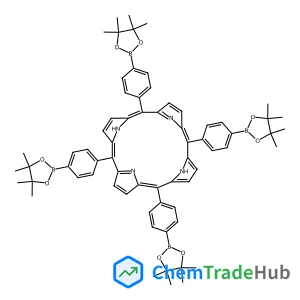
5,10,15,20-tetrakis(4-boronic acid pinacol ester phenyl) porphyrin
CAS番号:
1332748-00-1
分子式:
C68H74B4N4O8
![Imidazo[1,2-c]pyrimidine structure](https://static.chemtradehub.com/structs/274/274-78-2-8b4c.webp "Imidazo[1,2-c]pyrimidine structure")
![(4aR,5S,6R,8aS)-5-[2-(3-Furyl)ethyl]-8a-(hydroxymethyl)-5,6-dimethyl-3,4,4a,5,6,7,8,8a-octahydro-1-naphthalenecarboxylic acid structure](https://static.chemtradehub.com/structs/184/18411-75-1-d4cd.webp "(4aR,5S,6R,8aS)-5-[2-(3-Furyl)ethyl]-8a-(hydroxymethyl)-5,6-dimethyl-3,4,4a,5,6,7,8,8a-octahydro-1-naphthalenecarboxylic acid structure")
おすすめサプライヤー





免責事項
このページに表示される学術雑誌情報は、参考および研究目的のみを目的としています。当社は雑誌出版社とは提携しておらず、投稿の取り扱いも行っておりません。出版に関するお問い合わせは、各雑誌出版社に直接ご連絡ください。
表示されている情報に誤りがある場合は、support@chemtradehub.com までご連絡ください。迅速に確認し、対応いたします。