












The nature of NO-bonding in N-oxide group
文献情報
出版日
2015-05-21
DOI
10.1039/C5CP02148K
インパクトファクター
3.676
著者
Marlena Łukomska, Agnieszka J. Rybarczyk-Pirek, Mirosław Jabłoński, Marcin Palusiak
原文を見る
要旨
The nature of the NO-bond in the N-oxide group was investigated by means of combined theoretical calculations (including QTAIM and NBO approaches) and statistical analyses of the contents of crystal structure databases. The N–O bond in the N-oxide group should be classified as the NO donating bond with an important contribution of ON back-donation (of the π-electron type, when available). The visualization of the Laplacian of electron density in the region of an oxygen valence sphere suggests the presence of two lone pairs for the imine-N-oxide group (characterized by effective ON back-donation). A detailed bonding analysis performed by means of natural resonance theory indicates that the N→O bond is of an order of magnitude clearly greater than 1. In addition, the stability of the N→O bond in various N-oxides was estimated. The analyses of the hydrogen- and halogen-bonded complexes of the N-oxides reveal strong Lewis basicity of the N-oxide group. The formation of H- and X-bonding leads to N→O bond elongation due to its structural, topological and spectroscopic characteristics. Moreover, in pyridine-N-oxide, the electron-withdrawing –NO2 group additionally stabilizes the N→O bond, whereas the opposite effect can be observed for the electron-donating-NH2 substituent. This is due to a substituent effect on the π-type ON back-donation. As a result, the oxygen atom in pyridine-N-oxide may change its availability during intermolecular interaction formation, as revealed in the interaction energy, which changes by about half of the estimated total interaction energy.
関連文献
Linear and hyperbranched phosphorylcholine based homopolymers for blood biocompatibility
Manraj Jawanda, Benjamin F. L. Lai, Kazuhiko Ishihara, Ravin Narain
2013-03-13
Paper
DOI: 10.1039/C3PY00248A
The importance of ligand reactions in Cu(0)-mediated living radical polymerisation of acrylates
Athina Anastasaki, Christopher Waldron, Paul Wilson, Ronan McHale, David M. Haddleton
2013-03-04
Communication
DOI: 10.1039/C3PY00270E
Synthesis and characterization of a low band gap quinoxaline based D–A copolymer and its application as a donor for bulk heterojunction polymer solar cells
M. L. Keshtov, D. V. Marochkin, V. S. Kochurov, A. R. Khokhlov
2013-05-01
Paper
DOI: 10.1039/C3PY00391D
Hybrid materials consisting of an all-conjugated polythiophene backbone and grafted hydrophilic poly(ethylene glycol) chains
Luminita Cianga, Luis J. del Valle, Ioan Cianga
2013-03-01
Paper
DOI: 10.1039/C3PY00029J
Determination of copolymerisation characteristics in the N-carboxy anhydride polymerisation of two amino acids
Mischa Zelzer
2013-05-07
Paper
DOI: 10.1039/C3PY00431G
An effect on the side chain position of D–π–A-type conjugated polymers with sp2-hybridized orbitals for organic photovoltaics
Kwan Wook Song, Ho Jun Song, Tae Ho Lee, Soo Won Heo, Doo Kyung Moon
2013-03-12
Paper
DOI: 10.1039/C3PY00195D
Synthesis, self-assembly and (absence of) protein interactions of poly(glycerol methacrylate)–silicone macro-amphiphiles
Ghislaine Robert-Nicoud, Robert Evans, Cong-Duan Vo, Christopher J. Cadman
2013-04-03
Paper
DOI: 10.1039/C3PY00273J
Atom transfer radical polymerization as a tool for making poly(N-acryloylglycinamide) with molar mass independent UCST-type transitions in water and electrolytes
Fangyao Liu, Jan Seuring, Seema Agarwal
2013-03-05
Paper
DOI: 10.1039/C3PY00222E
Organoselenium compounds: development of a universal “living” free radical polymerization mediator
Jindong Zeng, Jian Zhu, Xiangqiang Pan, Zhengbiao Zhang, Nianchen Zhou, Zhenping Cheng, Wei Zhang, Xiulin Zhu
2013-04-19
Communication
DOI: 10.1039/C3PY00285C
こちらもおすすめ
化合物よくある質問
2-ヒドロキシ-5-ニトロベンジンブロモイドの代替品はありますか?
2-ヒドロキシ-5-ニトロベンジンブロモイドは特定の化学反応に適しているため、代替品は限られています。しかし、同様の構造を持つ2-ヒドロキシ-4-ニトロベンジン...
772-33-82-(Bromomethyl)-4-ni...
化合物よくある質問
N-(2-ブロモフェニル)-1-チロール-3-オキソ-3-(ピペリジニル)プロペン-2-イル)ベンゼンアミドを取り扱う際の実験室安全事項は何ですか?
N-(2-ブロモフェニル)-1-チロール-3-オキソ-3-(ピペリジニル)プロペン-2-イル)ベンゼンアミドは有毒で、皮膚や粘膜に刺激を与える可能性があります。...
1800044-77-2N-[(1Z)-1-(2-Bromoph...
化合物よくある質問
1,3プロパンジオール,2-[2-(2アミノ-6クロロ-9Hピリミジン-9-イル)エチル-1,1,2,2-D4]-2,3-ジアセタートの市場動向や研究トレンドはどうですか?
この化合物は、新規治療薬の開発に注目されています。市場では、その有効性と安全性が評価され、研究分野では、分子生物学と医薬化学の新たな発見が期待されています。
1020718-81-31,3-Propanediol, 2-[...
579-44-2Ethanone, 2-hydroxy-...
化合物よくある質問
Succinimidyl-alanyl-phenylalanyl-prolyl-phenylalanine 4-nitroanilide はどの業界で使用されていますか?
Succinimidyl-alanyl-phenylalanyl-prolyl-phenylalanine 4-nitroanilide は主に医薬品開発やポ...
128802-73-3succinimidyl-alanyl-...
化合物よくある質問
メチル6-アミノ-5-クロロピリジン-2-カーボイル酸について、適用される法規ガイドラインは何ですか?
メチル6-アミノ-5-クロロピリジン-2-カーボイル酸(CAS番号: 1256794-05-4)の使用には、GHS( Globally Harmonized S...
1256794-05-4Methyl 6-amino-5-chl...
化合物よくある質問
エチル4-(シクロ Pentagonyl)アミノ-2-メチル硫化基ピリミジン-5-カルボキシレートを取り扱う際の実験室安全事項は何ですか?
取り扱いには、耐薬品性の容器を使用し、通気性の良い場所で操作することを推奨します。漏れ時は、SDS(安全データシート)を参照して適切な措置を取ること。手洗いと洗...
211245-62-4ethyl 4-(cyclopentyl...
化合物よくある質問
(S)-3-ベンZYルピペリジン塩酸塩とは何ですか?
(S)-3-ベンZYルピペリジン塩酸塩は、CAS番号1258940-00-9で表される化合物です。これは、(S)-3-苯基哌啶的盐酸盐であり、主に医薬品の原料と...
1258940-00-9(S)-3-Phenylpiperidi...
化合物よくある質問
3,5-二甲基金剛胺の主な用途は何ですか?
3,5-二甲基金剛胺は、主に医薬品の原料として使用され、また抗うつ薬や抗アルツハイマー薬の開発に利用されます。さらに、化粧品や食品添加物の製造でも重要な役割を果...
19988-45-52-(2,3-Dihydroxyphen...
化合物よくある質問
ビス(4-メチル-2-ペンチル)フェニルカルボン酸エステルの代替品はありますか?
ビス(4-メチル-2-ペンチル)フェニルカルボン酸エステル (CAS番号: 1398066-13-1) の代替品には、ビス(2-エチルヘキシル)フェノールカルボ...
1398066-13-1Bis(4-methyl-2-penty...
掲載誌
Physical Chemistry Chemical Physics

CiteScore:
5.5
自己引用率:
10.3%
年間論文数:
3036
Physical Chemistry Chemical Physics (PCCP) is an international journal co-owned by 19 physical chemistry and physics societies from around the world. This journal publishes original, cutting-edge research in physical chemistry, chemical physics and biophysical chemistry. To be suitable for publication in PCCP, articles must include significant innovation and/or insight into physical chemistry; this is the most important criterion that reviewers and Editors will judge against when evaluating submissions. The journal has a broad scope and welcomes contributions spanning experiment, theory, computation and data science. Topical coverage includes spectroscopy, dynamics, kinetics, statistical mechanics, thermodynamics, electrochemistry, catalysis, surface science, quantum mechanics, quantum computing and machine learning. Interdisciplinary research areas such as polymers and soft matter, materials, nanoscience, energy, surfaces/interfaces, and biophysical chemistry are welcomed if they demonstrate significant innovation and/or insight into physical chemistry. Joined experimental/theoretical studies are particularly appreciated when complementary and based on up-to-date approaches.
おすすめ化合物
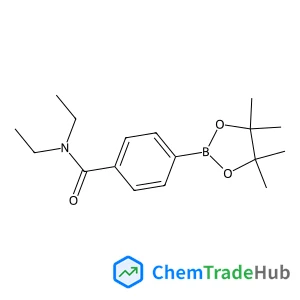
N,N-Diethyl-4-(4,4,5,5-tetramethyl-1,3,2-dioxaborolan-2-yl)benzamide
CAS番号:
325142-99-2
分子式:
C17H26BNO3
おすすめサプライヤー





免責事項
このページに表示される学術雑誌情報は、参考および研究目的のみを目的としています。当社は雑誌出版社とは提携しておらず、投稿の取り扱いも行っておりません。出版に関するお問い合わせは、各雑誌出版社に直接ご連絡ください。
表示されている情報に誤りがある場合は、support@chemtradehub.com までご連絡ください。迅速に確認し、対応いたします。