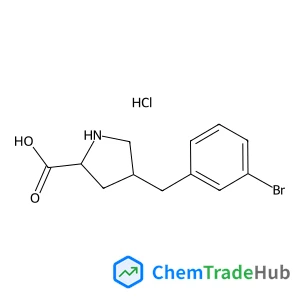
(2S,4R)-4-(3-Bromobenzyl)pyrrolidine-2-carboxylic acid hydrochloride
CAS番号:
1049734-10-2
分子式:
C12H15BrClNO2
Daphna Shimon, Yonatan Hovav, Ilia Kaminker, Akiva Feintuch, Daniella Goldfarb, Shimon Vega
DNP on heteronuclear spin systems often results in interesting phenomena such as the polarization enhancement of one nucleus during MW irradiation at the “forbidden” transition frequencies of another nucleus or the polarization transfer between the nuclei without MW irradiation. In this work we discuss the spin dynamics in a four-spin model system of the form {ea–eb–(1H,13C)}, with the Larmor frequencies ωa, ωb, ωH and ωC, by performing Liouville space simulations. This spin system exhibits the common 1H solid effect (SE), 13C cross effect (CE) and in addition high order CE-DNP enhancements. Here we show, in particular, the “proton shifted 13C-CE” mechanism that results in 13C polarization when the model system, at one of its 13C-CE conditions, is excited by a MW field at the zero quantum or double quantum electron–proton transitions ωMW = ωa ± ωH and ωMW = ωb ± ωH. Furthermore, we introduce the “heteronuclear” CE mechanism that becomes efficient when the system is at one of its combined CE conditions |ωa − ωb| = |ωH ± ωC|. At these conditions, simulations of the four-spin system show polarization transfer processes between the nuclei, during and without MW irradiation, resembling the polarization exchange effects often discussed in the literature. To link the “microscopic” four-spin simulations to the experimental results we use DNP lineshape simulations based on “macroscopic” rate equations describing the electron and nuclear polarization dynamics in large spin systems. This approach is applied based on electron–electron double resonance (ELDOR) measurements that show strong 1H-SE features outside the EPR frequency range. Simulated ELDOR spectra combined with the indirect 13C-CE (iCE) mechanism, result in additional “proton shifted 13C-CE” features that are similar to the experimental ones. These features are also observed experimentally in 13C-DNP spectra of a sample containing 15 mM of trityl in a glass forming solution of 13C-glycerol/H2O and are analyzed by calculating the basic 13C-SE and 13C-iCE shapes using simulated ELDOR spectra that were fitted to the experimental ones.

Chemical Communications

Saudi Pharmaceutical Journal

Russian Journal of General Chemistry

Russian Journal of Applied Chemistry

Journal of Saudi Chemical Society

Journal of Natural Medicines

New Journal of Chemistry

Journal of Peptide Science

Chemistry Education Research and Practice

Current Opinion in Colloid & Interface Science
Pallabi Sil, Simanta Sarani Paul, Eva Di Silvio, Carlo Travaglini-Allocatelli, Krishnananda Chattopadhyay
DOI: 10.1039/C6CP04819F
A. V. Gorbunov, T. Putzeys, I. Urbanavičiūtė, R. A. J. Janssen, M. Wübbenhorst, R. P. Sijbesma
DOI: 10.1039/C6CP03835B
Ping-Ping Sun, Wei-Jie Chi, Ze-Sheng Li
DOI: 10.1039/C6CP04344E
Tao Wu, Jiří Kessler, Petr Bouř
DOI: 10.1039/C6CP90213H
David Shai Ellis, Hen Dotan, Avner Rothschild
DOI: 10.1039/C6CP04683E
Doan Chau Yen Nguyen, Lars Smykalla, Thi Ngoc Ha Nguyen, Michael Mehring, Michael Hietschold
DOI: 10.1039/C6CP04764E
Xue-Ping Chang, Yiying Zheng, Ganglong Cui, Wei-Hai Fang, Walter Thiel
DOI: 10.1039/C6CP04919B
Chul Ho Park, Sung Jo Kwak, Joo-Youn Nam, Moon Seok Jang, Jung-Hyun Lee
DOI: 10.1039/C6CP03939A
Subhadip Mondal, Sayan Ganguly, Mostafizur Rahaman, Ali Aldalbahi, Tapan K. Chaki, Dipak Khastgir, Narayan Ch. Das
DOI: 10.1039/C6CP04274K
Houyang Chen
DOI: 10.1039/C6CP02927B
4'-ブロモビフェニル-3-メトークシーディ.ActionBarは、冷暗所で、直射日光を避け、密栓の容器に保存し、遠隔場所に保管してください。温度は常温(0〜2...
2-異丙基フェニルヒドラジン塩酸塩は、CAS番号58928-82-8を有する化合物で、構造式はC11H14N2HClです。これは塩基性化合物であり、水に溶けやす...
5-(4-クロロフェニル)-4H-1,2,4-三氮唑-3-アミンは取り扱いに注意が必要です。PPEとして防塵マスク、ゴーグル、手袋を使用し、ドラフトチャンバーを...
去甲基雷贝拉唑硫醚は、ベンジミダゾール硫化物と3-メチル-4-ピリジノールの反応によって合成されます。具体的には、2-チオキシドベンジミダゾールと3-メチル-4...
2-ブロモ-5-フロロ-N-(2-フェノールメチル)ベンゼンウレアは、毒性や刺激性の実験データに基づき、適切な取扱いと防護措置を講じることで安全に使用できます。...
対甲苯磺酸酯-四聚乙二醇-四氢吡喃醚のCAS番号は86259-89-4です。この化合物は無色の液体で、分子量は約724.8です。高濃度では溶血性が報告されており...
2-(3-(二氟甲基)-4-氟苯基)-4,4,5,5-四甲基-1,3,2-二噁硼戊環は、室温で暗い場所に保管し、直射日光から遠ざけ、容器は密閉状態で保存してくだ...
この化合物の代替品には、ピロリミジン酸やその類似物、またピロリミジンカルボン酸の他の異性体があります。これらの代替品は、特定の化学反応や目的に応じて選択すること...
5-クロロベンゾ[1,3]二オキセイン-4-アミンはCAS番号379228-45-2に該当します。この化合物はGHS分類でH314(接触により急性毒性がある)と...

Physical Chemistry Chemical Physics (PCCP) is an international journal co-owned by 19 physical chemistry and physics societies from around the world. This journal publishes original, cutting-edge research in physical chemistry, chemical physics and biophysical chemistry. To be suitable for publication in PCCP, articles must include significant innovation and/or insight into physical chemistry; this is the most important criterion that reviewers and Editors will judge against when evaluating submissions. The journal has a broad scope and welcomes contributions spanning experiment, theory, computation and data science. Topical coverage includes spectroscopy, dynamics, kinetics, statistical mechanics, thermodynamics, electrochemistry, catalysis, surface science, quantum mechanics, quantum computing and machine learning. Interdisciplinary research areas such as polymers and soft matter, materials, nanoscience, energy, surfaces/interfaces, and biophysical chemistry are welcomed if they demonstrate significant innovation and/or insight into physical chemistry. Joined experimental/theoretical studies are particularly appreciated when complementary and based on up-to-date approaches.
![Heptadecanoic Acid 3-[2-[4-(6-Fluoro-1,2-benzisoxazol-3-yl)-1-piperidinyl]ethyl]-6,7,8,9-tetrahydro-2-methyl-4-oxo-4H-pyrido[1,2-a]pyrimidin-9-yl Ester structure](https://static.chemtradehub.com/structs/140/1404053-62-8-9da4.webp "Heptadecanoic Acid 3-[2-[4-(6-Fluoro-1,2-benzisoxazol-3-yl)-1-piperidinyl]ethyl]-6,7,8,9-tetrahydro-2-methyl-4-oxo-4H-pyrido[1,2-a]pyrimidin-9-yl Ester structure")