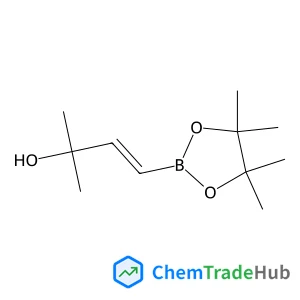
(E)-2-methyl-4-(4,4,5,5-tetramethyl-1,3,2-dioxaborolan-2-yl)but-3-en-2-ol
CAS番号:
581802-26-8
分子式:
C11H21BO3
Lichao Sun, Jinchuan Liu, Hanying Zhao
Micelles self-assembled by block copolymers are widely used in nanoscience and biomedical science. In the past few decades, much effort has been applied to the synthesis, characterization and applications of the polymeric micelles. However, previous research studies have paid less attention to the functionalization of coronae of the micelles. Herein, micelles with disulfide groups in the coronae were prepared and the micelles were used as a platform for functional modification reactions. Polystyrene-block-poly(oligo(ethylene glycol)monomethyl ether methacrylate)-block-poly(oligo(ethylene glycol)monomethyl ether methacrylate-co-2-((2-hydroxyethyl)disulfanyl)ethyl methacrylate), PS-b-PPEGMA-b-P(PEGMA-co-HDSMA), triblock copolymer was synthesized by RAFT polymerization. In aqueous solution, the triblock copolymer self-assembled into micelles with disulfides in the coronae. Upon cleavage of the disulfide bonds, thiol groups were produced in the coronae, and the micelles were able to undergo oxidation-induced aggregation. Hydroethyl disulfide groups in the PS-b-PPEGMA-b-P(PEGMA-co-HDSMA) triblock copolymer were converted to pyridyl disulfide groups by cleavage of the S–S bonds with tributylphosphine and reaction with dipyridyl disulfide. In PBS buffer solution, the modified triblock copolymer self-assembled into micelles with pyridyl disulfides in the coronae. The micelles were used as a platform for the preparation of glutathione or fluorescent group-decorated micelles. The antioxidant properties and the fluorescence properties of the functional micelles are reported in this paper. On the basis of this method, many different functional micelles can be prepared.

Saudi Pharmaceutical Journal

Journal of Natural Medicines

Crystallography Reports

Russian Journal of Applied Chemistry

Russian Journal of Coordination Chemistry

Journal of Saudi Chemical Society

Chemistry Education Research and Practice

Russian Chemical Bulletin

Russian Journal of Organic Chemistry

Acta Materialia
Li-Lin Tan, Hong-Yan Chen, Li-Feng Hao, Yong Shen, Li-Min Xiao, Jun-Min Liu, Dai-Bin Kuang, Cheng-Yong Su
DOI: 10.1039/C3CP51633D
João Pina, J. Seixas de Melo, D. Breusov, Ullrich Scherf
DOI: 10.1039/C3CP52056K
DOI: 10.1039/C3CP51650D
Min Zhou, Fan Pu, Zhao Wang, Tingwei Cai, Hao Chen, Haiyong Zhang, Shiyou Guan
DOI: 10.1039/C3CP51276B
Rita Nissim, Richard G. Compton
DOI: 10.1039/C3CP51732B
Ymène Houari, Adèle D. Laurent
DOI: 10.1039/C3CP50791B
Erik C. Neyts, Umedjon Khalilov, Bart Partoens
DOI: 10.1039/C3CP51621K
H. H. Zhang, X. H. Pan, B. Lu, J. Y. Huang, P. Ding, W. Chen, H. P. He, J. G. Lu, S. S. Chen, Z. Z. Ye
DOI: 10.1039/C3CP51156A
6- bromo-1-cyclopropyl-1H-benzimidazoleは、抗炎症、抗ウイルス作用を持つことが報告されており、新薬開発の研究対象として注目...
取り扱う際には、防護眼鏡と手袋を使用し、ドラフトチャンバー内で操作することを推奨します。漏洩時には適切な手順で処理し、安全データシートを常に参照してください。
2,2’-ジメチル-3,3’-ビピリジンは、ピリジンと2-メチルアクリルアミドを有機合成反応で合成します。この反応では、ピリジンと2-メチルアクリルアミドを含有...
6-甲基ピリジン-2-ボリック酸は、合成化学、医薬品合成、以及研究用途などに広く使用され、特に組換えDNA技術や分子生物学の研究において重要な役割を果たします。
(R)-3-(1-甲基-2-氧環己基)プロpano酸メチルは一定の安全性がありますが、直接的な皮膚接触や吸入は避けるべきです。使用する際は適切な個々の安全データ...
ketorolacは、密封して遮光容器に保管し、直射日光や高温を避けて保存してください。温度は常温で保存し、湿度をなるべく低く保つことが推奨されます。
L-2,3-二氨基丙酸二盐酸盐は腐食性が強く、皮膚や粘膜に刺激を与える可能性があります。取り扱う際は、防塵マスク、ゴーグル、手袋を使用し、適切な排気設備を使用し...
2-(4-溴ピリジン-2-基)乙腈のCAS番号は312325-73-8です。主に結晶形態で存在し、分子量は159.01 g/molです。この化合物は水に溶けやす...
この化合物は毒性は低いですが、直接的な接触や吸入に注意が必要です。PPE(個人防護具)を着用し、ドラフトチャンバーを使用して操作することを推奨します。また、漏洩...
3-(1-氧代-1,3-二氢-2H-2-异吲哚)丙酸は、薬理学研究や医薬品製造において広く用いられる化合物です。また、工業的な用途でも一部の化学反応の触媒や助剤...

Polymer Chemistry welcomes submissions in all areas of polymer science that have a strong focus on macromolecular chemistry. Manuscripts may cover a broad range of fields, yet no direct application focus is required.