












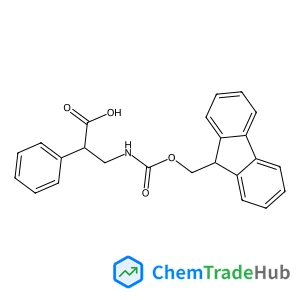
(S)-3-((((9H-Fluoren-9-yl)methoxy)carbonyl)amino)-2-phenylpropanoic acid
CAS番号:
1217663-60-9
分子式:
C24H21NO4
João Pina, J. Seixas de Melo, D. Breusov, Ullrich Scherf
A comprehensive spectral and photophysical investigation of four donor–acceptor–donor (DAD) oligomers consisting of electron-deficient 2,1,3-benzothiadiazole or quinoxaline moieties linked to electron-rich thienyl or bithienyl units has been undertaken. Additionally, a bis(dithienyl) substituted naphthalene was also investigated. The D–A–D nature of these oligomers resulted in the presence of an intramolecular charge transfer (ICT) state, which was further substantiated by solvatochromism studies (analysis with the Lippert–Mataga formalism). Hereby, significant differences have been obtained for the fluorescence quantum yields of the oligomers in the non-polar solvent methylcyclohexane vs. the polar ethanol. The study was further complemented with the determination of the optimized ground-state molecular geometries for the oligomers together with the prediction of the lowest vertical one-electron excitation energy and the relevant molecular orbital contours using DFT calculations. The electronic transitions show a clear HOMO to LUMO charge-transfer character. In contrast to the thiophene oligomers (the oligothiophenes with n = 1–7), where the intersystem crossing (ISC) yield decreases with n, the studied DAD oligomers were found to show an increase in the ISC efficiency with the number of (donor) thienyl units.
Yaqing Zhang, Xiaoxi Chang, Xin Wang
DOI: 10.1039/C9AY01632E
Xin-Yue Chen, Wei Ha, Xiao-Jie Jin, Yan-Ping Shi
DOI: 10.1039/D0AN01460E
Weijia Leng, Kimberly Evans, Michael G. Roper
DOI: 10.1039/C9AY01758E
Duo Lin, Jiahui Zhou, Yun Yu, Weiwei Chen, Pei-Hsuan Liao, Hao Huang, Kien Voon Kong
DOI: 10.1039/C9AY01466G
Yue Yu, Ying Liu, Wentao Wang, Yanbo Jia, Guiping Zhao, Xinxiang Zhang, Hongxu Chen, Yinglin Zhou
DOI: 10.1039/C9AY01728C
Xichuan Wei, Haizhu Zhang, Ming Niu, Dingkun Zhang
DOI: 10.1039/C9AY01310E
Jhih-Siang Chen, Pin-Fan Chen, Hana Tzu-Han Lin
DOI: 10.1039/D0AN01201G
6- bromo-1-cyclopropyl-1H-benzimidazoleは、抗炎症、抗ウイルス作用を持つことが報告されており、新薬開発の研究対象として注目...
取り扱う際には、防護眼鏡と手袋を使用し、ドラフトチャンバー内で操作することを推奨します。漏洩時には適切な手順で処理し、安全データシートを常に参照してください。
2,2’-ジメチル-3,3’-ビピリジンは、ピリジンと2-メチルアクリルアミドを有機合成反応で合成します。この反応では、ピリジンと2-メチルアクリルアミドを含有...
6-甲基ピリジン-2-ボリック酸は、合成化学、医薬品合成、以及研究用途などに広く使用され、特に組換えDNA技術や分子生物学の研究において重要な役割を果たします。
(R)-3-(1-甲基-2-氧環己基)プロpano酸メチルは一定の安全性がありますが、直接的な皮膚接触や吸入は避けるべきです。使用する際は適切な個々の安全データ...
ketorolacは、密封して遮光容器に保管し、直射日光や高温を避けて保存してください。温度は常温で保存し、湿度をなるべく低く保つことが推奨されます。
L-2,3-二氨基丙酸二盐酸盐は腐食性が強く、皮膚や粘膜に刺激を与える可能性があります。取り扱う際は、防塵マスク、ゴーグル、手袋を使用し、適切な排気設備を使用し...
2-(4-溴ピリジン-2-基)乙腈のCAS番号は312325-73-8です。主に結晶形態で存在し、分子量は159.01 g/molです。この化合物は水に溶けやす...
この化合物は毒性は低いですが、直接的な接触や吸入に注意が必要です。PPE(個人防護具)を着用し、ドラフトチャンバーを使用して操作することを推奨します。また、漏洩...
3-(1-氧代-1,3-二氢-2H-2-异吲哚)丙酸は、薬理学研究や医薬品製造において広く用いられる化合物です。また、工業的な用途でも一部の化学反応の触媒や助剤...

Physical Chemistry Chemical Physics (PCCP) is an international journal co-owned by 19 physical chemistry and physics societies from around the world. This journal publishes original, cutting-edge research in physical chemistry, chemical physics and biophysical chemistry. To be suitable for publication in PCCP, articles must include significant innovation and/or insight into physical chemistry; this is the most important criterion that reviewers and Editors will judge against when evaluating submissions. The journal has a broad scope and welcomes contributions spanning experiment, theory, computation and data science. Topical coverage includes spectroscopy, dynamics, kinetics, statistical mechanics, thermodynamics, electrochemistry, catalysis, surface science, quantum mechanics, quantum computing and machine learning. Interdisciplinary research areas such as polymers and soft matter, materials, nanoscience, energy, surfaces/interfaces, and biophysical chemistry are welcomed if they demonstrate significant innovation and/or insight into physical chemistry. Joined experimental/theoretical studies are particularly appreciated when complementary and based on up-to-date approaches.
![6-Bromo-2,3-dihydro-1H-pyrido[2,3-b][1,4]oxazine structure](https://static.chemtradehub.com/structs/120/1203499-17-5-b4d1.webp "6-Bromo-2,3-dihydro-1H-pyrido[2,3-b][1,4]oxazine structure")
![[4-(Isobutyrylamino)phenyl]boronic acid structure](https://static.chemtradehub.com/structs/874/874219-50-8-6ab5.webp "[4-(Isobutyrylamino)phenyl]boronic acid structure")
![2-{[(1R,2S)-2-Aminocyclohexyl]amino}-4-{[3-(2H-1,2,3-triazol-2-yl)phenyl]amino}-5-pyrimidinecarboxamide structure](https://static.chemtradehub.com/structs/137/1370261-96-3-40df.webp "2-{[(1R,2S)-2-Aminocyclohexyl]amino}-4-{[3-(2H-1,2,3-triazol-2-yl)phenyl]amino}-5-pyrimidinecarboxamide structure")




