


![[4-(Isobutyrylamino)phenyl]boronic acid structure](https://static.chemtradehub.com/structs/874/874219-50-8-6ab5.webp "[4-(Isobutyrylamino)phenyl]boronic acid structure")
Zinc complex based photoinitiating systems for acrylate polymerization under air; in situ formation of Zn-based fillers and composites
文献情報
出版日
2014-07-28
DOI
10.1039/C4PY00716F
インパクトファクター
5.582
著者
D.-L. Versace, J. Bourgon, E. Leroy, F. Dumur, D. Gigmes, J. P. Fouassier, J. Lalevée
原文を見る
要旨
[N,N′-Bis(salicylidene)-1,2-phenylenediamine]zinc(II) (ZnC) exhibits unexpected properties as a photoinitiator or additive for both free-radical photopolymerization reactions and in situ formation of Zn-based fillers under light activation and aerated conditions. The ZnC/2,2-dimethoxy-2-phenylacetophenone (DMPA) and ZnC/N-methyldiethanolamine (MDEA) couples are characterized by remarkable properties: (i) a photoinitiating efficiency for the radical polymerization of an acrylate matrix under air higher than that of a reference Type I photoinitiator such as DMPA (final conversion of ∼30–45% vs. 15%) and therefore a good ability to overcome the oxygen inhibition effect and (ii) a never reported in situ formation of Zn-based fillers (100 μm thick sticks) or composites. The photochemical properties of the ZnC are investigated by fluorescence and UV-visible spectroscopy and Electron Spin Resonance (ESR). The photodecomposition of ZnC under air is governed by either an addition of peroxyl radicals onto ZnC when associated with DMPA, or a H-abstraction mechanism when combined with MDEA. When using a ZnC/MDEA/silver salt photoinitiating system, a highly efficient polymerization of the acrylate matrix under air and a concomitant in situ production of Ag(0) NPs are observed.
おすすめジャーナル

Saudi Pharmaceutical Journal

Journal of Natural Medicines

Russian Chemical Bulletin

Russian Journal of Bioorganic Chemistry

Organic Process Research & Development

Russian Journal of Applied Chemistry

Journal of Peptide Science

Current Opinion in Colloid & Interface Science

Crystallography Reports

Chemical Communications
関連文献
Molecular rheometry: direct determination of viscosity in Lo and Ldlipid phases via fluorescence lifetime imaging
Yilei Wu, Agnieszka Olzyńska, Martin Hof, Gokhan Yahioglu, Duncan R. Casey, Oscar Ces, Jana Humpolíčková, Marina K. Kuimova
2013-07-09
Paper
DOI: 10.1039/C3CP51953H
Practical applications of small-angle neutron scattering
Martin J. Hollamby
2013-03-25
Perspective
DOI: 10.1039/C3CP50293G
Kinetic mixture effects in diffusion gradients in thin films (DGT)
Jaume Puy, Joan Cecília, Josep Galceran
2013-05-09
Paper
DOI: 10.1039/C3CP51038G
Solution-processable hole-transporting material containing fluorenyl core and triple-carbazolyl terminals: synthesis and application to enhancement of electroluminescence
Chia-Shing Wu, Szu-Wen Fang, Yun Chen
2013-07-17
Paper
DOI: 10.1039/C3CP52087K
Functionalized 129Xe as a potential biosensor for membrane fluidity
Matthias Schnurr, Christopher Witte, Leif Schröder
2013-06-07
Communication
DOI: 10.1039/C3CP51227D
Binding energy determination in a π-stacked aromatic cluster: the anisole dimer
2013-05-02
Paper
DOI: 10.1039/C3CP50191D
CH4combustion cycles at Pd/Al2O3 – important role of support and oxygen access
Izabela Czekaj, Katarzyna A. Kacprzak, John Mantzaras
2013-05-16
Paper
DOI: 10.1039/C3CP51085A
Donor–acceptor–donor thienyl/bithienyl-benzothiadiazole/quinoxaline model oligomers: experimental and theoretical studies
João Pina, J. Seixas de Melo, D. Breusov, Ullrich Scherf
2013-08-08
Paper
DOI: 10.1039/C3CP52056K
Chitosan conjugates for DNA delivery
Diana Paiva, Galya Ivanova, Maria do Carmo Pereira, Sandra Rocha
2013-06-13
Paper
DOI: 10.1039/C3CP51215K
An ENDOR and DFT analysis of hindered methyl group rotations in frozen solutions of bis(acetylacetonato)-copper(ii)
Katherine M. Sharples, Emma Carter, Colan E. Hughes, Kenneth D. M. Harris, James A. Platts, Damien M. Murphy
2013-08-05
Paper
DOI: 10.1039/C3CP52464G
こちらもおすすめ
化合物よくある質問
6- bromo-1-cyclopropyl-1H-benzimidazoleの市場動向や研究トレンドはどうですか?
6- bromo-1-cyclopropyl-1H-benzimidazoleは、抗炎症、抗ウイルス作用を持つことが報告されており、新薬開発の研究対象として注目...
1416713-53-56-Bromo-1-cyclopropy...
化合物よくある質問
環氧プロpanol-d5を取り扱う際の実験室安全事項は何ですか?
取り扱う際には、防護眼鏡と手袋を使用し、ドラフトチャンバー内で操作することを推奨します。漏洩時には適切な手順で処理し、安全データシートを常に参照してください。
1246819-20-4Glycidol-d5
化合物よくある質問
2,2’-ジメチル-3,3’-ビピリジンはどのように合成されますか?
2,2’-ジメチル-3,3’-ビピリジンは、ピリジンと2-メチルアクリルアミドを有機合成反応で合成します。この反応では、ピリジンと2-メチルアクリルアミドを含有...
86156-55-02,2’-Dimethyl-3,3’-b...
化合物よくある質問
6-甲基ピリジン-2-ボリック酸の主な用途は何ですか?
6-甲基ピリジン-2-ボリック酸は、合成化学、医薬品合成、以及研究用途などに広く使用され、特に組換えDNA技術や分子生物学の研究において重要な役割を果たします。
372963-50-3(6-Methyl-2-pyridiny...
化合物よくある質問
(R)-3-(1-甲基-2-氧環己基)プロpano酸メチルは安全ですか?
(R)-3-(1-甲基-2-氧環己基)プロpano酸メチルは一定の安全性がありますが、直接的な皮膚接触や吸入は避けるべきです。使用する際は適切な個々の安全データ...
94089-47-1methyl 3-[(1R)-1-met...
化合物よくある質問
ketorolacはどのように保存すればよいですか?
ketorolacは、密封して遮光容器に保管し、直射日光や高温を避けて保存してください。温度は常温で保存し、湿度をなるべく低く保つことが推奨されます。
74103-06-3rac Ketorolac
化合物よくある質問
L-2,3-二氨基丙酸二盐酸盐を取り扱う際の実験室安全事項は何ですか?
L-2,3-二氨基丙酸二盐酸盐は腐食性が強く、皮膚や粘膜に刺激を与える可能性があります。取り扱う際は、防塵マスク、ゴーグル、手袋を使用し、適切な排気設備を使用し...
19777-68-5(S)-2,3-Diaminopropa...
化合物よくある質問
2-(4-溴ピリジン-2-基)乙腈の物理化学的性質は何ですか?
2-(4-溴ピリジン-2-基)乙腈のCAS番号は312325-73-8です。主に結晶形態で存在し、分子量は159.01 g/molです。この化合物は水に溶けやす...
312325-73-8(4-Bromo-2-pyridinyl...
化合物よくある質問
3-フローロ-[1,1-ベンジレン]-3,4-ジカルボン酸を取り扱う際の実験室安全事項は何ですか?
この化合物は毒性は低いですが、直接的な接触や吸入に注意が必要です。PPE(個人防護具)を着用し、ドラフトチャンバーを使用して操作することを推奨します。また、漏洩...
1261915-32-53'-Fluoro-[1,1'-biph...
化合物よくある質問
3-(1-氧代-1,3-二氢-2H-2-异吲哚)丙酸の主な用途は何ですか?
3-(1-氧代-1,3-二氢-2H-2-异吲哚)丙酸は、薬理学研究や医薬品製造において広く用いられる化合物です。また、工業的な用途でも一部の化学反応の触媒や助剤...
83747-30-23-(1-Oxo-1,3-dihydro...
掲載誌
Polymer Chemistry

CiteScore:
8.6
自己引用率:
7.3%
年間論文数:
457
Polymer Chemistry welcomes submissions in all areas of polymer science that have a strong focus on macromolecular chemistry. Manuscripts may cover a broad range of fields, yet no direct application focus is required.
おすすめ化合物
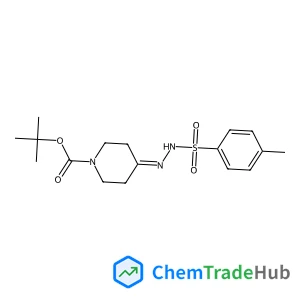
tert-Butyl 4-(2-(p-Tolylsulfonyl)hydrazono)piperidine-1-carboxylate
CAS番号:
1046478-89-0
分子式:
C17H25N3O4S
おすすめサプライヤー




免責事項
このページに表示される学術雑誌情報は、参考および研究目的のみを目的としています。当社は雑誌出版社とは提携しておらず、投稿の取り扱いも行っておりません。出版に関するお問い合わせは、各雑誌出版社に直接ご連絡ください。
表示されている情報に誤りがある場合は、support@chemtradehub.com までご連絡ください。迅速に確認し、対応いたします。