


Activities comparison of Schiff base zinc and tri-zinc complexes for alternating copolymerization of CO2 and epoxides
文献情報
出版日
2014-02-12
DOI
10.1039/C4PY00008K
インパクトファクター
5.582
著者
Yonghang Xu, Min Xiao, Shuanjin Wang, Mei Pan, Yuezhong Meng
原文を見る
要旨
A series of salicylaldiminato-zinc and -tri-zinc complexes containing various Schiff base ligands were prepared using quick methods and then well identified by full characterization. All zinc complexes were examined as catalysts for the copolymerization of CO2 and cyclohexene oxide. Many factors such as electron-donating or -withdrawing substituents on the benzene rings of the ligands, as well as chloride anions or acetate groups bound to the zinc centers, are found to greatly influence on the insertion of CO2 and ring-opening of epoxides. Tri-metallic complexes 2a and 2b exhibited excellent catalytic activities, and thus the copolymerization conditions such as temperature, pressure and reaction time were optimized. The molecular weights of the resulting copolymers determined by gel permeation chromatography display a bimodal distribution with relatively wide polydispersities. The results of the investigation indicate that the catalytic activities of zinc complexes are highly dependent on the electronic density and steric environment around the Zn metal centers.
おすすめジャーナル

Journal of the Indian Institute of Science

Main Group Chemistry

Colloid Journal

Acta Metallurgica Sinica-English Letters

Bioorganic & Medicinal Chemistry Letters

Atomization and Sprays

Medicinal Chemistry Research

Heteroatom Chemistry

Topics in Catalysis

Critical Reviews in Solid State and Materials Sciences
関連文献
Poly(dopamine acrylamide)-co-poly(propargyl acrylamide)-modified titanium surfaces for ‘click’ functionalization
Li Qun Xu, Hua Jiang, Koon-Gee Neoh, En-Tang Kang, Guo Dong Fu
2012-01-30
Paper
DOI: 10.1039/C2PY00552B
Cyclopenta[c]thiophene oligomers based solution processable D–A copolymers and their application as FET materials
Anjan Bedi, Satyaprasad P. Senanayak, Soumyajit Das, K. S. Narayan, Sanjio S. Zade
2012-04-27
Paper
DOI: 10.1039/C2PY20032E
Benzoxazine-based phosphinated bisphenols and their application in preparing flame-retardant, low dielectric cyanate ester thermosets
Hou Chien Chang, Hung Tse Lin, Ching Hsuan Lin
2012-02-01
Paper
DOI: 10.1039/C2PY00528J
Poly(N-isopropylacrylamide) on two-dimensional graphene oxide surfaces
Junjie Qi, Weipeng Lv, Guoliang Zhang, Fengbao Zhang, Xiaobin Fan
2012-01-18
Communication
DOI: 10.1039/C2PY00577H
A robust and high-throughput measurement platform for monomer reactivity ratios from surface-initiated polymerization
Derek L. Patton, Kirt A. Page, Emily A. Hoff, Michael J. Fasolka, Kathryn L. Beers
2012-02-23
Paper
DOI: 10.1039/C2PY20023F
こちらもおすすめ
化合物よくある質問
6- bromo-1-cyclopropyl-1H-benzimidazoleの市場動向や研究トレンドはどうですか?
6- bromo-1-cyclopropyl-1H-benzimidazoleは、抗炎症、抗ウイルス作用を持つことが報告されており、新薬開発の研究対象として注目...
1416713-53-56-Bromo-1-cyclopropy...
化合物よくある質問
環氧プロpanol-d5を取り扱う際の実験室安全事項は何ですか?
取り扱う際には、防護眼鏡と手袋を使用し、ドラフトチャンバー内で操作することを推奨します。漏洩時には適切な手順で処理し、安全データシートを常に参照してください。
1246819-20-4Glycidol-d5
化合物よくある質問
2,2’-ジメチル-3,3’-ビピリジンはどのように合成されますか?
2,2’-ジメチル-3,3’-ビピリジンは、ピリジンと2-メチルアクリルアミドを有機合成反応で合成します。この反応では、ピリジンと2-メチルアクリルアミドを含有...
86156-55-02,2’-Dimethyl-3,3’-b...
化合物よくある質問
6-甲基ピリジン-2-ボリック酸の主な用途は何ですか?
6-甲基ピリジン-2-ボリック酸は、合成化学、医薬品合成、以及研究用途などに広く使用され、特に組換えDNA技術や分子生物学の研究において重要な役割を果たします。
372963-50-3(6-Methyl-2-pyridiny...
化合物よくある質問
(R)-3-(1-甲基-2-氧環己基)プロpano酸メチルは安全ですか?
(R)-3-(1-甲基-2-氧環己基)プロpano酸メチルは一定の安全性がありますが、直接的な皮膚接触や吸入は避けるべきです。使用する際は適切な個々の安全データ...
94089-47-1methyl 3-[(1R)-1-met...
化合物よくある質問
ketorolacはどのように保存すればよいですか?
ketorolacは、密封して遮光容器に保管し、直射日光や高温を避けて保存してください。温度は常温で保存し、湿度をなるべく低く保つことが推奨されます。
74103-06-3rac Ketorolac
化合物よくある質問
L-2,3-二氨基丙酸二盐酸盐を取り扱う際の実験室安全事項は何ですか?
L-2,3-二氨基丙酸二盐酸盐は腐食性が強く、皮膚や粘膜に刺激を与える可能性があります。取り扱う際は、防塵マスク、ゴーグル、手袋を使用し、適切な排気設備を使用し...
19777-68-5(S)-2,3-Diaminopropa...
化合物よくある質問
2-(4-溴ピリジン-2-基)乙腈の物理化学的性質は何ですか?
2-(4-溴ピリジン-2-基)乙腈のCAS番号は312325-73-8です。主に結晶形態で存在し、分子量は159.01 g/molです。この化合物は水に溶けやす...
312325-73-8(4-Bromo-2-pyridinyl...
化合物よくある質問
3-フローロ-[1,1-ベンジレン]-3,4-ジカルボン酸を取り扱う際の実験室安全事項は何ですか?
この化合物は毒性は低いですが、直接的な接触や吸入に注意が必要です。PPE(個人防護具)を着用し、ドラフトチャンバーを使用して操作することを推奨します。また、漏洩...
1261915-32-53'-Fluoro-[1,1'-biph...
化合物よくある質問
3-(1-氧代-1,3-二氢-2H-2-异吲哚)丙酸の主な用途は何ですか?
3-(1-氧代-1,3-二氢-2H-2-异吲哚)丙酸は、薬理学研究や医薬品製造において広く用いられる化合物です。また、工業的な用途でも一部の化学反応の触媒や助剤...
83747-30-23-(1-Oxo-1,3-dihydro...
掲載誌
Polymer Chemistry

CiteScore:
8.6
自己引用率:
7.3%
年間論文数:
457
Polymer Chemistry welcomes submissions in all areas of polymer science that have a strong focus on macromolecular chemistry. Manuscripts may cover a broad range of fields, yet no direct application focus is required.
おすすめ化合物
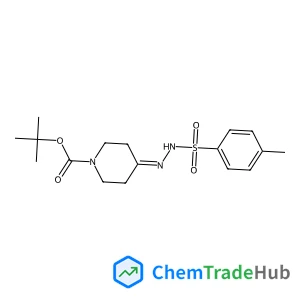
tert-Butyl 4-(2-(p-Tolylsulfonyl)hydrazono)piperidine-1-carboxylate
CAS番号:
1046478-89-0
分子式:
C17H25N3O4S
おすすめサプライヤー





免責事項
このページに表示される学術雑誌情報は、参考および研究目的のみを目的としています。当社は雑誌出版社とは提携しておらず、投稿の取り扱いも行っておりません。出版に関するお問い合わせは、各雑誌出版社に直接ご連絡ください。
表示されている情報に誤りがある場合は、support@chemtradehub.com までご連絡ください。迅速に確認し、対応いたします。