












Native like helices in a specially designed β peptide in the gas phase
文献情報
出版日
2015-01-09
DOI
10.1039/C4CP05216A
インパクトファクター
3.676
著者
Franziska Schubert, Stephan Warnke, Mario Salwiczek, Beate Koksch, Gert von Helden, Carsten Baldauf, Matthias Scheffler
原文を見る
要旨
In the natural peptides, helices are stabilized by hydrogen bonds that point backward along the sequence direction. Until now, there is only little evidence for the existence of analogous structures in oligomers of conformationally unrestricted β amino acids. We specifically designed the β peptide Ac-(β2hAla)6-LysH+ to form native like helical structures in the gas phase. The design follows the known properties of the peptide Ac-Ala6-LysH+ that forms a α helix in isolation. We perform ion-mobility mass-spectrometry and vibrational spectroscopy in the gas phase, combined with state-of-the-art density-functional theory simulations of these molecular systems in order to characterize their structure. We can show that the straightforward exchange of alanine residues for the homologous β amino acids generates a system that is generally capable of adopting native like helices with backward oriented H-bonds. By pushing the limits of theory and experiments, we show that one cannot assign a single preferred structure type due to the densely populated energy landscape and present an interpretation of the data that suggests an equilibrium of three helical structures.
関連文献
Light-induced modulation of DNA recognition by the Rad4/XPC damage sensor protein
Amirrasoul Tavakoli, Debamita Paul, Hong Mu, Jagannath Kuchlyan, Saroj Baral, Anjum Ansari, Suse Broyde, Jung-Hyun Min
2021-01-06
Paper
DOI: 10.1039/D0CB00192A
Chemical methods for protein site-specific ubiquitination
Weijun Gui, Gregory A. Davidson, Zhihao Zhuang
2021-02-25
Review Article
DOI: 10.1039/D0CB00215A
Modified internucleoside linkages for nuclease-resistant oligonucleotides
Guillaume Clavé, Maeva Reverte, Jean-Jacques Vasseur, Michael Smietana
2020-12-08
Review Article
DOI: 10.1039/D0CB00136H
Optogenetic modulation of real-time nanoscale dynamics of HCN channels using photoactivated adenylyl cyclases
Meenakshi Tanwar, Suneel Kateriya, Deepak Nair, Mini Jose
2021-03-08
Paper
DOI: 10.1039/D0CB00124D
Identification of fragments binding to SARS-CoV-2 nsp10 reveals ligand-binding sites in conserved interfaces between nsp10 and nsp14/nsp16
Frank Kozielski, Céleste Sele, Vladimir O. Talibov, Jiaqi Lou, Danni Dong, Qian Wang, Xinyue Shi, Maria Nyblom, Annika Rogstam, Tobias Krojer, Wolfgang Knecht
2021-10-06
Paper
DOI: 10.1039/D1CB00135C
Aquaporin-driven hydrogen peroxide transport: a case of molecular mimicry?
Darren Wragg, Stefano Leoni, Angela Casini
2020-11-25
Communication
DOI: 10.1039/D0CB00160K
In silico peptide-directed ligand design complements experimental peptide-directed binding for protein–protein interaction modulator discovery
Lesley Ann Howell, Andrew Michael Beekman
2020-11-19
Paper
DOI: 10.1039/D0CB00148A
Bypassing the requirement for aminoacyl-tRNA by a cyclodipeptide synthase enzyme
Christopher J. Harding, Emmajay Sutherland, Jane G. Hanna, Douglas R. Houston, Clarissa M. Czekster
2021-01-15
Paper
DOI: 10.1039/D0CB00142B
Chemical synthesis of a haemathrin sulfoprotein library reveals enhanced thrombin inhibition following tyrosine sulfation
Daniel Clayton, Sameer S. Kulkarni, Jessica Sayers, Luke J. Dowman, Jorge Ripoll-Rozada, Pedro José Barbosa Pereira
2020-09-21
Communication
DOI: 10.1039/D0CB00146E
Modified nucleoside triphosphates in bacterial research for in vitro and live-cell applications
Adeline Espinasse, Hannah K. Lembke, Angela A. Cao
2020-09-14
Review Article
DOI: 10.1039/D0CB00078G
こちらもおすすめ
化合物よくある質問
2-メトキシ-4-(メチルスルフィニル)アミンの主な用途は何ですか?
2-メトキシ-4-(メチルスルフィニル)アミンは、主に医薬品および農薬の製造に使用されます。また、合成化学の一部として研究用材料としても利用されます。
41608-73-52-Methoxy-4-(methyls...
118684-13-24-(Bromomethyl)-3-me...
化合物よくある質問
4,6-二氯-N-甲基ピラミジンアミンの代替品はありますか?
代替品としては、4,6-二クロロピラミジンアミンや他のピラミジン系化合物が考えられます。ただし、目的と用途によって最適な代替品は異なります。
10397-15-64,6-Dichloro-N-methy...
化合物よくある質問
6-氯-4-甲基-1H-吲哚を含む廃棄物はどのように処理すべきですか?
6-氯-4-甲基-1H-吲哚の廃棄物は、適切な容器に収集し、密閉して保管します。温度は常温、湿度は低く、直射日光を避けて保管することを推奨します。廃棄処理は専門...
885520-84-36-chloro-4-methyl-1H...
化合物よくある質問
2-フローユロ-4-(トリフルオロメチル)ベンゾイドについて「に適用される法規ガイドラインは何ですか」
2-フローユロ-4-(トリフルオロメチル)ベンゾイドのCAS番号は207974-08-1です。この化合物はGHS分類で毒性物質と有害な反応物質として分類されます...
207974-08-1[2-Fluoro-4-(trifluo...
化合物よくある質問
4-ニトロフェニルN-[(ベンゼルオキシルカーボンイル]グリシングリシングリシン酸はどのように保存すればよいですか?
4-ニトロフェニルN-[(ベンゼルオキシルカーボンイル]グリシングリシングリシン酸は、室温で暗所に保管し、乾燥した環境で保存することを推奨します。容器は密閉性の...
19811-64-44-Nitrophenyl N-[(be...
化合物よくある質問
イソデスロラタドリンの代替品はありますか?
イソデスロラタドリンの代替品としては、デスロラタドリンや他の抗ヒスタミン薬が挙げられます。具体的には、デスロラタドリン、ラセカミド、フェルタドリンなどが、症状や...
183198-49-4Iso Desloratadine
化合物よくある質問
5-甲氧基-1,2,3,4-四氢异喹啉盐酸盐はどのように合成されますか?
5-甲氧基-1,2,3,4-四氢异喹啉盐酸盐の一般的な合成方法は、メタノール中で5-メトキシ-1,2,3,4-四ヒュドロイソキシンを塩酸で塩化します。この反応で...
103030-69-95-Methoxy-1,2,3,4-te...
化合物よくある質問
4-アミノ-5-メトキシ-2-トルエンサルホニック酸についての法規ガイドラインは何ですか?
CAS番号6471-78-9の4-アミノ-5-メトキシ-2-トルエンサルホニック酸は、GHS分類では corrosive(腐食性)と識別されます。EUのREAC...
6471-78-94-Amino-5-Methoxy-2-...
化合物よくある質問
甲基孕酮を取り扱う際の実験室安全事項は何ですか?
甲基孕酮の取り扱いは、PPE(個人保護具)の使用が必要な重要な安全事項を伴います。防塵マスク、ゴーグル、手袋を着用することが推奨されます。ドラフトチャンバーを使...
204063-33-22-[(Diphenylmethyl)a...
掲載誌
Physical Chemistry Chemical Physics

CiteScore:
5.5
自己引用率:
10.3%
年間論文数:
3036
Physical Chemistry Chemical Physics (PCCP) is an international journal co-owned by 19 physical chemistry and physics societies from around the world. This journal publishes original, cutting-edge research in physical chemistry, chemical physics and biophysical chemistry. To be suitable for publication in PCCP, articles must include significant innovation and/or insight into physical chemistry; this is the most important criterion that reviewers and Editors will judge against when evaluating submissions. The journal has a broad scope and welcomes contributions spanning experiment, theory, computation and data science. Topical coverage includes spectroscopy, dynamics, kinetics, statistical mechanics, thermodynamics, electrochemistry, catalysis, surface science, quantum mechanics, quantum computing and machine learning. Interdisciplinary research areas such as polymers and soft matter, materials, nanoscience, energy, surfaces/interfaces, and biophysical chemistry are welcomed if they demonstrate significant innovation and/or insight into physical chemistry. Joined experimental/theoretical studies are particularly appreciated when complementary and based on up-to-date approaches.
おすすめ化合物

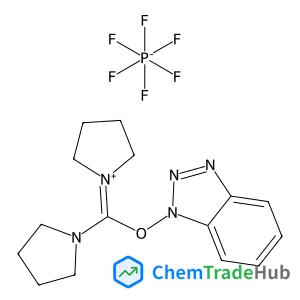
(1H-Benzotriazol-1-yloxy)(di-1-pyrrolidinyl)methylium hexafluorophosphate
CAS番号:
105379-24-6
分子式:
C15H21F6N5OP

おすすめサプライヤー





免責事項
このページに表示される学術雑誌情報は、参考および研究目的のみを目的としています。当社は雑誌出版社とは提携しておらず、投稿の取り扱いも行っておりません。出版に関するお問い合わせは、各雑誌出版社に直接ご連絡ください。
表示されている情報に誤りがある場合は、support@chemtradehub.com までご連絡ください。迅速に確認し、対応いたします。