












Synergistic effects of nonmetal co-doping with sulfur in anatase TiO2: a DFT + U study
文献情報
出版日
2014-12-04
DOI
10.1039/C4CP05065G
インパクトファクター
3.676
著者
Zong-Yan Zhao, Qing-Ju Liu
原文を見る
要旨
Using DFT + U calculations, the crystal structure and electronic properties of nonmetal co-doping with sulfur in anatase TiO2 are systematically investigated. The initial purpose of this work is to improve the photocatalytic performance of S mono-doped TiO2, in which S occupies the lattice Ti site and acts as a recombination center. Among eight nonmetal impurities that occupy the interstitial site of a TiO6 octahedron, the synergistic effects of B, C, and O with S could achieve this purpose: suppressing the recombination of photogenerated electron–hole pairs by inducing a local inner built-in electric field and eliminating the deep impurity energy bands of S mono-doped TiO2. Furthermore, the photon absorption could be extended to the visible-light region, owing to the overlap of impurity energy bands with the top of the valence band or the bottom of the conduction band. Thus, Ti1−xO2SxBy, Ti1−xO2SxCy and Ti1−xO2SxOy could be considered as promising efficient photocatalysts. Furthermore, the underlying mechanism and tendency of these synergistic effects have been discussed, according to the relationship between the photocatalytic performance and the crystal or electronic structure.
関連文献
Conformational and electronic effects on the formation of anti cyclobutane pyrimidine dimers in G-quadruplex structures
Wook Lee, Spiridoula Matsika
2016-12-08
Paper
DOI: 10.1039/C6CP05604K
Understanding the influence of Mg doping for the stabilization of capacity and higher discharge voltage of Li- and Mn-rich cathodes for Li-ion batteries
Prasant Kumar Nayak, Judith Grinblat, Elena Levi, Mikhael Levi, Boris Markovsky, Doron Aurbach
2017-01-20
Paper
DOI: 10.1039/C6CP07383B
Charge transport in organic donor–acceptor mixed-stack crystals: the role of nonlocal electron–phonon couplings
Lingyun Zhu, Hua Geng, Yuanping Yi, Zhixiang Wei
2017-01-06
Paper
DOI: 10.1039/C6CP07417K
Mechanism and kinetics of the electrocatalytic reaction responsible for the high cost of hydrogen fuel cells
Tao Cheng, William A Goddard, III, Qi An, Hai Xiao, Boris Merinov, Sergey Morozov
2016-12-21
Communication
DOI: 10.1039/C6CP08055C
A new approach to distance measurements between two spin labels in the >10 nm range
2017-01-27
Paper
DOI: 10.1039/C6CP07597E
The crucial role of Mn spiral spin order in stabilizing the Dy–Mn exchange striction in multiferroic DyMnO3
H. W. Wang, C. L. Li, S. L. Yuan, J. F. Wang, C. L. Lu, J.-M. Liu
2017-01-04
Paper
DOI: 10.1039/C6CP06369A
Low intensity, continuous wave photodoping of ZnO quantum dots – photon energy and particle size effects
Matías E. Aguirre, S. Municoy, M. A. Grela, A. J. Colussi
2017-01-04
Paper
DOI: 10.1039/C6CP06829D
Toward full simulation of the electrochemical oxygen reduction reaction on Pt using first-principles and kinetic calculations
Minoru Otani
2017-01-04
Paper
DOI: 10.1039/C6CP08466D
Conceptual density functional theory for electron transfer and transport in mesoscopic systems
Paulo R. Bueno, David A. Miranda
2017-02-02
Paper
DOI: 10.1039/C6CP02504H
こちらもおすすめ
化合物よくある質問
2-ブロモ-9,9-ジフェニル-9H-フルオレンの主な用途は何ですか?
2-溴-9,9-二苯基芴は、医薬品、工業材料、有機合成の研究分野で応用されます。特に、レーザー材料や機能性ポリマーの合成に使用されることがあります。また、蛍光色...
474918-32-62-Bromo-9,9-diphenyl...
化合物よくある質問
四氯化铱の市場動向や研究トレンドはどうですか?
四氯化铱の市場は研究開発分野で注目されており、特にナノ技術や金属有機框架(MOFs)の分野での需要が増加傾向にあります。価格は安定しており、中国や韓国での生産が...
207399-11-9Tetrachloroiridium h...
882-06-44-Nitrocinnamic acid
化合物よくある質問
1-(4-溴-3-氟苯基)-2-氯乙酮を含む廃棄物はどのように処理すべきですか?
1-(4-溴-3-氟苯基)-2-氯乙酮 (CAS番号: 1260857-14-4) の廃棄物は専門的な廃棄処理が必要です。まず、廃棄物は密閉された容器に収集し、...
1260857-14-41-(4-Bromo-3-fluorop...
化合物よくある質問
苦参酚Kとは何ですか?
苦参酚Kは、CAS番号101236-49-1を持つ化合物で、主に天然由来の生薬から抽出されます。この化合物は、抗炎症作用や抗癌作用を持つことが報告されています。
101236-49-1Kushenol K
化合物よくある質問
POTASSIUM (1-(TERTBUTOXYCARBONYL)AZETIDIN-3-YL)TRIFLUOROBORATE を含む廃棄物はどのように処理すべきですか?
POTASSIUM (1-(TERTBUTOXYCARBONYL)AZETIDIN-3-YL)TRIFLUOROBORATE を含む廃棄物は、まず安全なエント...
1430219-73-0Potassium (1-(tert-b...
化合物よくある質問
4-庚基-4’-联苯羧酸の市場動向や研究トレンドはどうですか?
4-庚基-4’-聯苯羧酸は、特殊化学品や合成化学の分野で用いられる化学物質ですが、市場動向としては、研究開発の進展とともに需要が増加しています。また、環境配慮型...
58573-94-74'-Heptyl-4-biphenyl...
化合物よくある質問
6-ブロモ-3-メトキシ-1-フェニル-1H-インドゾールを含む廃棄物はどのように処理すべきですか?
6-ブロモ-3-メトキシ-1-フェニル-1H-インドゾールを含む廃棄物は、適切な化学廃棄処理が必要です。通常、廃棄物は密閉容器に収集され、専門の廃棄処理業者に引...
1332527-03-36-Bromo-3-methoxy-1-...
化合物よくある質問
4,4-二甲基-2-吡咯烷酮はどの業界で使用されていますか?
4,4-二甲基-2-吡咯烷酮は医薬、ポリマー、センサー、半導体などの業界で広く使用されています。特に溶媒としての性能が高く評価されています。
66899-02-34,4-dimethylpyrrolid...
51312-42-6Sodium Phosphotungst...
掲載誌
Physical Chemistry Chemical Physics

CiteScore:
5.5
自己引用率:
10.3%
年間論文数:
3036
Physical Chemistry Chemical Physics (PCCP) is an international journal co-owned by 19 physical chemistry and physics societies from around the world. This journal publishes original, cutting-edge research in physical chemistry, chemical physics and biophysical chemistry. To be suitable for publication in PCCP, articles must include significant innovation and/or insight into physical chemistry; this is the most important criterion that reviewers and Editors will judge against when evaluating submissions. The journal has a broad scope and welcomes contributions spanning experiment, theory, computation and data science. Topical coverage includes spectroscopy, dynamics, kinetics, statistical mechanics, thermodynamics, electrochemistry, catalysis, surface science, quantum mechanics, quantum computing and machine learning. Interdisciplinary research areas such as polymers and soft matter, materials, nanoscience, energy, surfaces/interfaces, and biophysical chemistry are welcomed if they demonstrate significant innovation and/or insight into physical chemistry. Joined experimental/theoretical studies are particularly appreciated when complementary and based on up-to-date approaches.
おすすめ化合物
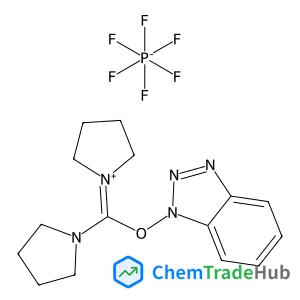
(1H-Benzotriazol-1-yloxy)(di-1-pyrrolidinyl)methylium hexafluorophosphate
CAS番号:
105379-24-6
分子式:
C15H21F6N5OP
おすすめサプライヤー





免責事項
このページに表示される学術雑誌情報は、参考および研究目的のみを目的としています。当社は雑誌出版社とは提携しておらず、投稿の取り扱いも行っておりません。出版に関するお問い合わせは、各雑誌出版社に直接ご連絡ください。
表示されている情報に誤りがある場合は、support@chemtradehub.com までご連絡ください。迅速に確認し、対応いたします。