












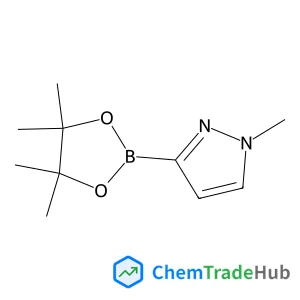
1-Methyl-3-(4,4,5,5-tetramethyl-1,3,2-dioxaborolan-2-yl)-1H-pyrazole
CAS番号:
1020174-04-2
分子式:
C10H17BN2O2
Minoru Otani
Present fuel cells must increase the activity of the oxygen reduction reaction (ORR) on platinum (or Pt alloy) electrodes. Detailed simulation analyses can direct future investigations by providing a better understanding of the ORR. We adopted a density functional theory (DFT)-based, first-principles molecular dynamics simulation for the elementary steps of the electrochemical ORR on Pt(111). The two-step process involves successive protonation of O and OH, which are adsorbed on Pt. The relevant redox potentials were estimated by changing the coverage of OH(ad) and O(ad). The reaction energy profiles were determined along the reaction coordinate using the Blue-Moon ensemble method and a constant-bias scheme in the DFT calculations. These profiles at different biases were then used to generate activation energies and symmetry factors. Cyclic voltammetry (CV) and linear sweep voltammetry profiles were then calculated from the Butler–Volmer rate, Nernst equilibrium, and mass diffusion equations using these obtained parameters, literature values and appropriate prefactors in the rate equations. The experimentally observed reversible and irreversible peaks in CV were obtained. The irreversibility of the protonation of O(ad), (R2), attributed to its higher activation energy, affects the ORR potential and thus fuel cell performance. It is therefore necessary not only to tune the adsorption energy of the O(ad) and OH(ad) intermediates, which are the origin of the “volcano plot”, but also to tune (R2)'s activation energy to elevate the performance above that of the volcano-top.
Chai Won Kim, Ji Hye Lee, Seunguk Cho, Hyung Jong Kim, Jinhyo Hwang, Yong Woo Kim, Dae Hyuk Choi, Min Ju Cho, Kwangyeol Lee, Dong Hoon Choi
DOI: 10.1039/D1PY00497B
Randall A. Scanga, James F. Reuther
DOI: 10.1039/D0PY01558J
Haoxiang Wang, Lei Shen
DOI: 10.1039/D1PY00637A
Natanel Jarach, Daniel Golani, Ofer Asaf, Hanna Dodiuk, Yoav Shamir, Amir Goldbourt, Samuel Kenig, Naum Naveh
DOI: 10.1039/D1PY00116G
Jacob J. Lessard, Georg M. Scheutz, Angie B. Korpusik, Rebecca A. Olson, C. Adrian Figg, Brent S. Sumerlin
DOI: 10.1039/D1PY00208B
Mariya Edeleva, Yoshi W. Marien, Paul H. M. Van Steenberge
DOI: 10.1039/D1PY00151E
Jianjun Li, Jiaqi Chen, Jiang Wu, Handan Lei, Yuting Tian
DOI: 10.1039/D1PY00493J
2-溴-9,9-二苯基芴は、医薬品、工業材料、有機合成の研究分野で応用されます。特に、レーザー材料や機能性ポリマーの合成に使用されることがあります。また、蛍光色...
四氯化铱の市場は研究開発分野で注目されており、特にナノ技術や金属有機框架(MOFs)の分野での需要が増加傾向にあります。価格は安定しており、中国や韓国での生産が...
1-(4-溴-3-氟苯基)-2-氯乙酮 (CAS番号: 1260857-14-4) の廃棄物は専門的な廃棄処理が必要です。まず、廃棄物は密閉された容器に収集し、...
苦参酚Kは、CAS番号101236-49-1を持つ化合物で、主に天然由来の生薬から抽出されます。この化合物は、抗炎症作用や抗癌作用を持つことが報告されています。
POTASSIUM (1-(TERTBUTOXYCARBONYL)AZETIDIN-3-YL)TRIFLUOROBORATE を含む廃棄物は、まず安全なエント...
4-庚基-4’-聯苯羧酸は、特殊化学品や合成化学の分野で用いられる化学物質ですが、市場動向としては、研究開発の進展とともに需要が増加しています。また、環境配慮型...
6-ブロモ-3-メトキシ-1-フェニル-1H-インドゾールを含む廃棄物は、適切な化学廃棄処理が必要です。通常、廃棄物は密閉容器に収集され、専門の廃棄処理業者に引...
4,4-二甲基-2-吡咯烷酮は医薬、ポリマー、センサー、半導体などの業界で広く使用されています。特に溶媒としての性能が高く評価されています。

Physical Chemistry Chemical Physics (PCCP) is an international journal co-owned by 19 physical chemistry and physics societies from around the world. This journal publishes original, cutting-edge research in physical chemistry, chemical physics and biophysical chemistry. To be suitable for publication in PCCP, articles must include significant innovation and/or insight into physical chemistry; this is the most important criterion that reviewers and Editors will judge against when evaluating submissions. The journal has a broad scope and welcomes contributions spanning experiment, theory, computation and data science. Topical coverage includes spectroscopy, dynamics, kinetics, statistical mechanics, thermodynamics, electrochemistry, catalysis, surface science, quantum mechanics, quantum computing and machine learning. Interdisciplinary research areas such as polymers and soft matter, materials, nanoscience, energy, surfaces/interfaces, and biophysical chemistry are welcomed if they demonstrate significant innovation and/or insight into physical chemistry. Joined experimental/theoretical studies are particularly appreciated when complementary and based on up-to-date approaches.
![[4-Amino-2-(methylsulfanyl)-5-pyrimidinyl]methanol structure](https://static.chemtradehub.com/structs/588/588-36-3-fc73.webp "[4-Amino-2-(methylsulfanyl)-5-pyrimidinyl]methanol structure")



