


Enhanced charge collection with ultrathin AlOx electron blocking layer for hole-transporting material-free perovskite solar cell
文献情報
出版日
2014-12-02
DOI
10.1039/C4CP04902K
インパクトファクター
3.676
著者
Huiyun Wei, Jiangjian Shi, Xin Xu, Junyan Xiao, Jianheng Luo, Juan Dong, Songtao Lv, Lifeng Zhu, Huijue Wu, Dongmei Li, Yanhong Luo, Qingbo Meng, Qiang Chen
原文を見る
要旨
An ultrathin AlOx layer has been deposited onto a CH3NH3PbI3 film using atomic layer deposition technology, to construct a metal–insulator–semiconductor (MIS) back contact for the hole-transporting material-free perovskite solar cell. By optimization of the ALD deposition cycles, the average power conversion efficiency (PCE) of the cell has been enhanced from 8.61% to 10.07% with a highest PCE of 11.10%. It is revealed that the improvement in cell performance with this MIS back contact is mainly attributed to the enhancement in charge collection resulting from the electron blocking effect of the AlOx layer.
おすすめジャーナル

Heteroatom Chemistry

Journal of the Indian Institute of Science

Chinese Journal of Chemistry

Main Group Chemistry

Biocatalysis and Biotransformation

Acta Metallurgica Sinica-English Letters

NDT & E International

Polycyclic Aromatic Compounds

Herald of the Russian Academy of Sciences

Bioorganic & Medicinal Chemistry
関連文献
A practical route to 2-iodoanilines via the transition-metal-free and base-free decarboxylative iodination of anthranilic acids under oxygen
2021-06-07
Research Article
DOI: 10.1039/D1QO00461A
Probing the mechanism of thermally driven thiol-Michael dynamic covalent chemistry
Borui Zhang, Progyateg Chakma, Max P. Shulman, Jun Ke, Zachary A. Digby, Dominik Konkolewicz
2018-03-15
Paper
DOI: 10.1039/C8OB00397A
Keep glowing and going: recent progress in diketopyrrolopyrrole synthesis towards organic optoelectronic materials
Nan Luo, Guanxin Zhang
2021-05-27
Review Article
DOI: 10.1039/D1QO00613D
Peroxy mediated Csp2–Csp3 dehydrogenative coupling: regioselective functionalization of coumarins and coumarin-3-carboxylic acids
Farnaz Jafarpour, Masoumeh Darvishmolla
2018-04-07
Paper
DOI: 10.1039/C7OB02771K
A solvent-free and efficient synthesis of bicyclic 2-pyridone derivatives for endoplasmic reticulum imaging
Xiaoyun Ran, Qian Zhou, Jin Zhang, Shanqiang Wang, Gui Wang, Hui Yang, Xiaochun Liu, Zhouyu Wang
2021-04-26
Research Article
DOI: 10.1039/D1QO00350J
Modular synthesis of heptaarylindole
Shin Suzuki, Takashi Asako, Kenichiro Itami, Junichiro Yamaguchi
2018-05-03
Paper
DOI: 10.1039/C8OB00993G
Cucurbitimines – imine cages with concave walls
Christine Bourguignon, Dorothee Schindler, Gangxiang Zhou, Frank Rominger, Michael Mastalerz
2021-05-17
Research Article
DOI: 10.1039/D1QO00478F
Nickel-catalyzed defluorinative alkylation of C(sp2)–F bonds
Xue Tong, Si-Si Luo, Hua Shen, Shu Zhang, Tian Cao, Yi-Peng Luo, Long-Ling Huang, Xi-Tao Ma, Xiang-Wei Liu
2021-06-07
Research Article
DOI: 10.1039/D1QO00549A
Metal-free oxidative cyclization of trifluoroacetimidohydrazides with methylhetarenes: a facile access to 3-hetaryl-5-trifluoromethyl-1,2,4-triazoles
Jiajun Zhang, Tian-Hui Xu, Zhengkai Chen
2021-06-11
Research Article
DOI: 10.1039/D1QO00790D
Photocatalyzed cascade Meerwein addition/cyclization of N-benzylacrylamides toward azaspirocycles
Li Yuan, Sheng-Ming Jiang, Zeng-Zeng Li, Yong Zhu, Jian Yu, Lan Li, Ming-Zhu Li, Shi Tang
2018-03-17
Communication
DOI: 10.1039/C8OB00132D
こちらもおすすめ
化合物よくある質問
2-メトキシ-4-(メチルスルフィニル)アミンの主な用途は何ですか?
2-メトキシ-4-(メチルスルフィニル)アミンは、主に医薬品および農薬の製造に使用されます。また、合成化学の一部として研究用材料としても利用されます。
41608-73-52-Methoxy-4-(methyls...
118684-13-24-(Bromomethyl)-3-me...
化合物よくある質問
4,6-二氯-N-甲基ピラミジンアミンの代替品はありますか?
代替品としては、4,6-二クロロピラミジンアミンや他のピラミジン系化合物が考えられます。ただし、目的と用途によって最適な代替品は異なります。
10397-15-64,6-Dichloro-N-methy...
化合物よくある質問
6-氯-4-甲基-1H-吲哚を含む廃棄物はどのように処理すべきですか?
6-氯-4-甲基-1H-吲哚の廃棄物は、適切な容器に収集し、密閉して保管します。温度は常温、湿度は低く、直射日光を避けて保管することを推奨します。廃棄処理は専門...
885520-84-36-chloro-4-methyl-1H...
化合物よくある質問
2-フローユロ-4-(トリフルオロメチル)ベンゾイドについて「に適用される法規ガイドラインは何ですか」
2-フローユロ-4-(トリフルオロメチル)ベンゾイドのCAS番号は207974-08-1です。この化合物はGHS分類で毒性物質と有害な反応物質として分類されます...
207974-08-1[2-Fluoro-4-(trifluo...
化合物よくある質問
4-ニトロフェニルN-[(ベンゼルオキシルカーボンイル]グリシングリシングリシン酸はどのように保存すればよいですか?
4-ニトロフェニルN-[(ベンゼルオキシルカーボンイル]グリシングリシングリシン酸は、室温で暗所に保管し、乾燥した環境で保存することを推奨します。容器は密閉性の...
19811-64-44-Nitrophenyl N-[(be...
化合物よくある質問
イソデスロラタドリンの代替品はありますか?
イソデスロラタドリンの代替品としては、デスロラタドリンや他の抗ヒスタミン薬が挙げられます。具体的には、デスロラタドリン、ラセカミド、フェルタドリンなどが、症状や...
183198-49-4Iso Desloratadine
化合物よくある質問
5-甲氧基-1,2,3,4-四氢异喹啉盐酸盐はどのように合成されますか?
5-甲氧基-1,2,3,4-四氢异喹啉盐酸盐の一般的な合成方法は、メタノール中で5-メトキシ-1,2,3,4-四ヒュドロイソキシンを塩酸で塩化します。この反応で...
103030-69-95-Methoxy-1,2,3,4-te...
化合物よくある質問
4-アミノ-5-メトキシ-2-トルエンサルホニック酸についての法規ガイドラインは何ですか?
CAS番号6471-78-9の4-アミノ-5-メトキシ-2-トルエンサルホニック酸は、GHS分類では corrosive(腐食性)と識別されます。EUのREAC...
6471-78-94-Amino-5-Methoxy-2-...
化合物よくある質問
甲基孕酮を取り扱う際の実験室安全事項は何ですか?
甲基孕酮の取り扱いは、PPE(個人保護具)の使用が必要な重要な安全事項を伴います。防塵マスク、ゴーグル、手袋を着用することが推奨されます。ドラフトチャンバーを使...
204063-33-22-[(Diphenylmethyl)a...
掲載誌
Physical Chemistry Chemical Physics

CiteScore:
5.5
自己引用率:
10.3%
年間論文数:
3036
Physical Chemistry Chemical Physics (PCCP) is an international journal co-owned by 19 physical chemistry and physics societies from around the world. This journal publishes original, cutting-edge research in physical chemistry, chemical physics and biophysical chemistry. To be suitable for publication in PCCP, articles must include significant innovation and/or insight into physical chemistry; this is the most important criterion that reviewers and Editors will judge against when evaluating submissions. The journal has a broad scope and welcomes contributions spanning experiment, theory, computation and data science. Topical coverage includes spectroscopy, dynamics, kinetics, statistical mechanics, thermodynamics, electrochemistry, catalysis, surface science, quantum mechanics, quantum computing and machine learning. Interdisciplinary research areas such as polymers and soft matter, materials, nanoscience, energy, surfaces/interfaces, and biophysical chemistry are welcomed if they demonstrate significant innovation and/or insight into physical chemistry. Joined experimental/theoretical studies are particularly appreciated when complementary and based on up-to-date approaches.
おすすめ化合物
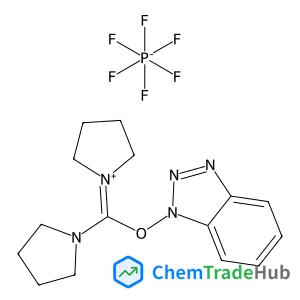
(1H-Benzotriazol-1-yloxy)(di-1-pyrrolidinyl)methylium hexafluorophosphate
CAS番号:
105379-24-6
分子式:
C15H21F6N5OP
おすすめサプライヤー





免責事項
このページに表示される学術雑誌情報は、参考および研究目的のみを目的としています。当社は雑誌出版社とは提携しておらず、投稿の取り扱いも行っておりません。出版に関するお問い合わせは、各雑誌出版社に直接ご連絡ください。
表示されている情報に誤りがある場合は、support@chemtradehub.com までご連絡ください。迅速に確認し、対応いたします。