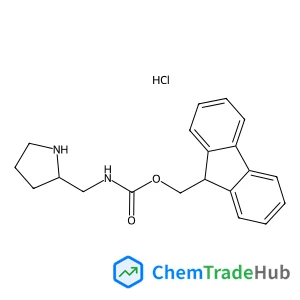
(S)-(9H-Fluoren-9-yl)methyl (pyrrolidin-2-ylmethyl)carbamate hydrochloride
CAS番号:
1217813-15-4
分子式:
C20H23ClN2O2
Nguyen Xuan Truong, Marco Savoca, André Fielicke, Otto Dopfer
Neutral silicon clusters doped with first row elements (Si6X) have been generated (X = B, C, N, O) and characterized by infrared–ultraviolet (IR–UV) two-photon resonance-enhanced ionization spectroscopy (X = C, O) and quantum chemical calculations (X = Be, B, C, N, O, Si). In the near threshold UV photoionization, the ion signal of specific cluster sizes can be significantly enhanced by resonant excitation with tunable IR light prior to UV irradiation, allowing for the measurement of the IR spectra of Si7, Si6C, and Si6O clusters. Structural assignments are achieved with the help of a global optimization procedure using density functional theory (DFT). The most stable calculated structures show the best agreement between predicted and measured spectra. The dopant atoms in the Si6X clusters have a negative net charge and the Si atoms act as electron donors within the clusters. Moreover, the overall structures of the Si6X clusters depend strongly on the nature of the dopant atom, i.e., its size and valency. While in some of the Si6X clusters one Si atom in Si7 is simply substituted by the dopant atom (X = Be, B, C), other cases exhibit a completely different geometry (X = N, O). As a general trend, doping of the Si7 cluster with first-row dopants is predicted to shift the optically allowed electronic transitions into the visible or even near-IR spectral range due to symmetry reduction or the radical character of the doped cluster.
Alessandro Longo, Sergio Giuffrida, Grazia Cottone, Lorenzo Cordone
DOI: 10.1039/B926977K
María Paz Fernández-García, Pedro Gorria, Marta Sevilla, Antonio B. Fuertes, Roberto Boada, Jesús Chaboy, Giuliana Aquilanti, Jesús A. Blanco
DOI: 10.1039/C0CP00396D
Luca Artiglia, Thomas Diemant, Heinrich Hartmann, Joachim Bansmann, R. Jürgen Behm, Gaetano Granozzi
DOI: 10.1039/C000884B
Eduardo D. Martínez, Leticia Granja, Martín G. Bellino, Galo J. A. A. Soler-Illia
DOI: 10.1039/C0CP00824A
Guang-Jiu Zhao, Ke-Li Han
DOI: 10.1039/B924549A
Fang Qin, Yaobin Jiang, Yue Chen, Maoying Wu, Guanwen Yan, Wenjun Ye, Yixue Li, Jian Zhang
DOI: 10.1039/C0CP00701C
Chuan-Pei Lee, Po-Yen Chen, R. Vittal
DOI: 10.1039/B923477B
R. Angelico, C. Oliviero Rossi, L. Ambrosone, K. Mortensen, U. Olsson
DOI: 10.1039/B926152D
Antonius Indarto, Anna Giordana, Giovanni Ghigo, Andrea Maranzana, Glauco Tonachini
DOI: 10.1039/C000491J
DOI: 10.1039/C0CP00855A
2-メトキシ-4-(メチルスルフィニル)アミンは、主に医薬品および農薬の製造に使用されます。また、合成化学の一部として研究用材料としても利用されます。
代替品としては、4,6-二クロロピラミジンアミンや他のピラミジン系化合物が考えられます。ただし、目的と用途によって最適な代替品は異なります。
6-氯-4-甲基-1H-吲哚の廃棄物は、適切な容器に収集し、密閉して保管します。温度は常温、湿度は低く、直射日光を避けて保管することを推奨します。廃棄処理は専門...
2-フローユロ-4-(トリフルオロメチル)ベンゾイドのCAS番号は207974-08-1です。この化合物はGHS分類で毒性物質と有害な反応物質として分類されます...
4-ニトロフェニルN-[(ベンゼルオキシルカーボンイル]グリシングリシングリシン酸は、室温で暗所に保管し、乾燥した環境で保存することを推奨します。容器は密閉性の...
イソデスロラタドリンの代替品としては、デスロラタドリンや他の抗ヒスタミン薬が挙げられます。具体的には、デスロラタドリン、ラセカミド、フェルタドリンなどが、症状や...
5-甲氧基-1,2,3,4-四氢异喹啉盐酸盐の一般的な合成方法は、メタノール中で5-メトキシ-1,2,3,4-四ヒュドロイソキシンを塩酸で塩化します。この反応で...
CAS番号6471-78-9の4-アミノ-5-メトキシ-2-トルエンサルホニック酸は、GHS分類では corrosive(腐食性)と識別されます。EUのREAC...
甲基孕酮の取り扱いは、PPE(個人保護具)の使用が必要な重要な安全事項を伴います。防塵マスク、ゴーグル、手袋を着用することが推奨されます。ドラフトチャンバーを使...

Physical Chemistry Chemical Physics (PCCP) is an international journal co-owned by 19 physical chemistry and physics societies from around the world. This journal publishes original, cutting-edge research in physical chemistry, chemical physics and biophysical chemistry. To be suitable for publication in PCCP, articles must include significant innovation and/or insight into physical chemistry; this is the most important criterion that reviewers and Editors will judge against when evaluating submissions. The journal has a broad scope and welcomes contributions spanning experiment, theory, computation and data science. Topical coverage includes spectroscopy, dynamics, kinetics, statistical mechanics, thermodynamics, electrochemistry, catalysis, surface science, quantum mechanics, quantum computing and machine learning. Interdisciplinary research areas such as polymers and soft matter, materials, nanoscience, energy, surfaces/interfaces, and biophysical chemistry are welcomed if they demonstrate significant innovation and/or insight into physical chemistry. Joined experimental/theoretical studies are particularly appreciated when complementary and based on up-to-date approaches.
![2-(7,7-Difluorobicyclo[4.1.0]hept-1-yl)ethanamine structure](https://static.chemtradehub.com/structs/209/2098065-08-6-ff24.webp "2-(7,7-Difluorobicyclo[4.1.0]hept-1-yl)ethanamine structure")