












![[(2R)-6,6-Dimethyl-2-morpholinyl]methanol hydrochloride (1:1) structure](https://static.chemtradehub.com/structs/141/1416444-88-6-e06a.webp "[(2R)-6,6-Dimethyl-2-morpholinyl]methanol hydrochloride (1:1) structure")
The electrical conductivity of thin film donor doped hematite: from insulator to semiconductor by defect modulation
文献情報
出版日
2014-04-29
DOI
10.1039/C4CP01144A
インパクトファクター
3.676
著者
J. Engel, H. L. Tuller
原文を見る
要旨
Hematite or α-Fe2O3 has emerged as a highly promising photoanode candidate for photoelectrochemical cells. While significant improvements in its performance have recently been achieved, it remains unclear why the maximum photocurrents still remain well below their theoretical predictions. Here, we report, for the first time, a detailed correlation between the electrical conductivity of undoped and 1 atom% Ti doped hematite and the conditions under which it was annealed (20 ≤ T ≤ 800 °C and 10−4 ≤ pO2 ≤ 1 atm). Hematite thin films grown by pulsed laser deposition onto sapphire single crystals were evaluated by impedance spectroscopy. Hematite's room temperature conductivity can be increased from ∼10−11 S cm−1 for undoped films by as much as nine orders of magnitude by doping with the Ti donor. Furthermore, by controlling the non-stoichiometry of Ti-doped hematite, one can tune its conductivity by up to five orders of magnitude. Depending on processing conditions, donor dopants in hematite may be compensated largely by electrons or by ionic defects (Fe vacancies). A defect model was derived to explain this phenomenon. In addition, a temperature independent value for the electron mobility of 0.01 cm2 V−1 s−1 for a donor density of 4.0 × 1020 cm−3 (1% Ti) was derived. These results highlight the importance of carefully controlling photoanode processing conditions, even when operating within the material's extrinsic dopant regime, and more generally, provide a model for the electronic properties of semiconducting metal oxide photoanodes.
関連文献
Photoelectrochemical detection of metal ions
Wei-Wei Zhao, Jing-Juan Xu, Hong-Yuan Chen
2016-06-03
Critical Review
DOI: 10.1039/C6AN01123C
Mathematical chromatography deciphers the molecular fingerprints of dissolved organic matter
Urban J. Wünsch, Jeffrey A. Hawkes
2020-01-09
Paper
DOI: 10.1039/C9AN02176K
Complexometric titrations: new reagents and concepts to overcome old limitations
Jingying Zhai, Eric Bakker
2016-05-27
Minireview
DOI: 10.1039/C6AN00538A
Measurement of serum phosphate levels using a mobile sensor
Sarah Esparza, Dimei Wu, Mark R. Hanudel, Barbara Gales, Isidro B. Salusky
2020-01-10
Paper
DOI: 10.1039/C9AN02215E
Gadolinium-based MRI contrast agent for the detection of tyrosinase
Hyewon Seo
2019-12-17
Communication
DOI: 10.1039/C9AN02213A
Acetylcholinesterase-catalyzed silver deposition for ultrasensitive electrochemical biosensing of organophosphorus pesticides
Zhenhui Liu, Xin Xia, Guoxing Zhou, Lei Ge, Feng Li
2020-01-15
Paper
DOI: 10.1039/C9AN02546D
A paper-based biosensor for visual detection of glucose-6-phosphate dehydrogenase from whole blood
Dawn White, Mehdi Keramane, Alfredo Capretta, John D. Brennan
2020-01-20
Paper
DOI: 10.1039/C9AN02219H
The presence of a 5′-abasic lesion enhances discrimination of single nucleotide polymorphisms while inducing an isothermal ligase chain reaction
Abu Kausar, Eiman A. Osman, Tendai Gadzikwa, Julianne M. Gibbs-Davis
2016-05-27
Communication
DOI: 10.1039/C6AN00614K
Retraction: Microelectrochemical cell arrays for whole-cell currents recording through ion channel proteins based on trans-electroporation approach
Jan C. Behrends, Jürgen Rühe
2020-01-31
Retraction
DOI: 10.1039/D0AN90011G
DNA detection by SERS: hybridisation parameters and the potential for asymmetric PCR
Daniel Macdonald, Ewen Smith, Karen Faulds, Duncan Graham
2020-01-13
Paper
DOI: 10.1039/C9AN01732A
こちらもおすすめ
化合物よくある質問
2,3-スチオエポキシマドルを取り扱う際の実験室安全事項は何ですか?
取り扱いにはPPE(プロテクティブ・パーソナル・エイド)が必要で、防ぐ手袋と保護眼鏡を着用してください。ドラフトチャンバーの使用を推奨します。漏洩した場合は、適...
4267-80-52,3-Thioepoxy Madol
53981-25-22-Amino-6-fluorophen...
化合物よくある質問
BOC-S-3-アミニ-4-(4-メチオキシベンチル)-ブタン酸の代替品はありますか?
この化合物の代替品としては、BOC保護基を有さないアミノ酸やその他の保護基化合物が考えられます。また、メチオキシ基を有しない他の芳香族アミノ酸も代替品として挙げ...
126800-59-7(3S)-4-(4-Methoxyphe...
化合物よくある質問
Methyl 2-(chloromethyl)-3-nitrobenzoate(1218910-61-2)の代替品はありますか?
Methyl 2-(chloromethyl)-3-nitrobenzoate(1218910-61-2)の代替品としては、化学組成を変えることで効果を達成する...
1218910-61-2Methyl 2-(chlorometh...
化合物よくある質問
(2R)-2-アミノ-N-ベンジル-3-ヒドロキシプロパナミドを含む廃棄物はどのように処理すべきですか?
(2R)-2-アミノ-N-ベンジル-3-ヒドロキシプロパナミドを含む廃棄物は、適切な廃棄物管理ガイドラインに基づき処理する必要があります。まず、廃棄物を適切に収...
175481-39-7(2R)-2-amino-N-benzy...
化合物よくある質問
6,7-二氢-咪唑並[1,2-a]ピリドイン-8(5h)-酮はどのように合成されますか?
6,7-二氢-咪唑並[1,2-a]ピリドイン-8(5h)-酮は、2-ブロモフェニルアセトインとリン酸ハロゲン化物を反応させることで合成できます。この反応は高温で...
457949-09-66,7-Dihydroimidazo[1...
化合物よくある質問
エチル(3R)-3-ピロリジニル酢酸水和塩とは何ですか?
エチル(3R)-3-ピロリジニル酢酸水和塩は、CAS番号1332459-32-1の化合物で、(R)-乙基2-(ピロリジン-3-基)酢酸塩水和塩と呼ばれます。この...
1332459-32-1Ethyl (3R)-3-pyrroli...
化合物よくある質問
(2S)-{[(2-メチルエチルオキシ]カルボニル}アミノ)[2-(トリアフルオロメチルフェニル]エチカシック酸の物理化学的性質は何ですか?
(2S)-{[(2-メチルエチルオキシ]カルボニル}アミノ)[2-(トリアフルオロメチルフェニル]エチカシック酸のCAS番号は1203454-45-8です。この...
1203454-45-8(2S)-({[(2-Methyl-2-...
化合物よくある質問
2-ブロモ-1-(2-メチル-2-プロパニル)-4-ニトロベンゼンはどのように保存すればよいですか?
2-ブロモ-1-(2-メチル-2-プロパニル)-4-ニトロベンゼンは、直射日光を避けて暗所で、室温(約15℃〜25℃)、乾燥した場所に保存する必要があります。ま...
6310-17-42-Bromo-1-(2-methyl-...
化合物よくある質問
1-[(4-硝基フェニル)スルホニル]-1H-1,2,4-三唑の市場動向や研究トレンドはどうですか?
市場動向としては、1-[(4-硝基フェニル)スルホニル]-1H-1,2,4-三唑は主に農業用除草剤や合成化学製品の原料として利用されています。研究トレンドとして...
57777-84-11-[(4-Nitrophenyl)su...
掲載誌
Physical Chemistry Chemical Physics

CiteScore:
5.5
自己引用率:
10.3%
年間論文数:
3036
Physical Chemistry Chemical Physics (PCCP) is an international journal co-owned by 19 physical chemistry and physics societies from around the world. This journal publishes original, cutting-edge research in physical chemistry, chemical physics and biophysical chemistry. To be suitable for publication in PCCP, articles must include significant innovation and/or insight into physical chemistry; this is the most important criterion that reviewers and Editors will judge against when evaluating submissions. The journal has a broad scope and welcomes contributions spanning experiment, theory, computation and data science. Topical coverage includes spectroscopy, dynamics, kinetics, statistical mechanics, thermodynamics, electrochemistry, catalysis, surface science, quantum mechanics, quantum computing and machine learning. Interdisciplinary research areas such as polymers and soft matter, materials, nanoscience, energy, surfaces/interfaces, and biophysical chemistry are welcomed if they demonstrate significant innovation and/or insight into physical chemistry. Joined experimental/theoretical studies are particularly appreciated when complementary and based on up-to-date approaches.
おすすめ化合物

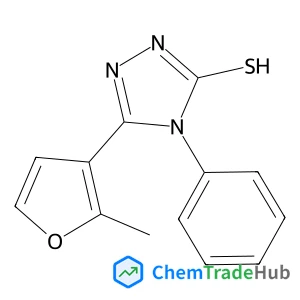
5-(2-Methyl-3-furyl)-4-phenyl-2,4-dihydro-3H-1,2,4-triazole-3-thione
CAS番号:
346464-59-3
分子式:
C13H11N3OS
おすすめサプライヤー






免責事項
このページに表示される学術雑誌情報は、参考および研究目的のみを目的としています。当社は雑誌出版社とは提携しておらず、投稿の取り扱いも行っておりません。出版に関するお問い合わせは、各雑誌出版社に直接ご連絡ください。
表示されている情報に誤りがある場合は、support@chemtradehub.com までご連絡ください。迅速に確認し、対応いたします。