


![2-Methyl-2-propanyl {3-[4-(4,4,5,5-tetramethyl-1,3,2-dioxaborolan-2-yl)phenyl]-3-oxetanyl}carbamate structure](https://static.chemtradehub.com/structs/127/1279090-25-3-1b84.webp "2-Methyl-2-propanyl {3-[4-(4,4,5,5-tetramethyl-1,3,2-dioxaborolan-2-yl)phenyl]-3-oxetanyl}carbamate structure")
Muon spin spectroscopy of ferrocene: characterization of muoniated ferrocenyl radicals
文献情報
出版日
2014-04-17
DOI
10.1039/C4CP00618F
インパクトファクター
3.676
著者
原文を見る
要旨
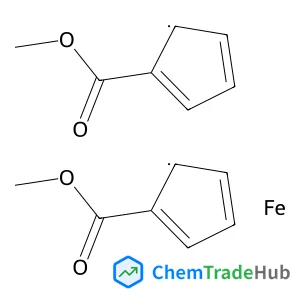
Radicals formed by the reaction of muonium (Mu), a light isotope of hydrogen, with ferrocene and ferrocene-d10 have been studied with the avoided level crossing muon spin resonance (ALC-μSR) and longitudinal field muon spin relaxation (LF-μSR) techniques between 10 and 100 K. A single type of radical was observed in each compound and the muon hyperfine coupling constants (hfcc) and the muon spin relaxation rates were measured as a function of temperature. A previous report concerning the observation of Mu adducts of ferrocene (U. A. Jayasooriya et al. Chem. – Eur. J., 2007, 13, 2266–2276) appears to be incorrect. DFT calculations were performed to aid in the assignment of the ALC-μSR spectra. A tentative assignment is that the observed radicals were formed by Mu addition to the exterior of the cyclopentadienyl rings and that the structures are distorted due to interactions with neighbouring molecules. The temperature dependence of the muon hfcc can be explained assuming the population of two levels with different muon hfccs separated by 1.4 ± 0.1 kJ mol−1. The temperature dependence of the width and amplitude of the Δ1 resonance and the muon spin relaxation rate suggests that the electron spin relaxation rate increase with temperature, but the relaxation mechanism is unknown.
おすすめジャーナル

Environmental Toxicology and Pharmacology

Journal of Enzyme inhibition and Medicinal Chemistry

European Journal of Organic Chemistry

Angewandte Chemie International Edition

Physical Chemistry Chemical Physics

Journal of Medical Biochemistry

Contact Lens & Anterior Eye

Lab on a Chip

Green Chemistry

Current Pharmaceutical Biotechnology
関連文献
Synergy of oxygen vacancies and Bi nanoparticles on BiOBr nanosheets for enhanced photocatalytic H2O2 production
Li Feng, Hanping Fu, Tianxiang Zhang, Qing Zhang, Shufen Ren, Jiayun Cheng, Qingshuang Liang, Xiufeng Xiao
2023-12-25
Paper
DOI: 10.1039/D3NJ03815G
Microporous organic nanoparticles bearing tri-Zn macrocycles: heterogeneous catalysts for the conversion of biomass-derived furan esters to polymer platforms
June Young Jang, Gang Min Lee, Jong Doo Lee, Seung Uk Son
2023-10-20
Communication
DOI: 10.1039/D3TA04797K
Huperzine alkaloids: forty years of total syntheses
Lili Song
2023-10-11
Review Article
DOI: 10.1039/D3NP00029J
A biscationic imidazolium ionic liquid immobilized on graphene oxide as an efficient heterogeneous catalyst for the synthesis of tetraketone derivatives
Padmini Gupta, Bholey Singh, Manjeet Dhama, Balaram Pani, Subho Mozumdar
2023-11-14
Paper
DOI: 10.1039/D3NJ03812B
Correction: Nickel carbonate (Ni2(CO3)3) as an electrocatalyst and photo-electrocatalyst for methanol electro-oxidation
Iranna Udachyan, Jayesh T. Bhanushali, Tomer Zidki, Amir Mizrahi
2023-11-06
Correction
DOI: 10.1039/D3TA90234J
Design and numerical-phase analysis of an SPR system for direct detection of SARS-CoV-2 virus in pharyngeal swab solution
Yansheng Liu, Xiaobo Jia, Jin Zhou, Hongli Li, Xiaohong Wang, Yating Chen, Zhenle Qin, Zhichen Jin, Guofu Wang
2023-12-18
Paper
DOI: 10.1039/D3NJ05083A
One-pot, efficient synthesis of fused quinoline analogues via room temperature C(sp3)–N cleavage/aromatization reaction
Subramaniyan Prasanna Kumari, Subbiah Thamotharan, Subramaniapillai Selva Ganesan
2024-01-02
Paper
DOI: 10.1039/D3NJ05462D
Crystal structure, magnetic properties and theoretical study of a bithiazolebis(oxamate)-containing [Ni II3] helicate
Lucas H. G. Kalinke, Mariany S. Silva, Ana K. Valdo, Felipe T. Martins, Nicolás Moliner, Miguel Julve, Francesc Lloret, Joan Cano, Danielle Cangussu
2024-01-08
Paper
DOI: 10.1039/D3NJ04701F
Cathode interface materials based on perylene-diimide derivatives for thickness insensitivity and high fill factor heterojunction organic solar cells
Lei Li, Jie Xu, Wenli Luo, Ke Zhong, Xiaohong Zhao, Yu Hu, Zhongyi Yuan, Yiwang Chen
2023-10-18
Paper
DOI: 10.1039/D3TA04833K
The role of Caenorhabditis elegans in the discovery of natural products for healthy aging
Benjamin Kirchweger, Julia Zwirchmayr, Ulrike Grienke, Judith M. Rollinger
2023-08-16
Review Article
DOI: 10.1039/D3NP00021D
こちらもおすすめ
化合物よくある質問
2-メトキシ-4-(メチルスルフィニル)アミンの主な用途は何ですか?
2-メトキシ-4-(メチルスルフィニル)アミンは、主に医薬品および農薬の製造に使用されます。また、合成化学の一部として研究用材料としても利用されます。
41608-73-52-Methoxy-4-(methyls...
118684-13-24-(Bromomethyl)-3-me...
化合物よくある質問
4,6-二氯-N-甲基ピラミジンアミンの代替品はありますか?
代替品としては、4,6-二クロロピラミジンアミンや他のピラミジン系化合物が考えられます。ただし、目的と用途によって最適な代替品は異なります。
10397-15-64,6-Dichloro-N-methy...
化合物よくある質問
6-氯-4-甲基-1H-吲哚を含む廃棄物はどのように処理すべきですか?
6-氯-4-甲基-1H-吲哚の廃棄物は、適切な容器に収集し、密閉して保管します。温度は常温、湿度は低く、直射日光を避けて保管することを推奨します。廃棄処理は専門...
885520-84-36-chloro-4-methyl-1H...
化合物よくある質問
2-フローユロ-4-(トリフルオロメチル)ベンゾイドについて「に適用される法規ガイドラインは何ですか」
2-フローユロ-4-(トリフルオロメチル)ベンゾイドのCAS番号は207974-08-1です。この化合物はGHS分類で毒性物質と有害な反応物質として分類されます...
207974-08-1[2-Fluoro-4-(trifluo...
化合物よくある質問
4-ニトロフェニルN-[(ベンゼルオキシルカーボンイル]グリシングリシングリシン酸はどのように保存すればよいですか?
4-ニトロフェニルN-[(ベンゼルオキシルカーボンイル]グリシングリシングリシン酸は、室温で暗所に保管し、乾燥した環境で保存することを推奨します。容器は密閉性の...
19811-64-44-Nitrophenyl N-[(be...
化合物よくある質問
イソデスロラタドリンの代替品はありますか?
イソデスロラタドリンの代替品としては、デスロラタドリンや他の抗ヒスタミン薬が挙げられます。具体的には、デスロラタドリン、ラセカミド、フェルタドリンなどが、症状や...
183198-49-4Iso Desloratadine
化合物よくある質問
5-甲氧基-1,2,3,4-四氢异喹啉盐酸盐はどのように合成されますか?
5-甲氧基-1,2,3,4-四氢异喹啉盐酸盐の一般的な合成方法は、メタノール中で5-メトキシ-1,2,3,4-四ヒュドロイソキシンを塩酸で塩化します。この反応で...
103030-69-95-Methoxy-1,2,3,4-te...
化合物よくある質問
4-アミノ-5-メトキシ-2-トルエンサルホニック酸についての法規ガイドラインは何ですか?
CAS番号6471-78-9の4-アミノ-5-メトキシ-2-トルエンサルホニック酸は、GHS分類では corrosive(腐食性)と識別されます。EUのREAC...
6471-78-94-Amino-5-Methoxy-2-...
化合物よくある質問
甲基孕酮を取り扱う際の実験室安全事項は何ですか?
甲基孕酮の取り扱いは、PPE(個人保護具)の使用が必要な重要な安全事項を伴います。防塵マスク、ゴーグル、手袋を着用することが推奨されます。ドラフトチャンバーを使...
204063-33-22-[(Diphenylmethyl)a...
掲載誌
Physical Chemistry Chemical Physics
CiteScore:
5.5
自己引用率:
10.3%
年間論文数:
3036
Physical Chemistry Chemical Physics (PCCP) is an international journal co-owned by 19 physical chemistry and physics societies from around the world. This journal publishes original, cutting-edge research in physical chemistry, chemical physics and biophysical chemistry. To be suitable for publication in PCCP, articles must include significant innovation and/or insight into physical chemistry; this is the most important criterion that reviewers and Editors will judge against when evaluating submissions. The journal has a broad scope and welcomes contributions spanning experiment, theory, computation and data science. Topical coverage includes spectroscopy, dynamics, kinetics, statistical mechanics, thermodynamics, electrochemistry, catalysis, surface science, quantum mechanics, quantum computing and machine learning. Interdisciplinary research areas such as polymers and soft matter, materials, nanoscience, energy, surfaces/interfaces, and biophysical chemistry are welcomed if they demonstrate significant innovation and/or insight into physical chemistry. Joined experimental/theoretical studies are particularly appreciated when complementary and based on up-to-date approaches.
おすすめ化合物

おすすめサプライヤー





免責事項
このページに表示される学術雑誌情報は、参考および研究目的のみを目的としています。当社は雑誌出版社とは提携しておらず、投稿の取り扱いも行っておりません。出版に関するお問い合わせは、各雑誌出版社に直接ご連絡ください。
表示されている情報に誤りがある場合は、support@chemtradehub.com までご連絡ください。迅速に確認し、対応いたします。