













Oxygen-evolving complex of photosystem II: correlating structure with spectroscopy
文献情報
出版日
2014-03-28
DOI
10.1039/C4CP00493K
インパクトファクター
3.676
著者
Ravi Pokhrel, Gary W. Brudvig
原文を見る
要旨
Water oxidation at the oxygen-evolving complex (OEC) of photosystem II (PSII) involves multiple redox states called Sn states (n = 0–4). The S1 → S2 redox transition of the OEC has been studied extensively using various forms of spectroscopy, including electron paramagnetic resonance (EPR) and Fourier transform infrared (FTIR) spectroscopy. In the S2 state, two isomers of the OEC are observed by EPR: a ST = 1/2 form and a ST = 5/2 form. DFT-based structural models of the OEC have been proposed for the two spin isomers in the S2 state, but the factors that determine the stability of one form or the other are not known. Using structural information on the OEC and its surroundings, in conjunction with spectroscopic information available on the S1 → S2 transition for a variety of site-directed mutations, Ca2+ and Cl− substitutions, and small molecule inhibitors, we propose that the hydrogen-bonding network encompassing D1-D61 and the OEC-bound waters plays an important role in stabilizing one spin isomer over the other. In the presence of ammonia, PSII centers can be trapped in either the ST = 5/2 form after a 200 K illumination procedure or an ammonia-altered ST = 1/2 form upon annealing at 273 K. We propose a mechanism for ammonia binding to the OEC in the S2 state that takes into account the hydrogen-binding requirements for ammonia binding and the specificity for binding of ammonia but not methylamine. A discussion regarding the possibility of spin isomers of the OEC in the S1 state, analogous to the spin isomers of the S2 state, is also presented.
関連文献
Photoconversion of 6,13-α-diketopentacene in the crystalline phase
Katsuki Tanaka, Mariko Oe
2014-05-21
Paper
DOI: 10.1039/C4CP01607F
Micropore engineering of carbonized porous aromatic framework (PAF-1) for supercapacitors application
Yanqiang Li, Soumyajit Roy, Teng Ben, Shixian Xu, Shilun Qiu
2014-04-10
Paper
DOI: 10.1039/C4CP00550C
Oxygen-evolving complex of photosystem II: correlating structure with spectroscopy
Ravi Pokhrel, Gary W. Brudvig
2014-03-28
Perspective
DOI: 10.1039/C4CP00493K
The photo-orientation of azobenzene in viscous solutions, simulated by a stochastic model
Valentina Cantatore, Giovanni Granucci, Maurizio Persico
2014-10-14
Paper
DOI: 10.1039/C4CP03472D
Theoretical simulation of reduction mechanism of graphene oxide in sodium hydroxide solution
Chu Chen, Weixin Kong, Hai-Ming Duan, Jun Zhang
2014-04-10
Paper
DOI: 10.1039/C4CP01031K
Computational study on the interaction between CCR5 and HIV-1 entry inhibitor maraviroc: insight from accelerated molecular dynamics simulation and free energy calculation
Yang Zhang, Xiaomeng Li, Wenbo Chen, Huanxiang Liu, Xiaojun Yao
2014-09-29
Paper
DOI: 10.1039/C4CP03331K
Unimolecular reaction chemistry of a charge-tagged beta-hydroxyperoxyl radical
Sui So, Gabriel da Silva
2014-10-09
Paper
DOI: 10.1039/C4CP02981J
Fracture mechanism of amorphous polymers at strain fields
Lan Huang, Xiaoping Yang, Xiaolong Jia, Dapeng Cao
2014-10-06
Paper
DOI: 10.1039/C4CP03120B
Flue gas CO2 mineralization using thermally activated serpentine: from single- to double-step carbonation
Mischa Werner, Subrahmaniam Hariharan, Marco Mazzotti
2014-09-30
Paper
DOI: 10.1039/C4CP02786H
こちらもおすすめ
化合物よくある質問
1-{3-[5-(エチルカルボンイル)-2,4-ジメチル-1H-ピロロール-3-基]プロパニル}ピペリジン-4-カルボン酸について、適用される法規ガイドラインは何ですか?
この化合物はCAS番号1142209-81-1であり、GHS分類では corrosive (腐食性物質) と classified (分類物質) として指定され...
1142209-81-11-{3-[5-(Ethoxycarbo...
化合物よくある質問
2,2-二氟-1,3-ベンゾジオキサン-5-カルボキシlic酸とは何ですか?
2,2-二氟-1,3-ベンゾジオキサン-5-カルボキシlic酸は、CAS番号656-46-2の化合物で、化学式はC8H4F2O4です。この化合物は白色の結晶性粉...
656-46-22,2-Difluoro-1,3-ben...
化合物よくある質問
8-氯-4-色原酮の代替品はありますか?
8-氯-4-色原酮(CAS番号: 49701-11-3)の代替品には、他の色原酮類似物や、構造が似ている化合物があります。例えば、8-メチル-4-色原酮や、他の...
49701-11-38-Chloro-2,3-dihydro...
化合物よくある質問
エチル6,6-ジメチル-4,5,6,7-テトラヒドロ-1H-インドアゼー-3-カルボキシレートとは何ですか?
エチル6,6-ジメチル-4,5,6,7-テトラヒドロ-1H-インドアゼー-3-カルボキシレートは、CAS番号1233243-56-5を有する化合物です。これは有...
1233243-56-5Ethyl 6,6-dimethyl-4...
化合物よくある質問
4-叔丁基-6-氯-嘧啶に適用される法規ガイドラインは何ですか?
4-叔丁基-6-氯-嘧啶はCAS番号3435-24-3で、GHS分類では毒性物質とみなし、GHSの危険性分類が適用されます。REACH規則では登録が必要で、Eu...
3435-24-34-Tert-butyl-6-chlor...
化合物よくある質問
維库溴铵杂质Bはどのように合成されますか?
維库溴铵杂质Bは、アンドロステンデンから始まり、一連の合成反応、包括的な選択性と高い収率で合成されます。具体的には、ブロミド化、酸化、ジマーゼ反応、アミド化など...
50587-95-6(2beta,3alpha,5alpha...
化合物よくある質問
2-(4-氟苄基)-吡咯烷の物理化学的性質は何ですか?
CAS番号350017-04-8の2-(4-氟苄基)-吡咯烷は、結晶性の白色粉末です。分子量は199.17 g/molで、水に溶けにくいです。化学反応では比較的...
350017-04-82-(4-Fluorobenzyl)py...
化合物よくある質問
3-喹啉甲醛(2-チロール-8-エチル)は安全ですか?
3-喹啉甲醛(2-チロール-8-エチル)は一定の毒性を持つため、取扱には注意が必要です。使用する際は適切な防護具を着用し、密閉容器で保管・搬送し、直接的な接触を...
335196-05-92-Chloro-8-ethyl-3-q...
化合物よくある質問
エチル3-(ヒドロキシメチル)-1H-ピロール-2-カルボキシレートはどのように保存すればよいですか?
エチル3-(ヒドロキシメチル)-1H-ピロール-2-カルボキシレートは、室温(25℃)以下で保存し、直射日光を避け、乾燥した環境で保管することが推奨されます。ま...
75448-69-0Ethyl 3-(hydroxymeth...
119410-05-88-Chloro-11-(4-piper...
掲載誌
Physical Chemistry Chemical Physics

CiteScore:
5.5
自己引用率:
10.3%
年間論文数:
3036
Physical Chemistry Chemical Physics (PCCP) is an international journal co-owned by 19 physical chemistry and physics societies from around the world. This journal publishes original, cutting-edge research in physical chemistry, chemical physics and biophysical chemistry. To be suitable for publication in PCCP, articles must include significant innovation and/or insight into physical chemistry; this is the most important criterion that reviewers and Editors will judge against when evaluating submissions. The journal has a broad scope and welcomes contributions spanning experiment, theory, computation and data science. Topical coverage includes spectroscopy, dynamics, kinetics, statistical mechanics, thermodynamics, electrochemistry, catalysis, surface science, quantum mechanics, quantum computing and machine learning. Interdisciplinary research areas such as polymers and soft matter, materials, nanoscience, energy, surfaces/interfaces, and biophysical chemistry are welcomed if they demonstrate significant innovation and/or insight into physical chemistry. Joined experimental/theoretical studies are particularly appreciated when complementary and based on up-to-date approaches.
おすすめ化合物
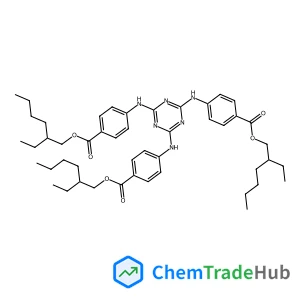
Tris(2-ethylhexyl) 4,4',4''-(1,3,5-triazine-2,4,6-triyltriimino)tribenzoate
CAS番号:
88122-99-0
分子式:
C48H66N6O6

![2-Bromodibenzo[b,d]furan structure](https://static.chemtradehub.com/structs/86-/86-76-0-1814.webp "2-Bromodibenzo[b,d]furan structure")
![[2',6'-bis(propan-2-yloxy)-[1,1'-biphenyl]-3-yl]dicyclohexylphosphane structure](https://static.chemtradehub.com/structs/787/787618-22-8-dda2.webp "[2',6'-bis(propan-2-yloxy)-[1,1'-biphenyl]-3-yl]dicyclohexylphosphane structure")
[2',6'-bis(propan-2-yloxy)-[1,1'-biphenyl]-3-yl]dicyclohexylphosphane
CAS番号:
787618-22-8
分子式:
C30H43O2P
おすすめサプライヤー





免責事項
このページに表示される学術雑誌情報は、参考および研究目的のみを目的としています。当社は雑誌出版社とは提携しておらず、投稿の取り扱いも行っておりません。出版に関するお問い合わせは、各雑誌出版社に直接ご連絡ください。
表示されている情報に誤りがある場合は、support@chemtradehub.com までご連絡ください。迅速に確認し、対応いたします。