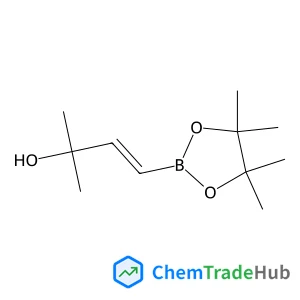
(E)-2-methyl-4-(4,4,5,5-tetramethyl-1,3,2-dioxaborolan-2-yl)but-3-en-2-ol
CAS番号:
581802-26-8
分子式:
C11H21BO3
Ryousuke Hara, Kangcheng Chen, Nobutaka Endo, Mitsuru Higa, Ken-ichi Okamoto, Lianjun Wang
Novel poly(tri-sulfonated phenylene)-block-poly(arylene ether sulfone) copolymers (PTSP-b-PAESs) were synthesized by Ni(0)-catalyzed copolymerization of 2,5-dichloro-3′-sulfo-4′-((2,4-disulfo)phenoxy)-benzophenone and chlorobenzophenone-endcapped oligo(arylene ether sulfone). Their physical properties, morphology and polymer electrolyte fuel cell (PEFC) performance were investigated compared to those of poly(mono-sulfonated phenylene)-block-poly(arylene ether sulfone) and the corresponding random copolymers. They had a low ion exchange capacity (IEC) of 1.1–1.2 meq. g−1 and showed very low water uptake and in-plane dimensional change in water. They exhibited a more well-defined microphase-separated structure composed of hydrophilic and hydrophobic domains, where the hydrophilic domains were well-connected to each other to form the channels for proton conduction, than the mono-sulfonated one. This led to the relatively high proton conductivity under low relative humidities. The corresponding random copolymers exhibited a homogeneous morphology and much lower proton conductivity in spite of a high IEC of 2.0–2.1 meq. g−1. Even under the low humidification of 30% RH at 90 °C and 0.2 MPa, they exhibited high PEFC performance and durability; for example, a cell voltage of 0.69 V at a load current density of 0.5 A cm−2 and a maximum output of 0.73 W cm−2, which was comparable to that of the mono-sulfonated one with a much higher IEC of 1.8 meq. g−1 and much higher than those of the corresponding random copolymers. PTSP-b-PAESs have high potential as polymer electrolyte membranes for fuel cell applications.

Herald of the Russian Academy of Sciences

Acta Metallurgica Sinica-English Letters

Critical Reviews in Solid State and Materials Sciences

Atomization and Sprays

Journal of the Indian Institute of Science

Bioorganic & Medicinal Chemistry Letters

Electroanalysis

Topics in Catalysis

Heteroatom Chemistry

Medicinal Chemistry Research
Maribel Hernández-Guerrero, Martina H. Stenzel
DOI: 10.1039/C1PY00219H
Yukiya Kitayama, Hirotaka Moribe, Kazuya Kishida
DOI: 10.1039/C2PY20105D
Boyd A. Laurent, Scott M. Grayson
DOI: 10.1039/C1PY00378J
Arulraj Arulkashmir, Rajashree Y. Mahale, Satej S. Dharmapurikar, Manoj K. Jangid, Kothandam Krishnamoorthy
DOI: 10.1039/C2PY20146A
Shaojie Chen, Qiuyu Zhang, Hepeng Zhang, Junwei Gu, Mingliang Ma, Tiejun Xin, Yanyang Zhou, Jian Zhou, Qing Liu
DOI: 10.1039/C2PY20122D
Derek L. Patton, Kirt A. Page, Emily A. Hoff, Michael J. Fasolka, Kathryn L. Beers
DOI: 10.1039/C2PY20023F
Hou Chien Chang, Hung Tse Lin, Ching Hsuan Lin
DOI: 10.1039/C2PY00528J
Wen-Da Li, Jian-Bing Zeng, Xiao-Jie Lou, Jing-Jing Zhang, Yu-Zhong Wang
DOI: 10.1039/C2PY20068F
6- bromo-1-cyclopropyl-1H-benzimidazoleは、抗炎症、抗ウイルス作用を持つことが報告されており、新薬開発の研究対象として注目...
取り扱う際には、防護眼鏡と手袋を使用し、ドラフトチャンバー内で操作することを推奨します。漏洩時には適切な手順で処理し、安全データシートを常に参照してください。
2,2’-ジメチル-3,3’-ビピリジンは、ピリジンと2-メチルアクリルアミドを有機合成反応で合成します。この反応では、ピリジンと2-メチルアクリルアミドを含有...
6-甲基ピリジン-2-ボリック酸は、合成化学、医薬品合成、以及研究用途などに広く使用され、特に組換えDNA技術や分子生物学の研究において重要な役割を果たします。
(R)-3-(1-甲基-2-氧環己基)プロpano酸メチルは一定の安全性がありますが、直接的な皮膚接触や吸入は避けるべきです。使用する際は適切な個々の安全データ...
ketorolacは、密封して遮光容器に保管し、直射日光や高温を避けて保存してください。温度は常温で保存し、湿度をなるべく低く保つことが推奨されます。
L-2,3-二氨基丙酸二盐酸盐は腐食性が強く、皮膚や粘膜に刺激を与える可能性があります。取り扱う際は、防塵マスク、ゴーグル、手袋を使用し、適切な排気設備を使用し...
2-(4-溴ピリジン-2-基)乙腈のCAS番号は312325-73-8です。主に結晶形態で存在し、分子量は159.01 g/molです。この化合物は水に溶けやす...
この化合物は毒性は低いですが、直接的な接触や吸入に注意が必要です。PPE(個人防護具)を着用し、ドラフトチャンバーを使用して操作することを推奨します。また、漏洩...
3-(1-氧代-1,3-二氢-2H-2-异吲哚)丙酸は、薬理学研究や医薬品製造において広く用いられる化合物です。また、工業的な用途でも一部の化学反応の触媒や助剤...
Journal of Materials Chemistry A, B & C cover high quality studies across all fields of materials chemistry. The journals focus on those theoretical or experimental studies that report new understanding, applications, properties and synthesis of materials. The journals have a strong history of publishing quality reports of interest to interdisciplinary communities and providing an efficient and rigorous service through peer review and publication. The journals are led by an international team of Editors-in-Chief and Associate Editors who are all active researchers in their fields. Journal of Materials Chemistry A, B & C are separated by the intended application of the material studied. Broadly, applications in energy and sustainability are of interest to Journal of Materials Chemistry A, applications in biology and medicine are of interest to Journal of Materials Chemistry B, and applications in optical, magnetic and electronic devices are of interest to Journal of Materials Chemistry C. More than one Journal of Materials Chemistry journal may be suitable for certain fields and researchers are encouraged to submit their paper to the journal that they feel best fits for their particular article. Example topic areas within the scope of Journal of Materials Chemistry A are listed below. This list is neither exhaustive nor exclusive. Artificial photosynthesis Batteries Carbon dioxide conversion Catalysis Fuel cells Gas capture/separation/storage Green/sustainable materials Hydrogen generation Hydrogen storage Photocatalysis Photovoltaics Self-cleaning materials Self-healing materials Sensors Supercapacitors Thermoelectrics Water splitting Water treatment
![2-{[(1R,2S)-2-Aminocyclohexyl]amino}-4-{[3-(2H-1,2,3-triazol-2-yl)phenyl]amino}-5-pyrimidinecarboxamide structure](https://static.chemtradehub.com/structs/137/1370261-96-3-40df.webp "2-{[(1R,2S)-2-Aminocyclohexyl]amino}-4-{[3-(2H-1,2,3-triazol-2-yl)phenyl]amino}-5-pyrimidinecarboxamide structure")